
Announcing the Kingdom of God
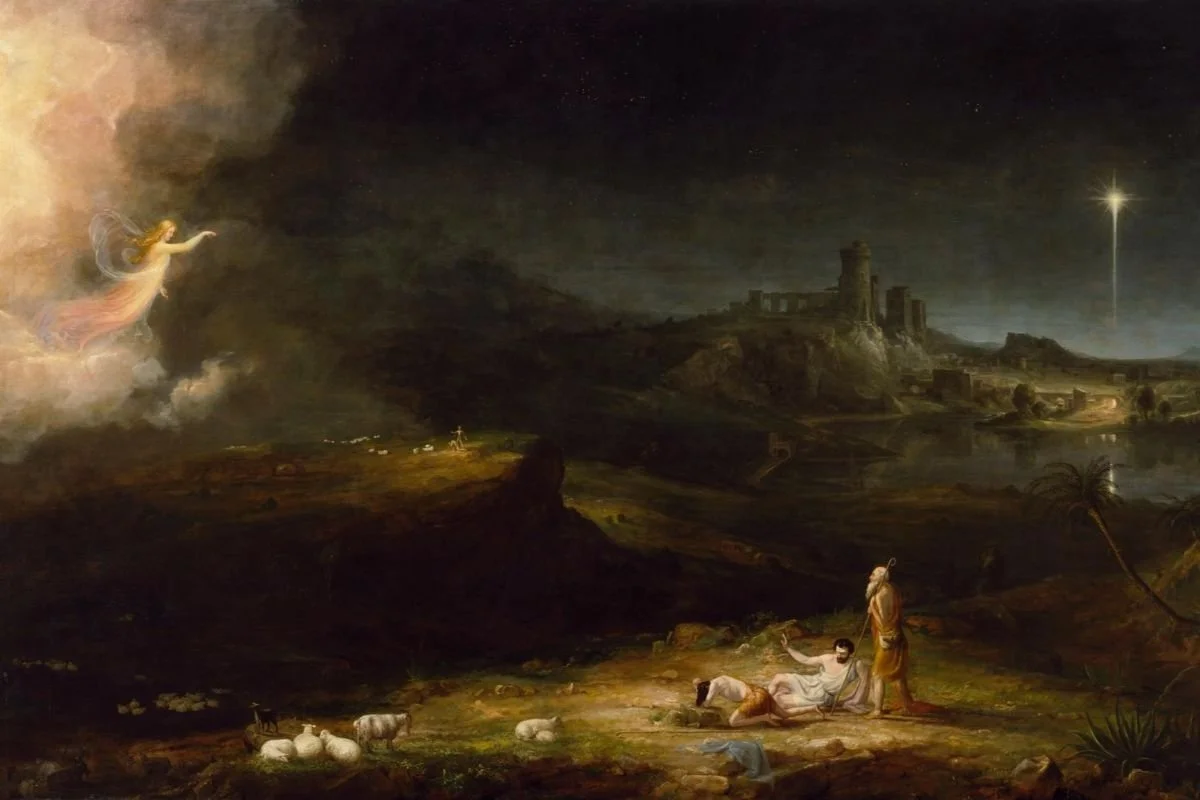
“The Angel Appearing to the Shepherds” by Thomas Cole, circa 1833. (Source: WikiCommons)
One of the gifts of the Incarnation is how the revelation of its truth and implication for all things continuously unfold over the entirety of a believer’s lifetime. Perhaps it's my age, midlife tends to bring on bouts of self reflection, but I find my attention captured by the angelic annunciation of Jesus' birth to the Shepherds. Why would one of, if not the most, cosmically significant moment in all eternity be shared with those who were considered among the least important? Found in Luke 2:8-14 the text reads:
And in the same region there were shepherds out in the field, keeping watch over their flock by night. And an angel of the Lord appeared to them, and the glory of the Lord shone around them, and they were filled with great fear. And the angel said to them, “Fear not, for behold, I bring you good news of great joy that will be for all the people. For unto you is born this day in the city of David a Savior, who is Christ the Lord. And this will be a sign for you: you will find a baby wrapped in swaddling cloths and lying in a manger.” And suddenly there was with the angel a multitude of the heavenly host praising God and saying, “Glory to God in the highest, and on earth peace among those with whom he is pleased!”
As a young mother in my early 20’s experiencing an unexpected pregnancy, the birth narrative of Luke was personally very significant to me. I imagine many young mothers resonate with Mary and her question: how will this be? And every parent who has been up in the dark stillness of late night with their infant likely knows the experience of looking down on a small sleepy face and pondering all that God has in store for his or her child. As my faith matured and deepened in my 30’s I confronted the pride of my unbelief around the supernatural and theological implications of the gospel. Now in my late 40’s I depend on the Holy Spirit’s comfort and guidance, and I treasure the wisdom of scripture for what it reveals of God's character and its witness to the undeniable inevitability of God’s sovereignty. Without falling into determinism I find myself rejoicing in the assurance that God’s will will absolutely come to pass, and that my only work in life is to discern his direction so I may follow.
Familiarity with the gospel birth narratives of Luke and Matthew provide us with overhead insight that reveals God’s sovereignty at work. I don’t claim to know the exact interplay of human agency and God’s omnipotence but I am convinced by scripture that human beings are given grace to respond to God; and we also live in a world that is cosmically subject to his just will, which cannot be stopped. We see this in the duality of reciprocity and conflict between humanity and God throughout scripture.
The miraculous in-breaking of Heaven for the Shepherds occurs within the mundane circumstances of their nightly work guarding sheep in the fields of Bethlehem. They are the first people outside of Jesus’ family to hear the news of the Messiah’s birth. No doubt they were oblivious to their own prophetic and symbolic significance. They were Israel’s ambassadors representing “the people who walked in darkness and have seen a great light” (Isaiah 9:2). The Shepherds also echo the humble beginnings of Israel’s paradigmatic king, David. And they point forward to the lowly manner in which the Messiah would inhabit his earthly authority. It is poignant to consider that Bethlehem's proximity to Jerusalem meant that the lambs the Shepherds were guarding were likely used for temple sacrifices.
Simultaneously, in the machine of state power Caesar Augustus called for a census, mandating that “all the world should be registered” (Luke 2:1) thereby causing Mary and Joseph to set off for Bethlehem, the prophesied place of the Messiah’s birth. Imperial leadership flexed the arm of its authority over the inhabitants of the vast Roman territory unilaterally to the benefit of the state. Caesar and his accomplices didn’t look kindly on those who undermined the law and order of the empire. But if there is anything the birth narratives demonstrate it is how easy it is for divine authority to circumvent imperial authority. To God, Caesar, as one who was determined to oppose him, was a pawn. In Matthew 2 King Herod the Great is outwitted by men and women who interpreted spiritual signs, obeyed messages sent to them in dreams, and spoke with angels. God’s purposes didn’t require military invasion to be accomplished. He simply invites us to have faith and obey.
The Shepherds, trembling in fear before angels, surrounded by the glory of God, received more than a birth announcement. They heard the heralding of God’s Kingdom come to Earth. And while kings like Herod may have viewed the Messiah’s birth as a threat to his kingship over Judea, God did not send his Son to simply over throw a puppet-king of Rome. The arrival of Jesus meant the end of a more foundational evil and corrupt reign of power namely, Satan’s reign of binding humans in sin, and rebellion against God.
God’s plan for redemption has always included the governing structures under which his people lived. The means by which human expressions of governance are reformed and transformed is through individuals who are personally yielded to the leadership of Christ. The implications of the Incarnation and Christ’s enthronement, for power structures run by leaders who are not yielded to God, means theirs is ultimately the legacy of Babel. While a nation can certainly be an instrument of God’s will, there is no government, army, economy, or leader this side of Heaven that can be a complete and holy expression of God’s will. However, leaders who embrace the values of Jesus in ministries of compassion, justice and ethics can demonstrate an understanding of God’s character and desires, and in that character lead people in a Christ-influenced culture.
Unique to the annunciation to the Shepherds was the appearance of the heavenly hosts, the Lord’s army. The heavenly hosts engage in spiritual warfare, as in 2 Kings 6 when the prophet Elisha prayed the Lord would open his servant’s eyes to see the angelic army sent to protect them against the attacking Syrian army. The heavenly hosts guide, protect and minister to God’s people, as it says in Hebrews 1:14; and in the particular instance of Luke 2:13-14 they lead worship of God and proclaim that peace has come upon the earth among those with whom God is pleased. This moment is the soaring fulfillment of the prophecy in Isaiah 9: 6-7:
For to us a child is born, to us a son is given; and the government shall be upon his shoulder, and his name shall be called Wonderful Counselor, Mighty God, Everlasting Father, Prince of Peace. Of the increase of his government and of peace there will be no end, on the throne of David and over his kingdom, to establish it and to uphold it with justice and with righteousness from this time forth and forevermore. The zeal of the Lord of hosts will do this.
The heavenly army of angels proclaims the good news of the King, who in his jealous love has come to save and reconcile with his lost children. Glory to God in the highest, indeed!
The challenging part of this truth is that suffering remained part of the human experience. Presumably after the Shepherds went to see the new born Messiah they went back to the difficult labor of shepherding. And while Mary, Joseph and the infant Jesus escaped the clutches of Herod, every child under 2 in Bethlehem did not. Jesus himself stood trial before Pilate and was condemned to die though he committed no crime. What are we to make of this?
There are good and sound theological responses to this question that expound on the importance of human agency and God’s desire for a people who choose him. However the older I get the greater my awareness of my finitude grows. I find there is a corresponding dissatisfaction with clinically correct answers, although I value and rely on them. They are often cold comfort in the face of pain and injustice that are part of life. I return again and again to the comfort of childlike faith and trust in God’s sovereign goodness. There is prophetic significance to the angelic announcement of Jesus’ birth to the Shepherds, and there is also a principle of wisdom. That is, in some way or another we are all like the Shepherds. We are ultimately of little importance beyond our immediate flock. And we are all subject to varying degrees at the very least, to the circumstantial effects of sin and worldly powers that are often beyond our ability to change. The good news is Jesus, who is God, came to us in our lowness and ignorance and he did not make power, status or achievement the standard for granting us his grace and love. He does not consider our degrees, wealth, notoriety or positions of authority. Rather, he rejoices in our dependence on him because he knows it is there in our need that true hope in him and his Kingdom is born.
Maggie Ulmer is a Deacon in the Global Methodist Church and a staff member of Spirit & Truth.