
Order and Holy Orders: A Scriptural and Wesleyan Reflection on Ordination, Part 2 (Deacons)

Photo by Jonathan Litchfield
This is Part 2 of a three-part series. Click here to read Part 1 and Part 3.
Three Orders in the Church: Laity, Deacon, Elder
In a previous article I described three orders of ministry in ways I think are both scriptural and Wesleyan (though not the traditional three of deacon, elder, bishop). The first order has a mission to the world, and two subdivisions of that first (the third being a subdivision of the second) have missions to the Church.
The primary order is the laity, ordered as ministers of the gospel to the world. Laity minister “in the world” (Jn 17:11), yet set apart from it, “not of the world” (Jn 17:14).
A subgroup of the laity is the order of deacon, called from among the laity, set apart within the laity, and sent as servants to the laity.
A subgroup of laity and deacons is the order of elder or presbyter, called from among the deacons, set apart within the diaconate, and sent to oversee the ministry of deacons and laity. Elders bear responsibility for oversight of Word, Sacrament, and Order in the Church, as subordinate functionaries in Christ’s offices of prophet, priest, and king to the Church.
Laity are in the world but set apart from the world for ministry to the world. Deacons are laity yet set apart within the laity for ministry to the laity. Elders are deacons and laity yet set apart within the diaconate and laity as overseers of the ministry of deacons and laity.

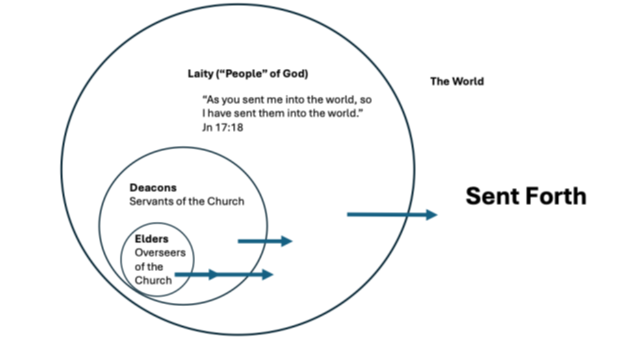
The mandate for laity (articulated in a previous article) is to be priests to the world (1 Pt 2:9). The mandate of deacons is to serve the church. The mandate for elders is to oversee the church. These three orders are assumed in Scripture, where elders are often referred to by their mandate as overseers. Paul and Timothy reflect this threefold order in their letter to the Philippians, addressed “to all God’s holy people in Christ Jesus at Philippi, together with the overseers and deacons” (Phil 1:1).
The responsibility of an order (lay, diaconal, or presbyteral) once received cannot be put aside. A material sacramental means of grace cannot be unreceived. Vows made cannot be unspoken. This is why baptism (at whatever age) is never actually repeated. People can, of course, betray their orders. They can fail to live them out faithfully. In such circumstances, a member of an order can be inhibited from representing that order. A lay person whose “salt loses its saltiness” (Mt 5:13) can be excommunicated; a deacon or elder can be defrocked. But having received an order’s mandate, accepted its privileges and responsibilities, a person is marked and will be judged accordingly.
This article is not intended as an historical review of John or Charles Wesley’s understandings on ordination, which differed significantly from each other. Both died as Anglicans, and were Charles to have had his way, there would never have been churches in the Wesleyan tradition to ponder a biblical Wesleyan ordering of our common life. Instead, this series of articles attempts to articulate a scriptural and Wesleyan account of order within the life of the church. This article, part 2 of 3, will focus on the order of deacon.
The Order of Deacons: Servants to the Bride of Christ
Deacons serve. The word, diakon, simply means “servant.” They serve the church. The question asked of deacons in the Wesley’s Sunday Service, which was an edited version of the Book of Common Prayer, was: “Do you think that you are truly called, according to the will of our Lord Jesus Christ, to the ministry of the church” (Sunday Service, 287). This order within the laity assists the laity in their service to the world, and assists the elders in their service of oversight in the Church.
Deacons serve under the authority of elders, those who oversee the ministry of word, sacrament, and order. But servanthood is the starting point. It is the first step of, and a prerequisite for, set-apart ministry within the church. “Whoever wants to become great among you must be your servant, and whoever wants to be first must be slave of all” (Mk 10:43-44).
The church has both male and female servants. In the Acts of the Apostles, Luke lists the first deacons as Stephen, as well as “Philip, Procorus, Nicanor, Timon, Parmenas, and Nicolas” (Acts 6:5). Later in Acts we encounter Tabitha, also called Dorcas (Acts 9:36), who is traditionally thought of as a deacon for her service to the church. More directly, Paul commended to the church in Rome “our sister Phoebe, a deacon of the church in Cenchreae” (Rom 16:1), entrusting to her what is arguably his most theologically significant letter.
As servants, male and female deacons personify Christ in representative ministry. They serve in the person of Christ, in persona Christi. “For even the Son of Man did not come to be served, but to serve, and to give his life as a ransom.” (Mk 10:45). Deacons serve the Bride of Christ. They are her handmaidens. They serve her as Christ served his bride, giving “himself up for her to make her holy, cleansing her by the washing with water through the word” (Eph 5:25-26).
For this reason, candidates for the diaconate must have demonstrated Christlike character as laity, as part of the people of God. Paul makes clear that “deacons are to be worthy of respect, sincere, not indulging in much wine, and not pursuing dishonest gain” (1 Tim 3:8). For women, Paul adds that they also must “be worthy of respect,” and “not malicious talkers but temperate and trustworthy in everything” (1 Tim 3:11). To faithfully serve the Bride of Christ, candidates for the diaconate must have demonstrated that they can serve their families. “A deacon must be faithful to his wife and must manage his children and his household well” (1 Tim 3:12). Although scripture does not explicitly mandate education, deacons “must keep hold of the deep truths of the faith with a clear conscience. They must first be tested.” But scripturally, the process does not appear onerous. “If there is nothing against them, let them serve as deacons” (Tim 3:9-10).
The Ordination of Servants to the Bride of Christ
Deacons are ordained. They have their lives ordered for service: by God’s order, by the Church’s agreement with that order, and by the Church’s oversight of their service. The ordination service for deacons included in Wesley’s Sunday Service asked: “Do you trust that you are inwardly moved by the Holy Ghost to take upon you this office and ministration, to serve God for the promoting of his glory and the edifying of his people?” The answer being: “I trust so.” (Sunday Service, 287)
On God's part, “ordering” implies both God giving an order and God creating order. God ordered “Let there be light,” and, “there was light,” creating order from disorder (Gen 1:3). God also orders deacons in both senses. They accept God’s order, his call on their lives, and are thereby reordered in their ministry and relationships, set apart within the laity (and that language of “within” rather than “from” is important).
In a Wesleyan understanding of divine action, God orders with and through active submission to His call and mission. Just like in our ordination to the laity, when we submitted to God’s Word (Jesus) and were made God’s children through regeneration and baptism, agency matters in ordination to the diaconate. Deacons must actively yield their wills to the divine will (as well as to the will of the Church). Becoming a deacon is more than simply learning to serve or serving in the church. It is submitting to BE a servant to the church – an act of humility, of sanctification, of kenosis as Christ’s representative (Phil 2:8; Eph 5:25-26).
Since the late nineteenth century, some have conceived deacons as primarily serving in the world or larger society in works of justice and mercy. This has been the understanding, for example, in the United Methodist Church. Deacons, however, by definition, do not minister in the world. If a deacon ministers outside the church, they do so as part of their mandate as the people of God, the laity. Deacons are already Christ’s servants to the world through baptism, and witnesses to God’s justice and mercy. But they became the Church’s servants through deacon’s ordination.
This misconception about the service of a deacon came about when the deacon/deaconess movement of the German Protestant state church was imported by Methodists in 1888 into the American free church context. The German Protestant understanding of “Church” as Volkskirche (a “peoples church”) assumed that Protestantism was the tribal religion of a German Volk. The religion of the tribal chief was the religion of the tribe. “Cuius regio, eius religio,” (whose realm, his religion) as articulated in the Treaty of Westphalia. Thus, all Saxons, Prussians, Hessians, and those who lived among them, were considered part of “the church.” By serving a German society, as part of a German Protestant state’s social services system, deacons therefore served the church. In a state without an established church, this conception never had a solid theological or ecclesiological foundation.
Becoming her servant alters the deacon’s relationship within and to the church. This is a permanent change. Vows are vows. There is no such thing as a “transitional deacon.” The phrase is nonsensical. A person can no more be a transitional deacon than a transitional lay person. Whatever further responsibilities laity may take on within the Church, they are always the “people” of God. And whatever further responsibilities a deacon may accept within the Church, they are always “servants” of the church. Elders are deacons. Overseers are servants. “What, after all, is Apollos? And what is Paul? Only servants [diakonoi]” (1 Cor 3:5).
The church, in diaconal ordination, affirms God’s call, and agrees to be served by and direct the ministry of a deacon. Deacons receive ordination through the laying on of hands (Acts 6:6) by those who have taken vows of oversight in the church. The service of ordination sent to establish the Methodist church in America used language of “authority” in its ordination liturgy for deacons (see Sunday Service, 287). This holdover from the Anglican Book of Common Prayer of Wesley’s Day (1662 Anglican BCP) may have caused confusion in Methodism’s understanding of the diaconate. Deacons do not need to “take authority,” because they do not govern. They serve. Indeed, the language of “authority” is not used for diaconal ordination in Anglican, Roman, or Orthodox contemporary liturgies. The current ACNA liturgy in the Book of Common Prayer has the bishop simply say, “Receive the Holy Spirit for the office and work of a Deacon in the Church of God, now committed to you by the imposition of my hands” (2019 ACNA BCP). Indeed, no one should be given authority in the church to govern until they have proved themselves “good and faithful” servants (Mt 25:21).
The Work of Servants to the Bride of Christ
The work of deacons is to clothe and nourish the Bride of Christ under the direction of Elders. They may do this in a literal sense. The first deacons cared for the needs of the poor within the church. They distributed food to widows (Acts 6:1-6) and made clothing for those who needed it (Acts 9:39). Deacons also feed and clothe the Bride of Christ in a mystical sense. In the early Church, deacons distributed the sacred food of the body and blood of Christ, though they did not oversee its preparation. Paul literally entrusted Phoebe with the Word, as she delivered his letter to the Romans. Presumably, she also helped explain its content to its recipients, though she did not oversee its composition.
Deacons serve the physical bodies, souls, and spirits of the church members. In the language of the Sunday Service,
[deacons] assist the elder in Divine Service, and especially when he ministereth the Holy Communion, to help him in the distribution thereof, and to read and expound the Holy Scriptures; to instruct the youth, and in the absence of the elder to baptize. And furthermore, it is his office to search for the sick, poor, and impotent, that they may be visited and relieved. (Sunday Service, 288).
Anything that assists the laity, Christ’s bride, to be well-nourished, healthy, and clothed in “fine linen, bright and pure … the righteous deeds of the saints” (Rev 19:7-8), is the work of a deacon.
Within the church, however, all kinds of ministries are open to deacons, though without ultimate responsibility for their oversight. The exercise of a particular ministry is limited only by the gifts given to a particular deacon by the Holy Spirit. In Wesleyan Methodist practice, if not always in language, this is reflected in a distinction between Orders and Offices. Orders (laity, deacon, or elder) delineate a particular mandate and level of responsibility within the body of Christ, as a member, servant, or overseer. Offices specify the kind of ministry in which a person (of any order) is engaged for the good of the whole Church.
The activities Paul mentions in Ephesians 4 and 1 Corinthians are ministry offices based on gifting. “So Christ himself gave the apostles, the prophets, the evangelists, the pastors and teachers, to equip his people for works of service, so that the body of Christ may be built up” (Eph 4:11-12). In Paul’s letter to Corinth, these offices also include “miracles, then gifts of healing, of helping, of guidance, and of different kinds of tongues” (1 Cor 12:28). Anyone in any order may be gifted for a particular ministry office, though how and at what level of responsibility depends on their order. A lay person might exercise apostolic gifts as a short-term missionary, a deacon as a missions pastor, and an elder as overseer of a mission or as an itinerant bishop or presiding elder. A lay person might pastor a class meeting, a deacon a small congregation under the oversight of an elder, and an elder as a senior pastor. Whatever ministry deacons perform “by gifts of the Holy Spirit distributed according to his will” (Heb 2:4), they do as servants of the laity, with the oversight of elders.
Conclusion
The Order of Deacon is an order of service to the church, Christ’s bride. It is a representative ministry within the laity of Christ’s humility, His sacrifice, and His devotion to His bride. Taking on the mantle of this order means submission to Christ, to the church, and to those who govern her—the elders of the church. As with all sacramental commitments, admission to this order requires vows to which one will be held accountable in this life and in the next. Ordination as a deacon is therefore not to be entered into lightly, but soberly and advisedly. The mission of this order, through the gifts and offices of its called and sent members, is to help the church as she strives to “reach unity in the faith and in the knowledge of the Son of God and become mature, attaining to the whole measure of the fullness of Christ” (Eph 4:13). In such faithful service is blessing. And all deacons “who have served well gain an excellent standing and great assurance in their faith in Christ Jesus” (1 Tim 3:13).
Scott T. Kisker is the Associate Provost at Asbury Theological Seminary and is an ordained elder in the Global Methodist Church. He serves on the Firebrand Editorial Board.