
The Ever-Slaughtered Lamb: Christ’s Perpetual Sacrifice in the Eucharist
[This article is adapted from a sermon that was originally preached at Lake Highlands United Methodist Church on Sunday, July 26, 2026.]
I appeal to you therefore, brothers and sisters, on the basis of God’s mercy, to present your bodies as a living sacrifice, holy and acceptable to God, which is your reasonable act of worship. Do not be conformed to this age, but be transformed by the renewing of the mind, so that you may discern what is the will of God—what is good and acceptable and perfect. (Romans 12:1-2, NRSVUE)
The idea of Christ’s presence in the Lord’s Supper is deeply significant for the Wesleyan theological worldview. Everything that we as Methodists believe about Communion emerges from that idea—the real presence of Christ at the table. The bread and wine are not just symbols. We believe we are sharing a meal with the risen Christ. He is alive, and he is truly with us. If the bread and wine are purely symbolic, if Christ is not present at the table, the Lord’s Supper is comparable to a funeral meal. Without his real presence we’re merely remembering his death, and mournfully observing his real absence. Remembrance becomes the sole purpose of the table. But if the bread and wine are the body and blood of Christ, the Lord’s Supper is not a funeral, but a wedding. It’s a joyful celebration of reunion between the Bride of Christ and her Savior-bridegroom. He is uniquely present with us, and we are re-united with the risen Christ each time we share this sacred meal together. In the Wesleyan view, we embrace the inherent mystery of Christ’s presence, and eschew the need for metaphysical clarity. At this table, the risen Christ is truly, uniquely, and mysteriously present among us. “Receiving the bread, On Jesus we feed: It doth not appear His manner of working: but Jesus is here!” (Hymn #28, Hymns on the Lord’s Supper)
But why do we break the bread? Each time we observe the Lord’s Supper we raise up a loaf of bread, tear it into pieces, and offer it to the congregation as Christ’s body. Why do we do that? This act is a critical feature of the Lord’s Supper. It demonstrates to us that Christ’s body was broken. It is a reminder that this sacred meal did not come without a price. Christ paid the price for this meal with his own broken body and spilled blood. The Last Supper was not just an ordinary meal; it was a Passover celebration. Christ gave himself up as an offering to God. He is the true and better Passover lamb. As John the Baptist said when he saw Jesus coming down the road, “Here is the Lamb of God who takes away the sin of the world!” (John 1:29)
There’s something interesting about the way that Jews observe the Passover. The Jewish tradition commands that in every generation each person is obligated to regard themselves as though they personally came out of Egypt. It’s not just a remembrance that their ancestors were delivered. During Passover, every Jew says of themselves, “God saved me from Egypt.” This is an acknowledgement of what God is doing in the present, not only what he did in the past! Each Jewish person in every generation is a slave in a metaphorical Egypt, and God delivers them from bondage. In a sense, the Jewish Passover lamb is a “living sacrifice” offered every year when the Jews celebrate their liberation from Egyptian oppression.
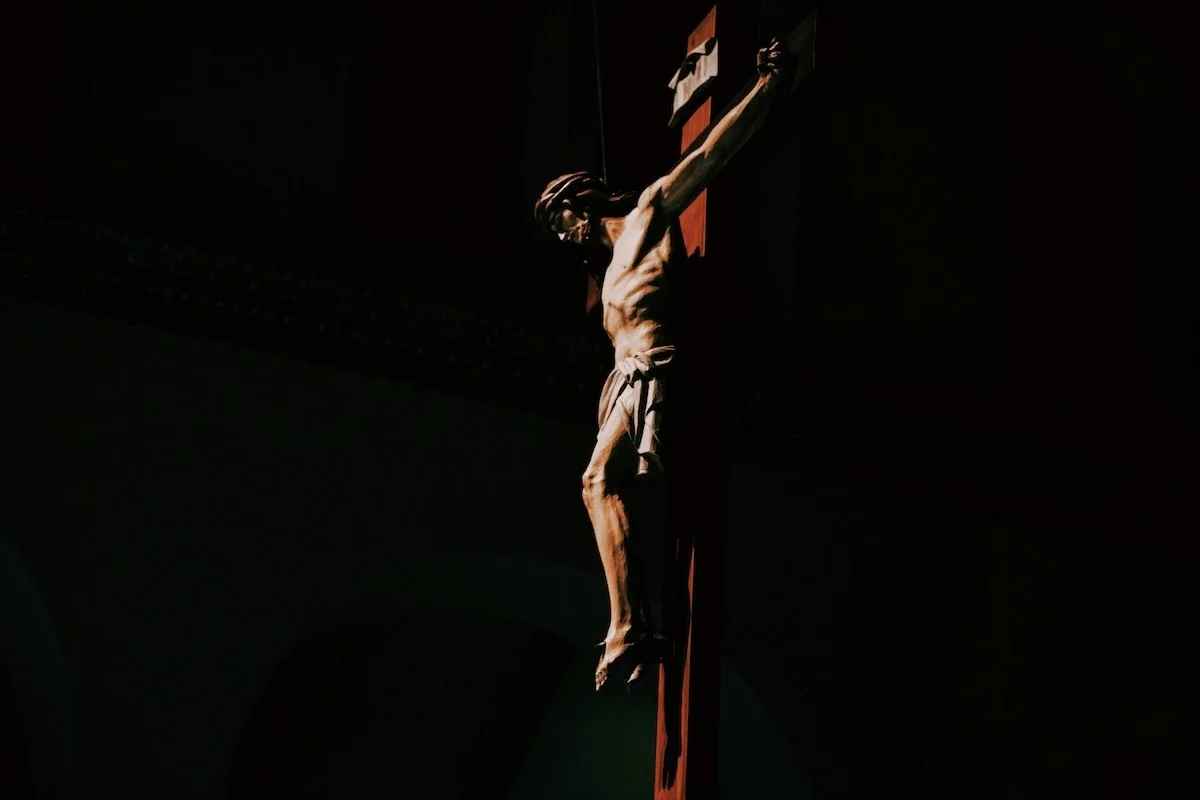
So what does it mean that Jesus is the true Passover lamb? Revelation 13:8 says that the Lamb was slain before the foundation of the world. What a strange verse! What does that mean? Jesus Christ was crucified by the Roman government on April 3rd in the year 33 AD. How could it be that the Lamb of God was slain before the foundation of the world? This implies that Christ’s sacrificial death is not constrained by history, but instead situated in eternity. When we raise up this loaf of bread and break it, we’re not just remembering Christ’s death. We are bearing witness to it. That sacrifice which occurred historically is present among us immanently. The Lamb of God slain before the foundation of the world is mystically slain before our eyes every time we take Communion together. Now let me be clear. I’m not saying that Christ is being sacrificed again in some way. Jesus Christ died once and for all at his crucifixion. His death is not repeated or re-enacted at the Lord’s Supper. Rather, it is re-presented. Christ’s death is re-presented to us at the table, and we are allowed to experience and witness his death in the eternal present.
John Wesley had an interesting way of describing this idea of Christ’s perpetual sacrifice in the Lord’s Supper. He referred to Communion as a “soul-transporting” feast. Wesley taught that we are spiritually “transported” to the event of Jesus’ death and made witnesses to it. Consider this hymn that the Wesley brothers penned in 1745: “Thy offering still continues new, Thy vesture keeps its bloody hue, Thou stand’st the ever slaughter’d Lamb, Thy priesthood still remains the same, Sure evidence of things unseen, Now let it pass the years between, And view thee bleeding on the tree, My God, who dies for me, for me!” (Hymn #708, Hymns on the Lord’s Supper). Christ is the “ever-slaughtered” lamb, and in the Lord’s Supper we experience the passing “of the years between,” and become present witnesses to Christ “bleeding on the tree.” We bear witness to the one true eternal sacrifice wherein God saved me from bondage, not just my ancestors. Every time we take the Lord’s Supper we are mystically re-presented with Christ’s death at the table. Through the Eucharist we are invited to step into eternity, and witness for ourselves the perpetual sacrifice of Christ.
Imagine you step outside tonight and look up at the stars. You may notice one particularly bright star, the north star Polaris. That star is millions of years old. The starlight entering your eye left Polaris centuries before you were ever born. But that light is not a mere photograph of that star or just a memory of it. It is the actual light, the original event, arriving now. You’re witnessing that event now in the present moment. Similarly, when we take the Lord’s Supper the reality of Christ’s crucifixion, which occurred 2000 years ago, is re-presented to us. Our souls are transported, and we are made spiritual witnesses to his sacrificial death. The “light” of Jesus’ crucifixion reaches our eyes, and we experience it anew in the present moment. We take a step from our own world into eternity, into that space wherein “the Lamb of God was slain before the foundation of the world.”
But what exactly does that mean for us here today? The Church exists not just to be fed, but to feed others. We do not just bear witness to Christ’s sacrifice. We ourselves become a “living sacrifice.” We as the Church become the body of Christ broken and scattered to feed the world. The United Methodist Communion liturgy captures this idea beautifully when it says: “And so, in remembrance of these your mighty acts in Jesus Christ, we offer ourselves in praise and thanksgiving as a holy and living sacrifice, in union with Christ's offering for us.” At the Lord’s Supper Christ is sacrificed before our eyes, and we respond by offering ourselves as a living sacrifice.
This is exactly what Paul is talking about in Romans 12:
“I appeal to you therefore, brothers and sisters, by the mercies of God, to present your bodies as a living sacrifice, holy and acceptable to God, which is your spiritual worship.”
Notice how Paul starts this passage. Not, "I command you to offer yourselves.” Not, "you owe God this sacrifice." He says, “I appeal to you... by the mercies of God.” Paul is not commanding obedience. He’s urging us to be grateful. He’s saying that, because of Christ’s sacrifice for you, in gratitude, offer yourselves in the same way. But look at what he actually asks for—our bodies, offered as a “living sacrifice.” This is a blatant contradiction, and Paul knows it. You don’t have to know much about the Old Testament or the Jewish sacrificial system to know that sacrificed animals did not usually survive the procedure! The animals don’t get to leave the altar. Sacrifice requires blood. The sacrifice isn’t complete until the animal is killed. And so it is with the sacrificial death of Jesus—he spilled his blood and experienced the fullness of death. But something new and unexpected happened—Jesus rose from the dead. He truly became a living sacrifice. He sacrificed his whole life, his entire self, for the sake of God’s kingdom. That’s what it means for us to become a “living sacrifice.” As Christ sacrificed himself for us, we sacrifice ourselves to God and for others. The Old Testament sacrificial system required you to bring a sacrifice to the altar. But in and through Christ, we, the Church, become the living sacrifice.
This is what we pray for in our liturgy when we celebrate the Lord’s Supper: “Pour out your Holy Spirit on us gathered here, and on these gifts of bread and wine. Make them be for us the body and blood of Christ, that we may be for the world the body of Christ, redeemed by his blood.” Christ gives himself to us, and we respond in gratitude by giving ourselves for others. This is what Paul means when he says that the Church is the “body of Christ.” The body of Christ. “For as in one body we have many members... so we, who are many, are one body in Christ, and individually we are members one of another” (Romans 12:4-5). We who are the many become one. We are gathered together from every tribe, tongue, nation, and people group. We are the body of Christ in the world.
So I’ll ask the question again—why do we break the bread? Why do we raise up this loaf of bread and tear it into pieces? Because bread can’t be shared unless it is broken. We are the body of Christ: broken, torn apart, and scattered to feed the world. Love requires sacrifice. Just as Christ was sacrificed for us, we as the Church become a sacrifice offered to God, through Christ, for the sake of the world. We pour ourselves out for others. We love our neighbors as we love ourselves.
Before we can become a living sacrifice, we must receive Christ’s living sacrifice for us at the table. We must witness Christ’s death anew for us, and experience his eternal, perpetual sacrifice in the Lord’s Supper and receive his forgiveness. We do not need to bring a perfect offering to God. We do not need to bring the best version of ourselves to this table. We come with whatever we have. Sometimes we come with nothing at all. When we are hungry, Christ is here. When we are hurting, Christ is here. When we want to know Christ and experience his presence, he is at the table waiting. The table is set. The bread is broken. We are invited to the meal of his holy body.
Colton Castle is Associate Pastor at Lake Highlands United Methodist Church in Dallas, Texas.