
An American In Zagreb: Reflections on the Challenges of Understanding a Global Church
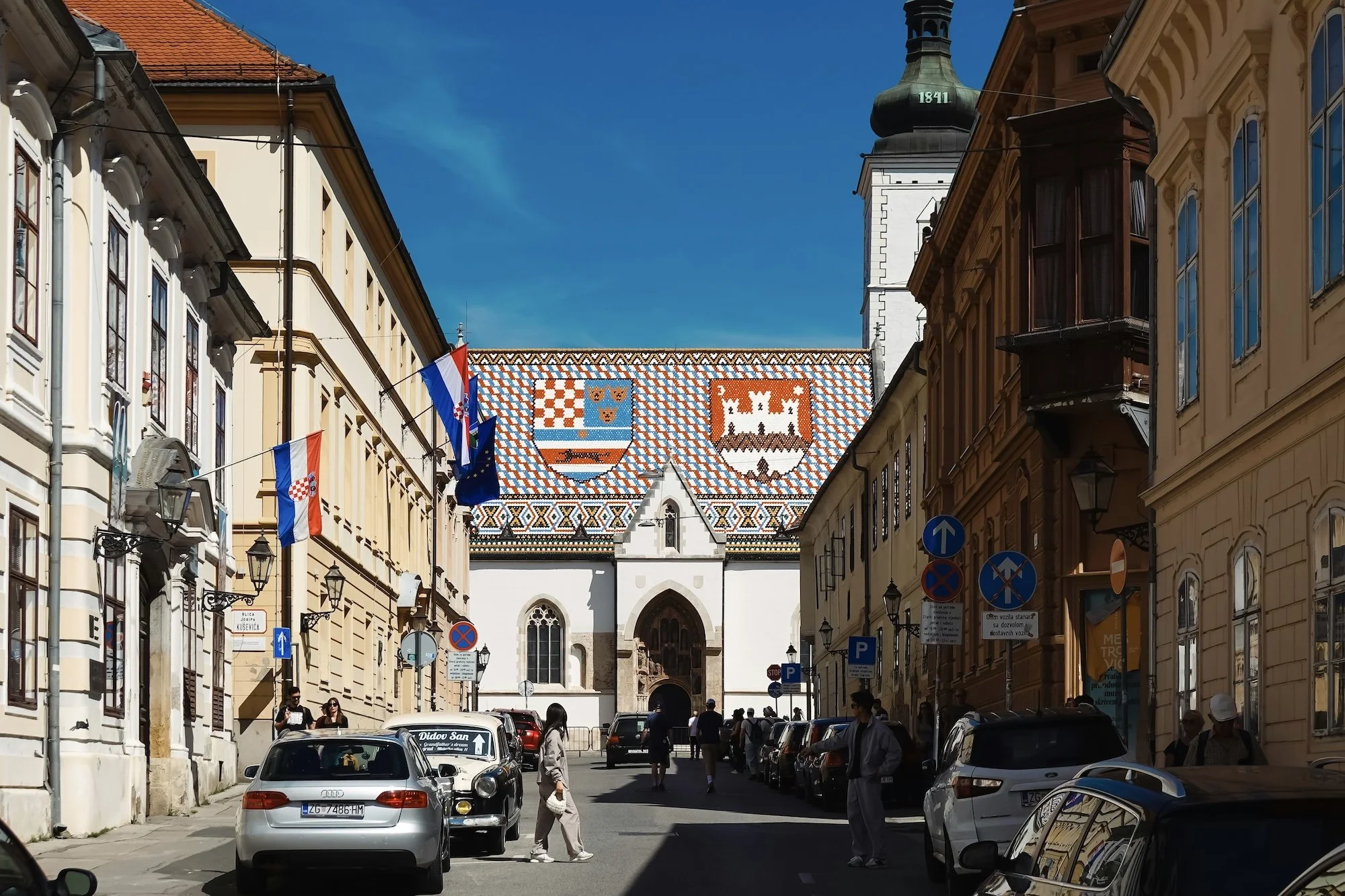
Zagreb, Croatia. Photo by Daniel Trofimov on Unsplash.
In his book How Soccer Explains the World: An Unlikely Theory of Globalization, author Franklin Foer examines how the effects of globalization differ from the theories. Many predicted that globalization would reduce the differences between different regions and ethnic groups, and gradually eliminate the differences between us. His examination of the global game of soccer revealed that instead of eliminating the differences between cultures and groups, globalization evolves and sometimes even emphasizes those differences.
As Americans, we understand that the American church is just one voice in a much larger global Christianity. The faith grows in the Global South, while American Christianity, in terms of raw numbers and influence, is declining. In my own denomination, the Global Methodist Church, we commit ourselves to truly being a global church, with all the obstacles and difficulties, but also blessings, that a global church presents.
In October, I attended the Adria Conference, a gathering of Wesleyan leaders in Crikvenica, Croatia. I attended two years ago, and have developed some relationships with Methodist leaders in that part of the world. I cannot claim the expertise to offer a comprehensive examination of the challenges and needs of the church in Europe. Instead, I offer three observations that challenged my assumptions of what it means to be a global church.
1) Identity creates significant opportunities and challenges
We often think of identity as a uniquely Western or American problem, often around sexual and gender identity. The USA also has distinct ethnic and racial identity issues, yet the "melting pot" culture of the USA cannot be overstated. A 2019 article by the American Immigration Council described American ethnic identity as "fluid." While we may be aware of our ethnic and family ties, the children born in America tend to see themselves in broader ethnic categories tied to the USA.
Issues of identity in Europe are more complex, with direct effects on the church. Ethnic groups do not always fit neatly into national boundaries. Some ethnic groups prioritize national identity, while some prioritize another identity and may largely ignore national identities. The Roma people, for example, largely identify themselves by ethnic lines. The Roma people themselves are far from uniform. One pastor in Slovakia described the challenges in her town. Different Roma tribes are more willing to interact with Slovaks than they are a different Roma tribe. One tribe near here emphasizes education, and many of the children earn post-graduate degrees. The next closest Roma tribe rejects outside education, and most children struggle to obtain even the most basic education. An Estonian pastor shared his experience working with an ethnic group whose population spoke their own distinct languages, and stretched from Estonia into the Siberian region of Russia. This ethnic group identified itself beyond the national borders; however, for obvious reasons, crossing from Estonia into Russia creates significant challenges for the church trying to reach that group.
National and ethnic identities may also contain religious ties. Croatia's national identity is tied to the Roman Catholic Church, while Serbia is tied to the Serbian Orthodox Church, and Bosnia-Herzegovina is predominantly Muslim. One Croatian I spoke to described a first visit to a Methodist church with feelings of betraying an important national identity. This is further complicated by ethnic ties. A Croatian may have Slovak, German, or some other ethnic background that may have its own religious affiliation that is different from the national affiliation.
I have heard many sermons in the USA quote Galatians 3:28 (“There is neither Jew nor Gentile, neither slave nor free, nor is there male and female, for you are all one in Christ Jesus.”) as a plea for unity and uniformity. Becoming a truly global church may require us to understand unity, while also acknowledging deep historical, cultural, ethnic, and religious connections beyond what we understand in the USA.
This does not take into account the considerable language barriers posed as well.
2) Communism, the Cold War, and even World War 2 are not ancient history
I take my coffee very seriously. I believe that serving subpar coffee at church is maybe not quite a sin, but definitely an obstacle to salvation. I have no context for understanding the conversation at lunch, when other European church leaders, roughly my age, talked about substitutes for coffee, such as acorns, used by their families during shortages caused by war. Even some of our companions from the UK, which has been a fairly peaceful and prosperous nation, described experiencing shortages and similar complications.
Most of my experience in Europe is in formerly communist countries. This creates cultural challenges beyond what I can understand in my American experience. Several church leaders said it is relatively easy to convince people to visit their church, but almost impossible to convince anyone to join the church. Even beyond the previously discussed ethnic ties, most people who remember communist times will not join any organization. They were forced to join the Communist Party, and distrust any organization that seeks membership now.
There is also the sense that capitalism will be a savior in Eastern Europe. This is a broad generalization, but switching to capitalism from communism created an immediate increase in wealth and opportunity in many formerly communist countries. Many place their hope for a better life in the growing economic opportunities not available before. Just as materialism and wealth can be an obstacle in American Christianity, the rapid change in economics in formerly communist countries creates similar obstacles.
In some nations, pastors and churches are paid and funded, partially or entirely, by the government. These traditions are often rooted in World War 2 or the Cold War, when governments became involved directly with churches as a way to influence or preserve the culture. These ties cannot easily be separated today.
An Albanian pastor described the challenges the church faced when the government seized and executed 300 clergy during the Cold War. I have no experience to begin to understand that challenge.
3) Partnership is more than funding
I spoke to a church leader about a new initiative to help church planters in Europe. I asked what I thought was a good strategic question. If we could provide the funding, where would you next plant a church? This leader shared that the question itself did not fit her context. The problem is not money. She used Zagreb, the capital city of Croatia, as an example. Even in Zagreb, she would need someone who spoke the language, someone who understood the culture, someone who would be willing to build deep community ties that overcome some of the problems mentioned earlier. The difficulty is not financial; it is relational.
As an American who was raised Methodist, I often equate mission with raising money, or taking a trip with 10 other people. We want to support clean water in Africa, so we raise money for an established mission organization that builds wells. We offer a spaghetti dinner, or a bake sale, or some sort of gimmick to encourage giving, and send a check. While I may intellectually understand this is not the full experience of missionary work, I often associate mission with sending money.
Churches in Europe do have financial needs. What I heard consistently from European leaders is that more than money, they need partners that want to pray together, encourage one another, and build relationships. Europe is a tough mission field. European church leaders and planters need more than financial support. They need fellow laborers.
I have heard, and often used, the relationship between Paul and Lydia as an example of Christian mission. Paul was the ministry leader while Lydia was the financial backing. When we support a mission partner with funding, the mission partner is Paul, and we are Lydia. This is a gross oversimplification of their relationship. My connections with European leaders show me that while they have financial needs, they do not need a silent financier. A better model for partnerships is Galatians 6:2, "Bear one another's burdens, and so fulfill the law of Christ."
My congregants often ask when we can go to Croatia to build something, serve in a ministry, or somehow “do” missions. The desire comes from a holy place. We want to use our gifts and resources to solve a problem. We want to accomplish something tangible we can point to as a “successful” mission. In order to fulfill our mission as a global church, we must adapt our understanding of mission. Building relationships that mutually help each other far outweighs what we might accomplish with a check or “work trip.”
My relationships with church leaders in Europe have been challenged and expanded by trying to understand what it means to be a global church. We have much to teach each other as we live into our mission. When our assumptions about what it means to be the church are challenged through global partnership, we grow closer to what we are called to be—neither Jew nor Greek, nor American or European church, but the bride of Christ.
Jonathan Hanover is an Elder in the Global Methodist Church. He serves as the pastor at Faith Global Methodist Church in Delmont, PA.