
Angels Dancing on the Sawdust Trail: Medieval Scholasticism and Contemporary Charismatic Experience
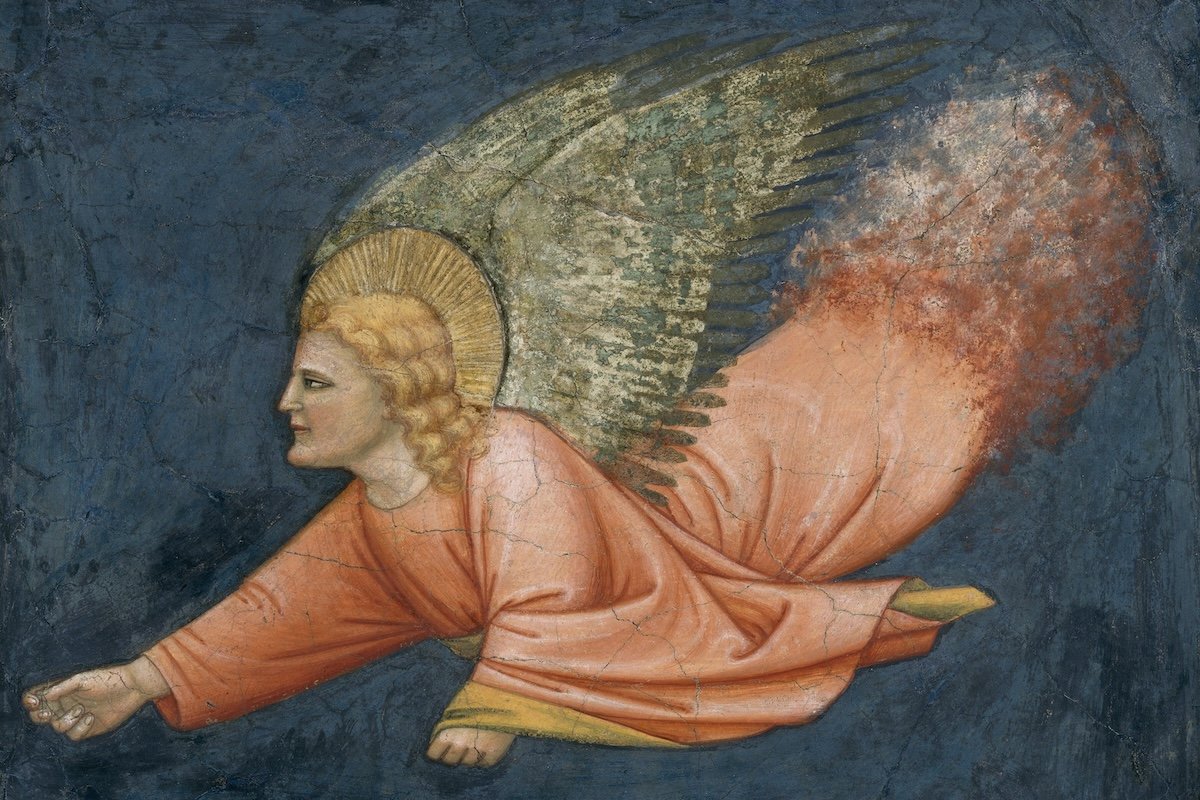
Two Angels, painting by North Italian Painter (artist unknown) 14th century. (Source: WikiCommons)
“How many angels can dance on the head of a pin?” This question is sometimes asked as a rhetorically forceful way of making the point that a great deal of academic theology seems detached from spiritual experience and far removed from the lived-out and real-life faith of ordinary Christians. Theology in general is sometimes said (and sometimes, in my view, with good reason) to be remote and irrelevant to the Christian lives of normal believers, and medieval scholasticism in particular is often taken to be the apex of irrelevance. After all, the philosophers and theologians of the “Dark Ages,” such as Thomas Aquinas and John Duns Scotus, sat around in their ivory towers and debated the most arcane and contrived issues, right? How more out of touch could they be? What could be less relevant—and less important and less meaningful to the actual lives of Christians—than the question of how many angels can dance on the head of a pin?
We don’t have any actual historical evidence that Aquinas, Scotus, or other medieval theologians really debated this question. The first references to the infamous question that historians of doctrine have been able to track down come from an early modern pastor who was using it to make fun of earlier medieval theology. In other words, it looks like it was invented by a critic of scholastic theology who wanted to score a snarky takedown and notch a quick victory without the hassle of making actual arguments. But make no mistake: even if the medieval theologians didn’t debate this actual question, they certainly were keenly interested in issues closely related to this question. For example, Peter Lombard offers extended reflection on the ways that angels and demons relate to bodies and appear in bodily form, and he works hard to understand whether and how evil spiritual creatures might enter and come to possess the bodies and souls of humans. Aquinas considers the issue of how angels relate to physical spaces, and he argues that while angels should be considered to be present to particular places, no angel can be in more than one place at the same time and no more than one angel can occupy the same physical space at the same time. Similarly, Scotus gives lengthy (and typically nuanced) consideration to questions of how spiritual creatures like angels and demons could be located in a physical space or be related to embodied creatures like humans.
So were the scholastic theologians—whether or not they actually debated the infamous question that has become something of a joke or a meme—myopically focused on trivial nonsense? After all, we might reasonably ask: “What does any of that have to do with real Christian faith in the real world? Seriously—who cares how many angels can dance on the head of a pin?”
These are good questions. And, on a bit of reflection, the answers might be a bit surprising but are actually quite straightforward. For it turns out that the theological issues at stake really are important for Christian life. The basic issue that had the medieval theologians so worked up is an important one for all believers who are doing their best to live out a real Christian faith in the real world. For the basic issue that got the scholastic theologians so fired up was this: how does spiritual reality relate to the physical world and to the physical, embodied people who live in it? It strikes me that this kind of question is important for all Christian believers. Whether or not we like the way that the medieval theologians approached it, and whether or not we agree with their answers, surely the basic issue is one that is anything but trivial or ridiculous. Truth be told, there are a lot of interesting theological questions about how spiritual reality relates to physical reality. And truth be told again, these questions are not only interesting at a theoretical level but also very important for spiritual formation and the life of the church.
As many of the medieval theologians rightly understood, some of the interesting and important questions have to do with metaphysics and ontology. For instance, just who is speaking when someone claims to be the mouthpiece of direct divine revelation? Whether such purported divine communication comes in a well-known language or one that is completely unknown (and thus granting the assumption that what is being said isn’t merely the syntax of one’s native language used in meaningless babble), just whose words are they? Is the speaking agent the Holy Spirit; are these the very words of God coming out of the mouth of a human person? Is the relation of the human voice to the divine speaker something like the relation of a trombone to the trombone player; is the humanity only something akin to the brass of the trombone? On the other hand, is the real and only speaker in question merely the human person who in this case has special knowledge from God? Or are both options mistaken; is the proper way to think about such things more along the lines of something like, say, group agency?
What is happening—and just who is doing what—when some person (or group of people together) is “slain in the Spirit” by another? Assuming for the moment that strictly naturalistic explanations of (at least some) such phenomena are incorrect, who is doing this? Is it the minister who throws and blows people over – albeit with unnatural and “borrowed” abilities? Is the real agent the Holy Spirit who is simply using the thrower and blower as a channel? Is the human person merely something like what the scholastics used to refer to as an “instrumental cause”? Or, again, is it a cooperative activity; is the relevant agent a “group agent” that is a third entity composed of both the human and divine persons?
Similarly, what is happening when someone exercises faith and is healed of some injury or disease? Is the person cooperating—and thus partly healing herself—by exercising faith? To again employ the older scholastic categories, is the faith-exercising act a kind of efficient causation? What is the faith doing in this event? Is it to be understood as a kind of instrumental cause?
To take a very different sort of example, how are we to understand agency when considering claims of demon possession? Is the relevant agent in question the demonic force that is “within” the human? In that case, who is responsible for the actions performed? Or are these truly the actions of the human person who in this case does this under a very unusual kind of influence? Or is it neither? Or somehow both? And, more fundamentally, what is going on when a spiritual entity with agency (like a demon) is said to be “inside” or “within” someone?
Other questions are more epistemological in nature. Consider the questions asked by the charismatic theologian Joanna Leidenhag:
How does a community know that a reported charismatic gift is the work of the Holy Spirit, and not another spirit—supernatural, demonic, psychological, alcoholic, or other—that may explain the phenomena? When is the community justified in believing that a charismatic gift is authentically the work of the Holy Spirit? When is an individual justified in believing that she is a recipient of a charismatic gift? What type of knowledge can be gained from a charismatic gift? Do beliefs obtained from charismatic gifts have warrant? Can charismatic gifts rightly be treated as evidence? What type of epistemic authority do charismatic gifts carry or bestow upon the recipient? (Joanna Leidenhag, “Toward an Analytic Theology of Charismatic Gifts: Preliminary Questions,” in T & T Clark Handbook of Analytic Theology, eds. James M. Arcadi and James T. Turner Jr., pp. 286-291).
In short, how do we tell the difference between authentic claims to special divine revelation and charlatan nonsense? How do we discern between genuine charismatic gifts and spurious simulacra?
The importance of such ontological and epistemological questions becomes more obvious when we take into account the pastoral and ethical implications. Several years ago I found myself in sub-Saharan Africa for a week of discussions with several dozen brilliant and devout African Christian leaders and theologians on the topic of witchcraft accusations. Recent work in the social sciences has demonstrated the sad but undeniable reality that many people – most commonly older women and young girls—are suspected and indeed often accused of being involved in sorcery and witchcraft. In some cases the mere accusations are taken as evidence, and in many—all too many—cases the accused are ostracized, banished, or otherwise punished (in some cases, even executed). The ethical issues are both glaringly obvious and obviously serious, and it is easy to see that they are closely related to the epistemological and ontological issues. The questions “what is going on?” and “how do we know what is going on?” are very closely related to “what do we do?”.
While witchcraft accusations may seem like an extreme example, it is not hard to see other cases that are much more mundane and common (at least in the West) but also potentially very serious. Consider, for example, the power that is wielded by someone who claims “God told me that you are to do X.” Consider further the potential for abuse of such claims. Think about the person who is told that her father will be healed of cancer if she has enough faith and then who wonders if she should take some credit for her father’s healing—or is left to struggle with the worries about her guilt for lack of faith when he dies. The possibilities for manipulation and abuse as well as well-intentioned nonsense that produces religious trauma (on which see Michelle Panchuk, Religious Trauma ) are real. It does not take grand powers of imagination to see how the epistemological and metaphysical issues are closely tied to pastoral problems and ethical challenges.
Such considerations are especially relevant for Wesleyan, holiness, Pentecostal, and charismatic Christians who put a high premium on certain types of spiritual experiences. For those who, like me, welcome and celebrate extraordinary movements of the Holy Spirit (see Thomas H. McCall and Jason E. Vickers, Outpouring: A Theological Witness ) even as we remain vigilant about the reality of mixed motives and attendant dangers, it is important to think long and hard about these matters, and to do so in a biblically rooted and theologically careful way. For those who are committed to the active pursuit of charismatic gifts and to the promotion and encouragement of charismatic phenomena, the stakes may be even higher, and there should be a very keen sense of responsibility and a corresponding and appropriately rigorous set of criteria. Rather than scoff or sneer at the medieval theologians who were asking such questions, we should join them in their pursuit of adequate answers. Indeed, we should be appreciative of all the help we can get. As Christian thinkers and leaders committed to the truth, beauty, and goodness of the gospel, we have a weighty responsibility to “test the spirits” (1 John 4:1). It is a responsibility that we should take with utter seriousness. For the stakes are high indeed.
Thomas H. McCall holds the Timothy C. and Julie M. Tennent Chair of Theology at Asbury Theological Seminary.