
Make Life Sacred Again: A Review of Carl R. Trueman’s The Desecration of Man
Image by Ontheroad
In recent years, Carl Trueman has emerged as one of the most significant voices in the Christian world. The Rise and Triumph of the Modern Self: Cultural Amnesia, Expressive Individualism, and the Road to Sexual Revolution (Crossway, 2020) is a masterful history of what can rightly be called the "identity revolution.” The authority we commonly ascribe to individual identity is, historically speaking, a novel development. Trueman shows us how we got here. I commend it to your reading, though some readers might prefer a more succinct version of the same argument, Strange New World: How Thinkers and Activists Redefined Identity and Sparked the Sexual Revolution (Crossway, 2022).
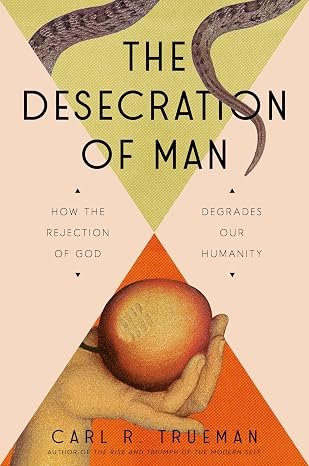
His newest work, The Desecration of Man: How the Rejection of God Degrades Humanity (Sentinel, 2026), is equally germane to our current moment, though less technical and more accessible than Rise and Triumph. While many people today talk about “secularization” and "disenchantment," Trueman provides stronger language for what has happened across the Western world. He describes it as a process of “desecration”: “the denial of sacred boundaries, the profanation of all that is holy” (xii). Desecration has not happened by accident. When Trueman speaks of desecration, he refers to “the active destruction of the sacred” (xv).
Throughout the work, Trueman refers back to Nietzsche’s parable of the madman. In The Gay Science, Nietzsche describes a madman who bursts onto the public square demanding to know where God is:
The madman jumped into their midst and pierced them with his eyes. "Whither is God?" he cried, "I will tell you. We have killed him—you and I. All of us are his murderers. But how did we do this? How could we drink up the sea? Who gave us the sponge to wipe away the entire horizon? What were we doing when we unchained this earth from its sun? Whither is it moving now? Whither are we moving? Away from all suns? Are we not plunging continually? Backward, sideward, forward, in all directions? Is there still any up or down? Are we not straying, as through an infinite nothing? Do we not feel the breath of empty space? Has it not become colder? Is not night continually closing in on us? Do we not need to light lanterns in the morning? Do we hear nothing as yet of the noise of the gravediggers who are burying God? Do we smell nothing as yet of the divine decomposition? Gods, too, decompose. God is dead. God remains dead. And we have killed him.”
Those in the crowd, broadly representative of the nineteenth-century intellectuals who believe they have outgrown the need for God, mock the madman. In turn, he realizes that he has come too early. They do not understand what they have done. They fail to grasp the full implications of the death of God. Nietzsche’s point is that we cannot divest ourselves of belief in the Christian God, an action he describes as “killing God,” and go on with life as usual. Nothing can be the same anymore. We have destroyed the foundation of the moral framework of Western culture. If God is dead, what is left is the will to power.
Trueman takes Nietzsche’s admonition seriously. We must reckon with the implications of a desecrated world. The social imaginary—the way everyday people think the world works, their cultural assumptions and common practices—has changed in remarkable ways. We have desecrated creation. We have desecrated marriage and sex. We have desecrated the beginning and end of life. We have desecrated humanity itself. The central crisis we face today is not some external threat such as nuclear bombs or AI. It is the fact that we have forgotten who we are. Once we have taken away the transcendent, inherent value of human life, whence comes life’s value? The "desecration of man” means that we tend to think of ourselves and other people primarily in instrumental terms.
In this work, Trueman has made at least two critical observations for understanding our cultural moment. The first is the diagnosis of desecration, rather than simply secularization or disenchantment, as the ailment we face. The de-sacralized world in which we live has not come down to us by accident. It results from an intentional dismantling of the Christian social imaginary by figures such as Rousseau, Marx, Nietzsche, and Freud. It is hard to overestimate the massive influence of Michel Foucault, the most commonly cited scholar in the world for at least the last fifty years. This dismantling is not the sole work of philosophers, however, but is also the work of activists, artists, politicians, and many others. (Rise and Triumph makes this case convincingly.) Even some theologians and clergy have contributed; recall the “death of God” theologians of the 1960s. The “immanent frame” of which Charles Taylor wrote—a worldview bereft of the transcendent—has become part of the social imaginary of hundreds of millions of people, and not accidentally.
The second critical observation Trueman makes is that desecration has had a massive impact upon the way in which we think about the nature of human beings. Consider what is happening in Canada with MAID (medical aid in dying, or, more accurately, assisted suicide). Today MAID accounts for around 5% of all deaths in Canada. Advocacy for MAID is growing both in the U.S. and Western Europe. As I wrote in Firebrand in 2022, the common argument that MAID allows people to “die with dignity” is irredeemably flawed. Some proponents argue that MAID can prevent an agonizing death. Even if this were a sufficient justification for its practice, MAID is being used in ways well outside of the bounds of this rationale. Many people who do not suffer from terminal conditions are opting for MAID, perhaps with encouragement from family or medical professionals. In some places, even teenagers are allowed to make this decision. If life is primarily instrumental, this approach to death makes perfect sense. If life is sacred, it is an abomination.
If desecration is the problem, what is the solution? Trueman argues that it is not enough to be a “cultural Christian,” as Richard Dawkins has called himself. In other words, it is insufficient to affirm the ethical framework of Christianity while rejecting its doctrinal claims. Trueman describes such an approach as “nihilism.” The whole point of the parable of the madman is that, by divesting themselves of belief in God, the European intelligentsia destroyed the foundation upon which the moral assumptions of the Western world rested. Christian values cannot inhere apart from Christian doctrine.
The way to address desecration is by consecration. We must come to understand human life as sacred once again. This is no small task. Undoing the devastating effects of desecration is easier said than done. It requires a change in the social imaginary. “Given that desecration permeates the social imaginary of this Hour of the Madman, this consecration must capture not simply the intellect but the imagination as a whole” (187). In other words, we must begin the process of re-envisioning all of life in terms of Christian belief and practice.
How is this possible? Trueman identifies three dimensions to Christianity that are crucial for the development of a Christian social imaginary: creed, cult, and code. By “creed,” he means Christianity’s doctrinal content, “the set of beliefs that define the faith” (188). We take these not simply as an organizing story by which we make sense of our lives, but as truth claims that describe reality. God is triune. Christ is divine. He atoned for our sins. He rose from the dead. To hold these claims to be true is to redefine our world. By “cult,” Trueman means the church’s worship practices, which involve elements such as preaching, sacraments, prayer, and the reading of Scripture. By “code,” he means “the moral habits and practices of life that are expected of Christians” (188). He writes, “In our sex-saturated age, these are often thought of as connected to chastity, but basic honesty, a good work ethic, and the giving of hospitality would all qualify as well” (188). “Code” encompasses the moral imagination of our faith. The project of consecration, then, begins with ordinary Christian beliefs, practices, and behaviors.
There is no shortage of Christian commentary on the cultural and moral decline of the Western world. We lament our moral decadence. We fear what AI may become. We decry abortion, euthanasia, and eugenics. We condemn racism and xenophobia. Trueman, however, has taken us a step back to the problem behind the problems. We have desecrated our humanity, and thus eviscerated any notion of an innate human nature. We have forgotten who we are, and we cannot remember without recalling the God who gave us life, came down from heaven in Jesus Christ for us and for our salvation, died on the cross, and rose from the dead. It is not enough, he reminds us, simply to live as if these things are true. Rather, we must weave them back into the fabric of our lives through creed, cult, and code. A deep process of Christian formation is essential.
What Trueman is calling for—the reshaping of the Western social imaginary—is a massively ambitious undertaking. The degradation of our social imaginary has taken place across three hundred years of cultural upheaval. We will not turn this ship around overnight. The place we must start is in the church. We must recommit ourselves to the slow, steady work of catechesis and discipleship. We must learn the faith, teach the faith, live the faith, and do so with patience and consistency over the course of our lives. We must live out what Eugene Peterson called “a long obedience in the same direction.” And we must apprentice others into this same way of life. It isn’t flashy. We won’t gain the kind of following we would have if we were to fashion ourselves into culture warriors and influencers. The life of simple faithfulness, undertaken by believers in the quotidian routines of work, play, family, and worship, will in time restore what we have lost—the awareness that our lives are not our own, but are the sacred possession of the living God.
David F. Watson is President of Asbury Theological Seminary and a member of Firebrand’s editorial team.