
Rooted in the Spirit: The Wesleyan Church’s Identity as a Faithful, Free, and Fruitful People
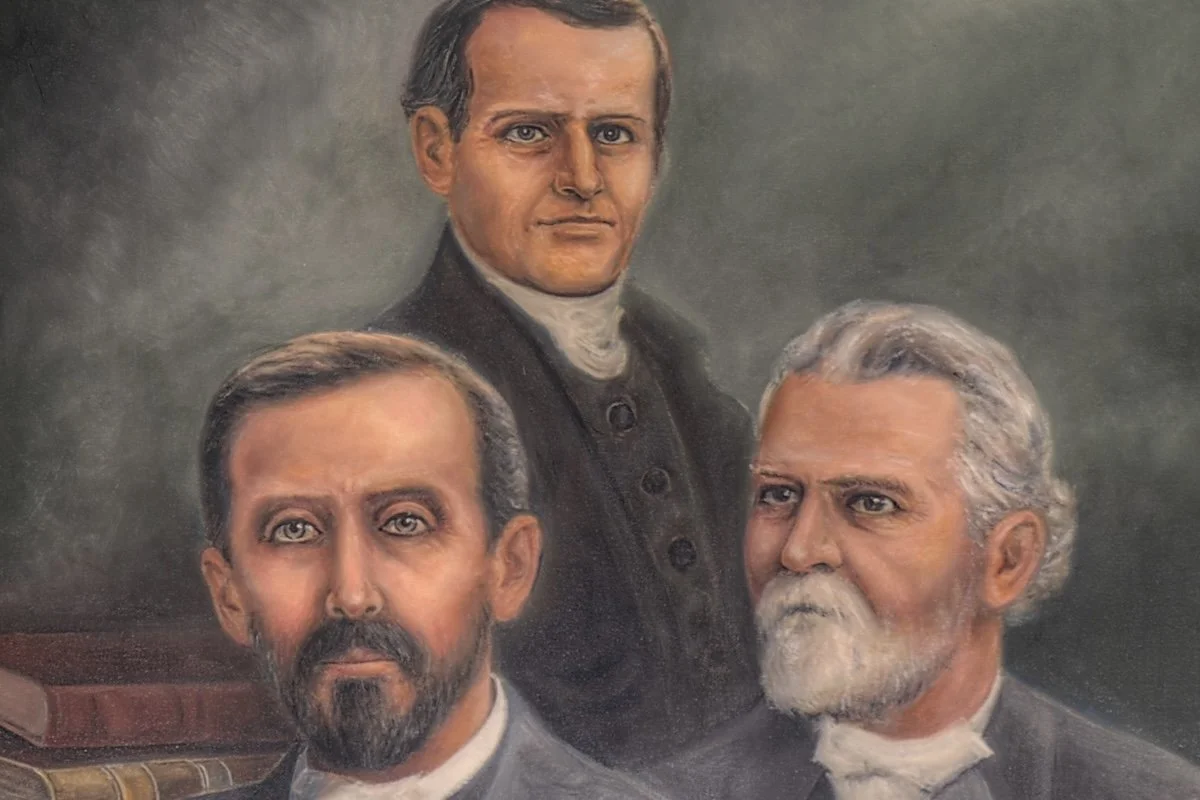
Painting of Martin Wells Knapp, Orange Scott, and Seth Cook Rees (Co-founders of the Wesleyan Church) on display at the World Methodist Museum, Lake Junaluska, NC. (Source: WikiCommons)
An Anti-Everything-Wrong Organization
In 1842 and 1843, Orange Scott, along with some other Methodist Episcopal leaders, decided they could no longer stay in the denomination they had poured their lives into. The driving issue was slavery. Could Methodism be a movement that allowed, and sometimes seemingly encouraged, this pernicious institution? These leaders said no. A surprising number of other leaders said yes. This led to the realization of another driving issue: that of authoritarianism. Attempts to debate the slavery issue at General Conference were silenced. Abolitionists were even called mentally incompetent, reckless incendiaries, and liars. A small number of leaders had decided that they, and not the wider Methodist movement, would decide what was and what was not allowed. Since they were bishops, and Scott was not, they thought they had the final say. They did not.
In stepping away, Orange Scott, Luther Lee, Jotham Horton, and La Roy Sunderland were not leaving Methodism as much as acknowledging that the Methodist Episcopal Church itself had already left the heart of John Wesley’s movement. Like Richard Allen did in the years leading up to the 1794 creation of the African Methodist Episcopal Church, Scott and his compatriots realized that, in order to maintain a Methodism faithful to the heart and mission of Wesley, they had to leave the denomination to stay faithful Methodists. In a short collection of writings, The Grounds of Secession from the M.E. Church, they shared the reasons for their separation with detailed arguments, writing “We take this step after years of consideration, and with a solemn sense of our responsibility to God, for the sake of a high and holy cause” (The Grounds of Secession from the M.E. Church: Being an Examination of Her Connection with Slavery, and Also of Her Form of Government, 1840). It was a stepping into faithfulness, an expression of what these leaders saw as a pure Wesleyan Methodism that prized biblical fidelity, a community of those equally called and empowered, and a holiness that transforms individual people and, from this, the wider society.
The Bold Step: Why They “Came Out”
While there were multiple issues, the primary concern had to do with the increasing support of slavery in the Methodist churches. Through the late 1700s and into the 1800s, the Methodist Episcopal Church had become a slave-holding and slavery-defending organization. It not only tolerated slave-owning members and ministers, contrary to Wesley’s own sharp views on the matter, but the bishops also suppressed anti-slavery voices, altered rules to favor internal slave trading, refused to reaffirm early anti-slavery positions, and took actions like the “colored testimony” resolution that disenfranchised black members. All of this was done accompanied by expressions of keeping unity and pursuing growth. That brings us back to the question about what unity actually is and who is responsible for defining it.
This is more than an organizational question. When it comes to church, such questions include the deeper concerns of ecclesiology, of course, but also pneumatology. Where is the locus of the Spirit’s work in the life of a Christian community? And who expresses, polices, and organizes that work? For Orange Scott and the others, their abolitionist work ran them headlong into what they soon saw as a deeper problem with the governing model of the church and they realized this too was a barrier to real unity. In seceding from the Methodist Episcopal church, the second major reason they gave for leaving was their perspective that the episcopal structure itself was unscriptural, aristocratic, and oppressive. Those who structurally represented the Methodist church in leadership, the bishops, assumed it was their prerogative to define unity. Thus, it was a hierarchy that those below must follow or be disciplined. This kind of hierarchy makes sense for driving, movement-focused leaders like John Wesley or Francis Asbury, among others. But hierarchy can be vulnerable to outside influences, especially when moving from a renewal movement to an established institution. Outside, often establishment, influences tend to parasitically co-opt transformative movements, leading to the promotion of those who are not adherents to the original vision, who then steer the emphases in divergent directions. The organization, then, maintains the name but not the priorities of the organization. What is the recourse when the leaders betray the founding mission? That was the crisis Orange Scott and the others were forced to address.
They argued that bishops held unchecked power over appointments, transfers, and conferences. Only clergy had influence. Lay people were excluded from key decisions in both local and district decisions. Pastors were able to arbitrarily discipline church members. It was this structure that enabled pro-slavery stances to take control, even though these ideas were counter to the established policies of Methodism from its beginnings. Attempts at reform were stifled under the guise of maintaining polity and unity. The abolitionists had to concede everything; the slavery supporting leaders conceded nothing.
Scott and the others believed that Wesleyan doctrines and practices, and the emphasis that all people were empowered by the Holy Spirit for holiness and mission, were increasingly in contrast to the church governance they experienced. Slavery was the problem, but being silenced became the last straw. After a long struggle to be heard, they finally decided that there was no alternative but to “stand forth for a new anti-slavery, anti-intemperance, anti-everything-wrong, church organization” (The Life of Rev. Orange Scott, Prindle and Matlack, 1848, 202) and the Wesleyan Methodist Church was formed in the early 1840s. “Others must judge for themselves,” they wrote, “but we feel it our duty to ‘come out of her’—to ‘have no fellowship’ or connection ‘with the unfruitful works of darkness,’ but to ‘come out from them and be separate!’" (The Grounds of Secession from the M.E. Church). To stay true to Wesley they felt they had to leave the Methodist Episcopal Church to preserve what they saw as a vital theme within Wesley’s vision of Christian community: people empowered by the Holy Spirit for ministry, no matter their race, social/economic status, or even their ordination. Everyone saved by Christ is empowered to be sanctified for life and calling by the Holy Spirit, an expansive view of salvation that defines Wesley’s vision for the movement.
The protest against slavery was established in the recognized personhood of those who were enslaved and in the recognition that those who were enslaving were in fundamental violation of God’s Law and love. Both sides were being dehumanized. Similarly, their reasoning for protesting the episcopacy came out of a similar drive to see spiritual authority empowered throughout the church, not just in clergy. When the Holy Spirit empowers the church, it is the people who make up the church, not the buildings, services, ministers, or government. That is why the early Methodist Episcopal Church leaders insisted on lay involvement at every stage of church, district, and denomination decisions.
Spreading Scriptural Holiness is a Project for the People
Orange Scott and his fellow ministers were not the first to split from Methodism and they certainly weren’t the last. Throughout its history there have been active renewing movements that exist alongside the denominations. These various expressions of Methodism create a wider, more diverse approach to the Wesleyan vision of living out Scriptural holiness in this world. We see this from the development of the Methodist Episcopal Church in the US to the continued thriving of the African American Methodist denominations, to the creation and mergers that form our Holiness community of churches, and now through the Global Methodist Church. These divisions have been full of tension and heartbreak but end up renewing the vision of holiness that is both personal and social.
The Wesleyan Church’s seceding founders were certainly focused on this core Methodist priority of holiness. Holiness is a work of the Spirit of God, who is holy and makes us holy. It’s in the name that became most used in the New Testament and throughout church history: Holy Spirit! While in the past some have seen holiness as a kind of legalistic adherence to a set of mostly-don’ts and some occasional-dos, holiness is best understood as communion with the living God. The locus of the Spirit’s work is through people in forming this communion. See, for instance, this emphasis in Acts 2, Romans 12, 1 Corinthians 12, Ephesians 4, and similar passages. God works in many ways, and we see some of those ways throughout Scripture, early on through prophets, through the Law, through Temple sacrifice, and occasionally through a king. These are good when God chooses that path, but they are not the purpose of God’s communion with humanity, which is seen most fully in the mission of Christ among us and in the sending of the Spirit with us. The primary place of the Spirit’s work is in people. And that is something far too many have ignored.
Slavery is an abomination because it dehumanizes people– both the slave and the slave-owner, who were no longer acting in empowered communion with each other or as part of the Christian community. Episcopacy, says Orange Scott et al, is a sin because it narrows the locus of God’s leadership to a small number of leaders who enact their calling while restricting the potential of others. We always need space for the prophets, after all, if we are to be biblical. And as Paul and Peter emphasize in their letters, we always need space for all the spiritual gifts to be expressed. In hindsight, it is clear that episcopacy in itself is not always wrong and other non-episcopal forms of church government are not themselves free from potential authoritarianism. That is why the deeper principle of a sanctified congregation is a key theme to keep in mind no matter our organizing structure.
People are the locus of the Spirit’s work. People are also a problem. We sin. We are fallible. We are broken. We strive to gain power and domination rather than loving one another. This is a problem but not a surprise to God nor was it to John Wesley. This problem inspires a methodology of transformation, leading people toward a scriptural way of salvation. And that is a wide work indeed, as Wesley preaches, “the salvation which is here spoken of might be extended to the entire work of God, from the first dawning of grace in the soul, till it is consummated in glory.” (John Wesley, Scriptural Way of Salvation). This is a personal and a social salvation that needs shared attention from evangelism into formation, working all together, each person contributing as the Spirit leads. There is, after all, no other kind of holiness than holiness expressed through the people together as a community.
The task of building holiness within each person was the very thing that defined Methodism and also sometimes a forgotten priority that must be ever-recovered. The steps taken in this pursuit allow us to be holy so that we are expressive in our communion with God and with this world, spreading this holiness—this Spirit locus within each person—to all parts of the earth. This continues to be our mission. The issues dividing us may be different in our era but the same mission still exists. First, we must break down the barriers that dehumanize or limit others. Then we take steps to lead them, by both discipline and opportunity, into increasing expression of the Spirit’s work in their lives and in our communities. We fight for freedom so that we, together, are faithful and fruitful in the deep and wide service to our God.
Patrick Oden is Dean of Ministry and Christian Thought at Oklahoma Wesleyan University.