
The Word “Catholic” Is Worth Fighting For
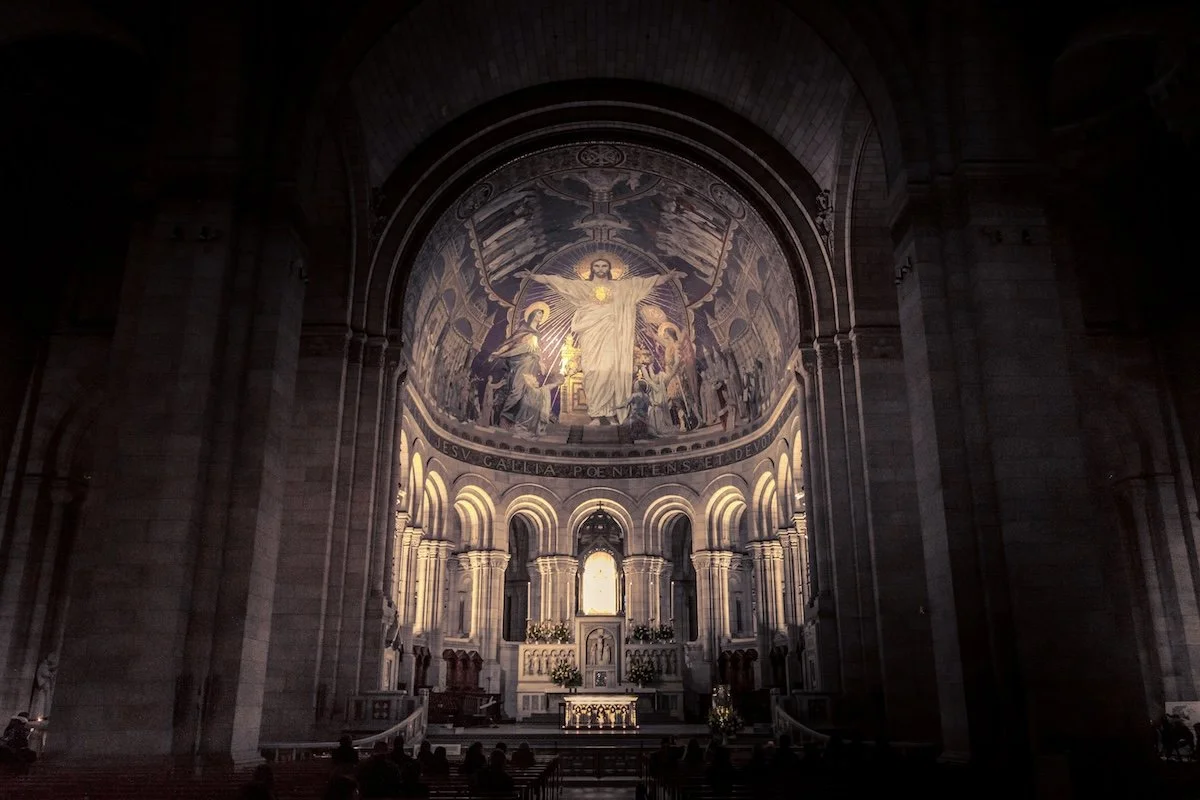
Photo by Chris Karidis on Unsplash
“I believe in the Holy Spirit, the holy universal church.”
I hesitated as I recited these words at a well-meaning evangelical church. I was glad that they were saying the Apostles’ Creed, and that the substance of the holy apostolic faith was communicated. But the word “catholic” is precious to me, and I am saddened when churches replace it in the Creed, often without understanding why it’s there in the first place, and why it was intentionally upheld by the Protestant Reformers. At a time when so many evangelicals are disconnected from their own history, the word “catholic” is worth fighting for.
“Catholic” in Scripture
The word “catholic” is, first and foremost, biblical. That is, it’s derived from words of Scripture. Acts 9:31 says that after Paul’s conversion, “the church throughout all Judea and Galilee and Samaria had peace and was being built up.” The Greek words translated as “throughout all” are kata holos. The word katholikos is simply a compound of these words, and from it we derive the word “catholic.” Acts 9:31 refers to “the church” (singular) as a single, unified reality that transcends ethnicity and geography, since it is “throughout all” Judea, Galilee, and Samaria. And since Acts 9:31 is intentionally echoing the mission statement of Acts 1:8, it points to the church as a single, unified reality that would soon extend to “the ends of the earth”—one church throughout the whole world.
“Catholic” in the Early Christian Vocabulary
The word “catholic” made its way into the Christian vocabulary remarkably early—around a century before the word “Trinity.” The earliest extant reference is around 110 AD, just a few decades after the apostles, in the writings of Ignatius, who may have been a disciple of John (or at least had some connection to him). Ignatius, the bishop of Antioch (the missionary base of the Apostle Paul), was arrested for his faith and taken by a company of ten soldiers on a journey to Rome to be martyred. Along the way, they stopped at Smyrna, and after moving on, Ignatius wrote a letter back to the church there, praising them for their faith in Christ, and reminding them that “wherever Jesus Christ is, there is the catholic church [katholike ekklesia]” (Letter to the Smyrnaeans 8.2). Ignatius viewed his own church in Antioch (Syria) and the church in Smyrna (modern-day Turkey) as local manifestations of a single reality: the one catholic church, united by the presence of the one Lord Jesus Christ in both places, who dwells in the church as his mystical yet visible body on earth.
Smyrna’s own bishop, Polycarp, was also later martyred, and his story is recorded in another second-century letter, The Martyrdom of Polycarp (the earliest martyrdom account in Christian history). The letter begins, “The church of God which sojourns at Smyrna, to the church of God sojourning in Philomelium, and to all the congregations of the holy and catholic church in every place.” Catholicity oozes from every phrase. The focus is not on the distinctness of any ecclesial body, but on how that local body is a manifestation of the one holy and catholic church of God, which “sojourns” at many places. Just decades after the apostles, the word “catholic” was already a weighty theological term in the church’s vernacular, in the way that words like “Trinity,” “incarnation,” and “atonement” are today.
“Catholic” Pervasive in Christian Literature
The word “catholic” is not just scattered about in a few ancient writings; it pervades the literature of church history, from the church fathers to the reformers. Augustine’s ordinary way of referring to the true church is as the “catholic church,” and his ordinary way of referring to true believers is as “catholics” (see, for example, Against the Fundamental Epistle of Manichaeus). In his letter on “the catholic name,” Pacian (c. 310–391), bishop of Barcelona, writes that “Christian is my name; Catholic is my surname” (Letter 1). In his Commonitorium, Vincent of Lérins explains that “he is the true and genuine catholic who loves the truth of God, who loves the church, who loves the body of Christ, who esteems divine religion and the catholic faith above every thing” (20.48). Vincent urges that “in the catholic church itself, all possible care must be taken, that we hold that faith which has been believed everywhere, always, by all. For that is truly and in the strictest sense catholic, which, as the name itself and the reason of the thing declare, comprehends all universally” (2.6). In his Catechetical Lectures, Cyril of Jerusalem explains that the church is “catholic” in the sense that it extends over the whole world, teaches the whole faith, brings the whole human race under Christ’s lordship, heals the whole class of sins, and possesses the whole range of virtues (18.23).
We could multiply examples, but most important of all is the pride of place that is given to the word “catholic” in the three great creeds: the Apostles’ Creed, the Nicene Creed, and the Athanasian Creed. Article 8 of the 39 Articles of Religion affirms that “the three creeds … ought thoroughly to be received and believed: for they may be proved by most certain warrants of Holy Scripture.” The Apostles’ Creed teaches us to confess “one holy catholic church.” The Nicene Creed, the most ecumenical of all the holy symbols, teaches us to confess “one holy catholic and apostolic church.” And the Athanasian Creed frames its teaching on the Trinity and incarnation as an exposition of “the catholic faith.” The word “catholic” is thus one of four words preferred by the historic Church to describe itself, and the word which is most commonly used to distinguish the true faith from heresy.
“Catholic” Crucial to Protestant Identity
In the 16th century, the church was known by all as “the catholic church,” the faith as “the catholic faith,” and Christians as “the catholics.” Contrary to the popular myth that the Protestant reformers “broke away from the Catholic Church,” the reformers were pushed out for insisting that the church was not sufficiently catholic. The Augsburg Confession (the first Protestant statement of faith) confronts the ways in which the Church of Rome had departed from historic catholic consensus, then concludes, “Our churches dissent in no article of the faith from the Church Catholic, but only omit some abuses which are new, and which have been erroneously accepted by the corruption of the times” (21); “in doctrine and ceremonies nothing has been received on our part against Scripture or the Church Catholic” (21). The purpose of the Protestant Reformers was not to get “back to the Bible” so much as to get back to the catholic consensus about what the Bible taught, from which Rome had departed in the late Middle Ages.
The very phrase “Roman Catholic Church” implies that catholicity is defined by conformity to Rome, and that being part of the one catholic church requires submission to Rome. The reformers argued, instead, that “to the true unity of the Church it is enough to agree concerning the doctrine of the gospel and the administration of the sacraments” (7). In his Institutes of the Christian Religion, Calvin explains that although there are catholics and catholic churches within the “Roman Catholic Church,” the true catholic church extends far beyond the boundaries of those who conform to Rome. Following in the footsteps of Vincent of Lérins, the reformers prioritized catholic faith—“that faith which has been believed everywhere, always, by all”—as the defining mark of catholicity. The reformers refused to cede the word “catholic” to Rome, because their fundamental claim was that Protestants were the true catholics—those who were holding fast to the faith passed down by the catholic church throughout history.
These core convictions run through the classical Protestant confessions. The Second Helvetic Confession insists that “we retain the Christian, orthodox and catholic faith whole and unimpaired” (11), and explains that the church is “catholic because it is universal, scattered through all parts of the world, and extended unto all times, and is not limited to any times or places” (17). It expresses disapproval of “the Roman clergy who have recently passed off only the Roman Church as catholic” (17). The Belgic Confession likewise says, “We believe and confess one single catholic or universal church” (Article 17). The Westminster Confession also teaches that the church is “catholic or universal under the gospel (not confined to one nation, as before under the law)” (Chapter 25). The Scots Confession agrees: “[the Church] is the body and spouse of Christ Jesus; which Church is Catholic, that is, universal, because it contains the Elect of all ages, of all realms, nations, and tongues” (Chapter 16).
“Catholic” Ingrained in Methodist Identity
In Protestant history, Methodism stands out for placing an especially strong emphasis on being first and foremost “catholic.” In William Burt Pope’s 1873 address on “The Peculiarities of Methodist Doctrine,” Pope emphasizes that Methodism receives “the Catholic verities of the Christian Faith,” and does not claim to have founded any new “Catholic and Apostolic Church.” Methodism is a branch of the one holy catholic and apostolic church which the Holy Spirit preserves in every age: “Our fellowship as a people is with the Catholic Church of the common Lord. Much as we value what we are constrained to call our peculiarities, we value our heritage in Christ and His kingdom upon earth infinitely more.” Pope celebrates that the Methodists of his day were characterized by a truly catholic attitude: “On the whole, it may be said that there is as much of the truly Catholic sentiment among this people as can be found anywhere in the Christian world.” Pope essentially says that although Methodism has its distinctives and is not ashamed of them, one of Methodism’s distinctives is that it doesn’t place too much emphasis on distinctives! Methodism is thoroughly catholic.
This Methodist spirit goes back to Wesley himself, who was unashamed to promote doctrines which distinguished Methodism from others (such as Calvinists), but always sought to locate these doctrines in Christian history, and did not want them to become the main thing for which Methodism was known. In his sermon “On Catholic Spirit,” Wesley defines “catholic spirit” as “catholic love”—a love for all who share the catholic faith, and a love for the catholic truth wherever it is found, despite other differences. Charles Wesley’s hymn “Catholic Love” captures the same spirit: “Forth from the midst of Babel brought, / Parties and sects I cast behind; / Enlarged my heart, and free my thought, / Where’er the latent truth I find / The latent truth with joy to own, / And bow to Jesus’ name alone.” The Wesleys did not avoid the word “catholic”; they cherished it.
“Catholic” Worth Fighting For Today
Pastors and churches today have two options: (1) avoid the word “catholic” and use a word like “universal” instead; or, (2) do what Christians have always done, embrace the word “catholic,” and simply explain it. About three years ago, when I came to the church where I am currently pastoring, the word “catholic” was not a part of their vocabulary. But when I introduced the Apostles’ Creed and then the Nicene Creed, I took the time to explain it. To this day, whenever we present the text of the Creed, we include a footnote explaining what “catholic” means. And every one of our disciples goes through a catechumenate in which the word is explained to them, and in which they encounter excerpts from ancient Christian writings which use the word positively. By leaning into the word “catholic,” we ensure that our disciples will not be confused when they inevitably hear it used outside our local context, or if they encounter it when reading works from Christian history. The word “catholic” doesn’t belong to “the Catholics” (Roman Catholics)—it belongs to all Christians, and it’s worth fighting for today.
I’m delighted to confess, “I believe in the Holy Spirit, the holy catholic church.”
Johnathan Arnold is pastor of Redeemer Wesleyan Church, global trainer with Shepherds Global Classroom, founder of holyjoys.org, and primary author of The Whole Counsel of God: A Protestant Catechism and Discipleship Handbook.