
Mother of the Faithful: A Wesleyan Reading of Mater Populi Fidelis
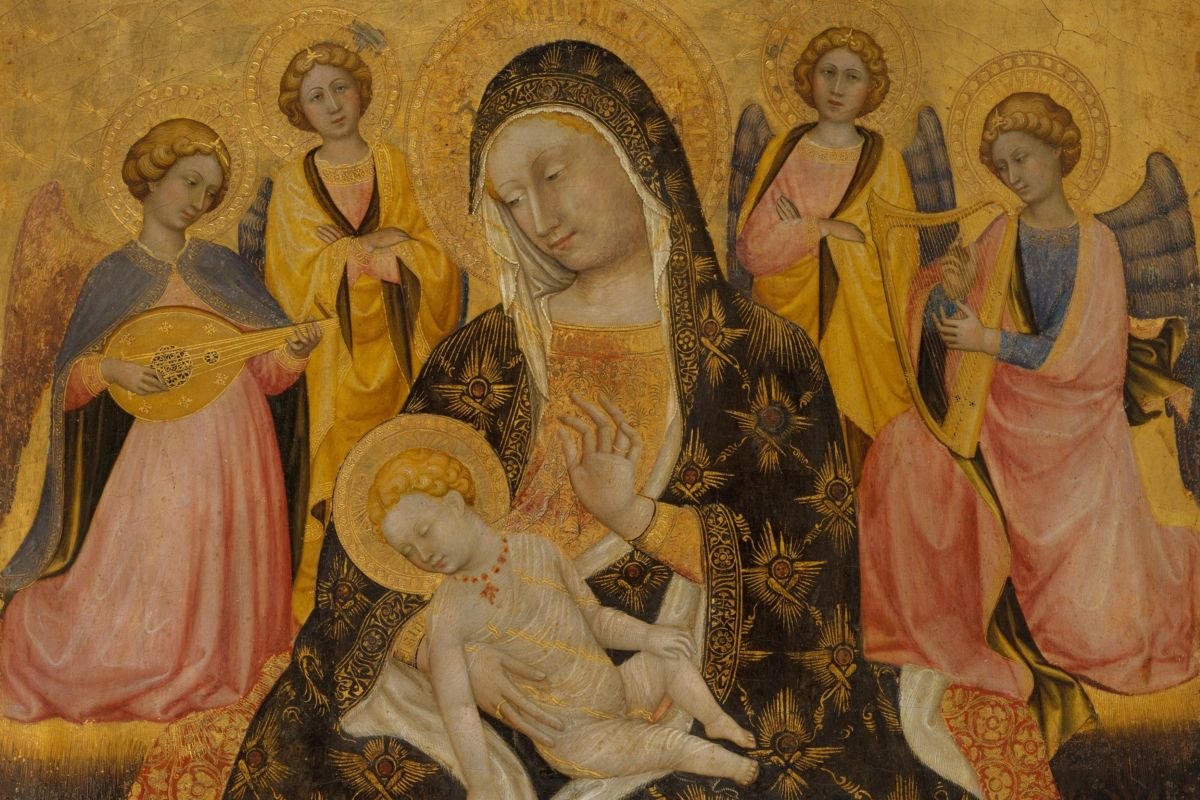
“Madonna and Child with Angels” by Pietro di Domenico da Montepulciano, circa 1420. (Source: WikiCommons)
In early November of 2025, the Roman Catholic Church's Dicastery for the Doctrine of the Faith released Mater Populi Fidelis ("Mother of the Faithful People of God"), a delineation of certain teachings on Mary, the mother of Christ. The document has sparked interesting conversation within Roman Catholicism and surprised many outside observers with its humility, warmth, and clarity. It primarily addresses Marian terms that have long troubled many non-Catholics, clarifying confusion both within and beyond the Roman Church around particular Marian titles while advancing ecumenical dialogue.
While I am not Roman Catholic, in recent years I have held a growing conviction that Roman Catholicism is a great gift to the body of Christ. Wesleyans and Catholics share a theological confluence on sanctification that deserves more attention at popular and congregational levels than it receives. The Second Vatican Council's statement on sanctification in Lumen Gentium stands as one of modern theology's most profound and pastoral reflections on holiness. Surprisingly, Rome's new clarification on Mary offers Wesleyans an unexpected entry point for continuing conversation on holiness. This essay argues that while significant dogmatic differences remain, Mater Populi Fidelis articulates a Mariology that resonates with core Wesleyan theological commitments, particularly Wesley's understanding of cooperation with grace and the social nature of sanctification.
Christians have debated Mary and her role in the gospel story since the church's earliest centuries. Those first controversies centered primarily on Christology rather than Mariology, though they inevitably raised questions about Mary's unique relationship to her son. Modern Protestants often hold a flattened understanding of Catholic Marian doctrine, unaware that Roman Catholic leaders have debated these teachings internally for centuries.
Mater Populi Fidelis primarily addresses two Marian terms that Catholics have long used without clear explanation: Mary as "co-Redemptrix" and "Mediatrix." The document, a "doctrinal note" (a category of explanatory writing, not authoritative dogma), seeks to provide scriptural and theological explanation for what is and is not appropriate and allowable regarding Marian devotion.
The central organizing principle of Mater Populi Fidelis—indeed its repeated refrain—holds that Mary's role always constitutes "subordinate cooperation" with Christ's centrality in salvation. It's worth parsing what this means. Catholics have historically viewed this cooperation from two perspectives. First is what the document calls Mary's "participation in the objective redemption accomplished by Christ..." (emphasis in original). Another way to say it is that this is the Mary of history. Just as Christ was a full-fleshed person preaching salvation and the Kingdom of God, so too was Mary there with him, raising him, sometimes pestering him (as all loving mothers do), and following him (quite literally) to Calvary. Just as the apostles did, Mary cooperated in Jesus's earthly ministry as his mother, and as such, her cooperation happened in a unique and special way.
Catholics have also viewed Mary's cooperation subjectively. This is reflected in the influence she currently exercises over those Christ has redeemed. We might call this the Mary of meta-history. This is likely the harder teaching for Protestants to accept, rooted more in theological reflection and Roman Catholic tradition than in explicit biblical texts. However, as I will attempt to show below, even this subjective understanding of Mary's cooperation in salvation has some corollary in Wesleyan thought.
Mater Populi Fidelis points towards the depiction of Mary in John's gospel as the scriptural expression of her subordinate cooperation. In John 2, at the wedding at Cana, Christ calls his mother "Woman" after she implores him to save a bride and groom from the social faux pas of running out of wine. In this name, Jesus links his mother to Eve, the first woman who, along with the first man, fell to the serpent's deception and plunged humanity into sin and isolation from God. Jesus doesn't mean to demean, deride, or dismiss his mother by using this name. Rather, he suggests that in that moment, worrying about what the neighbors think prevents her from grasping who her son was and would be.
In chapter 19 of John’s gospel a remarkable grace and transformation occur. As Jesus hangs on the cross he looks down at his mother and those brave souls who endured the shame of association with a crucified criminal. Addressing Mary and the disciple whom Jesus loves, Christ again calls Mary "woman" while giving her the beloved-disciple as her own son. In Christ's next breath, addressing his disciple, a new title for Mary is used: "Here is your mother." (emphasis added) At Calvary, Mary is transformed. She inherits a new title, from “woman” to "mother," a title Christ gave to no one else. Mary's sanctification, begun at the Annunciation, reached its fullness at Calvary. Just as Eve's motherhood became a curse to her, Mary's motherhood became a blessing through the cross. And we, like the disciple whom Jesus loves, also undergo a transformation. We move from being children of fallen Adam and Eve to being children of the New Adam (Christ) and the New Eve (Mary as mother).
In this way, Mary cooperates in salvation without reducing or displacing Christ and the cross. Mater Populi Fidelis is clear: the term "co-Redemptrix" is "always inappropriate" as a title for Mary. Rather, through Christ alone, we receive a whole new family with Mary as our mother and exemplar of faith, like the saints of Hebrews 11.
If "co-Redemptrix" is always off limits, the document takes a more qualified approach to the term "Mediatrix." While "co-Redemptrix" emerged more recently, Eastern Christians have used "Mediatrix" as a Marian title since the sixth century and Western Christians since at least the twelfth. The term carries two acceptable meanings. The first meaning tells us that by carrying the Christ child in her womb, Mary physically mediated the Incarnation. This is no small thing to celebrate! The second meaning tells us that Mary cooperates with Christ and us in intercession. Again, Cana becomes paradigmatic when Mary advocates for the needs of the newly married couple to her son. The document is careful to note that this is not the same as channeling grace but is pedagogical and dispositive. Marian mediation is never the cause of salvation, but one that models faithful cooperation.
Here Wesleyans will recognize a core conviction of our own tradition. Wesley preached a conjunctive theology seeking balance between divine sovereignty and human agency, emphasizing both "free grace" (leading to justification) and "co-operant grace" (leading to sanctification). In his sermon "On Working Out Our Own Salvation," Wesley memorably summarized this theological balance: "For, first, God works; therefore you can work. Secondly, God works; therefore you must work." (emphasis in original) Just as Wesley taught that God's preventing grace enables but does not coerce human cooperation with his saving work, Mater Populi Fidelis presents Mary as one who freely cooperated with grace. Mary was called "full of grace," accepted the call to mother the Savior with a holy yes, became her son's disciple, and followed him to the foot of the cross where she experienced transformation. In this way, Mater Populi Fidelis argues, Mary's mediating role is never to stand between a believer and Christ, but to "enkindle" greater devotion to Christ. Mary points us to her child and reminds us of who he is and what he has done. She does this not as a point of personal pride but out of love for us and faith in Christ.
Protestants might rightly balk at any overemphasis on saintly mediation. However, read through a Wesleyan lens, the doctrine finds more comfortable approval. Again, Mater Populi Fidelis does not present Mary as standing between Christ and the sinner, but as an exemplar of social holiness. Wesley organized Methodists into classes, bands, and societies precisely because he understood holiness as always communal, never merely individual. As Christians who affirm the Apostles' Creed, we also recognize that social holiness encompasses the "communion of saints"—both the church militant and the church triumphant. Those in glory continue to participate in the church's sanctification. While Wesleyans do not canonize saints or practice prayers of intercession through them as Catholics do, we affirm that our sanctification involves both the church here and the church in glory. And as Scripture attests, Mary holds a unique place in that community, a mother whom all generations call blessed.
Mater Populi Fidelis does not solve all problems that Orthodox or Protestant Christians have with Roman Catholic Marian devotion. The doctrines of the Immaculate Conception, Mary's perpetual virginity, and Mary's Assumption to heaven, none of which the document discusses in detail, have long been contested in various Protestant communities. In fact, the Johannine theology that reads Mary's transformation from “woman” to “mother” as a journey of progressive sanctification through grace, sits more naturally with Wesleyan theology than with the Immaculate Conception. For Wesley, all humans share in the effects of the fall, and all require the restoring work of grace. Additionally, one could question whether the qualifications on mediation go far enough in limiting misunderstandings of Mary's intercessory role. Why is Mary's intercession even necessary given Christ's advocacy and the Spirit's intercession? These are real limitations and deserve careful and constructive dialogue.
But Protestants should also recognize the charity Mater Populi Fidelis offers, particularly its humble recognition that unclarified teachings have caused confusion and division, and its good-faith effort to develop a clear Marian theology rooted in Scripture and tradition. The document is a step towards what ecumenical theologians call a "differentiated consensus." This means Catholics and Wesleyans can agree on theological frameworks even if disagreements remain on specific applications. For Wesleyans, this means we can affirm (with the historic church) Mary as Theotokos (God-bearer), first disciple and model of faith, and an example of cooperation with grace in redemption that spurs believers on to greater grace in Christ, even if we cannot accept other teachings as currently formulated.
Finally, if some in Roman Catholicism have erred in embracing a maximalist teaching on Mary, we Wesleyans should recognize that we have often made a minimalist error. Perhaps out of fear of any appearance of "works-righteousness," we have neglected the means of grace, including honoring those who have gone before us. Some of us trot Mary out only for one Sunday in Advent and perhaps a brief reflection in a seven-last-words liturgy on Good Friday. We should admit that Mary's witness in history and in the communion of saints deserves more of our honor and attention. Perhaps we might begin correcting this by recovering Mary's own voice. Anglican liturgy—Wesley's own tradition—prays the Magnificat daily, using Mary's words not to center devotion on her but to adore Christ through her witness. "Do whatever he tells you," Mary says in John 2. In this, Mary shows us the way.
Lane E. Davis is Assistant Professor of Church History and United Methodist Studies at Christian Theological Seminary in Indianapolis, Indiana.