
No Idle Tale: Women’s Leadership as a Wesleyan Distinctive
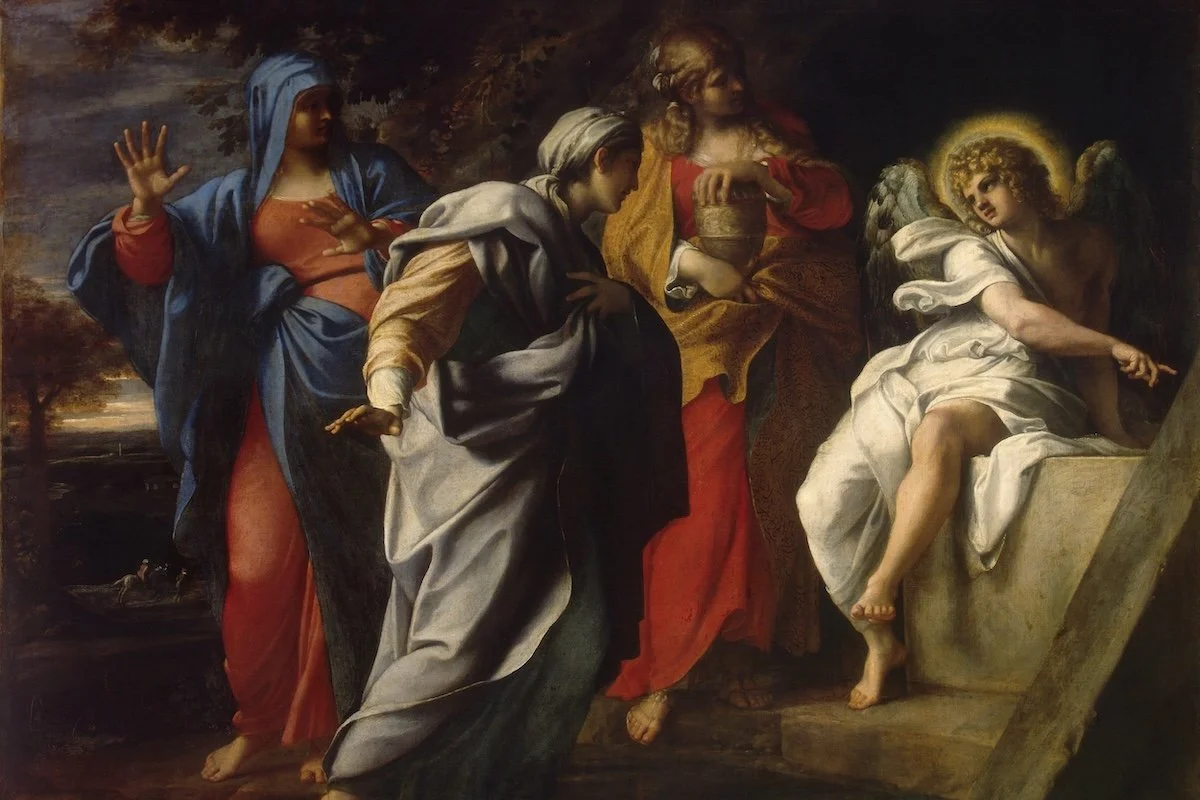
“Holy Women at Christ' s Tomb” by Annibale Carracci, circa 1590s. (Source: WikiCommons)
To my male pastoral colleagues and other church leaders: When was the last time a woman preached in your church?
The Easter season reminds us of the critical role women have held in the Christian movement from its earliest days. Women were the last to stay beside Jesus at the cross, the first to visit him at the tomb, and the first to be tasked with proclaiming the good news of the resurrection. It is very strange to argue that women cannot lead in the local church when Jesus entrusted women with the earth-shaking message of Easter. These faithful disciples were, however, met with skepticism and not enthusiasm from their male counterparts. “But these words seemed to them an idle tale, and they did not believe them,” Luke 24:11 records. Just like that first Easter, too many Christian spaces are still closed today to the message, gifts, and leadership of women.
In this essay, I will make a case that women’s leadership is a distinctive mark of the Wesleyan tradition. While the definition of our tradition is a notoriously moving target, our theologians and pastors will often name doctrines like prevenient grace, entire sanctification, or Arminianism, practices like class and band meetings, or liturgical elements like the open table or infant baptism to describe Wesleyan identity. Here I hope to make a modest case that the leadership of women also deserves to be seen as a Wesleyan distinctive that should be celebrated and defended today. To make that case, we will look at women in Wesleyan history, explore some pneumatological connections, and then conclude by speculating on the future of women’s leadership in Methodism and offering a personal account related to practical next steps.
Susanna Wesley & Early Methodist Women in Leadership
John and Charles’ mother, Susanna, was a spiritual giant. Their father, Samuel, was an Anglican priest with academic inclinations, who was, of course, influential. Susanna, however, was an outlier in her time, singular not only in her personal piety, but also in her parenting at home as well as her leadership in the parish. By all accounts a deeply faithful woman, Susanna took the spiritual formation of her many children quite seriously. She also made sure that not just her sons but her daughters learned to read, an unusual step in the 18th century. Moreover, she exercised something akin to a call to ministry.
When her husband Samuel was away for an extended period in the winter of 1711-12, Susanna was unsatisfied with the assistant who was left to minister in his stead, and she took it upon herself to begin offering what we could consider a large-scale Bible study or prayer meeting. She was such an effective leader that crowds of up to two hundred people came to her meetings, embarrassing Samuel. When he wrote and implied that Susanna ought to cease her gatherings, her reply gives a sense of just how sharp her elbows could be when needed:
“If you do, after all, think fit to dissolve this assembly, do not tell me that you desire me to do it, for that will not satisfy my conscience: but send me your positive command, in such full and express terms as may absolve me from all guilt and punishment for neglecting this opportunity of doing good when you and I shall appear before the great and awful tribunal of our Lord Jesus Christ.”
Later, as the Wesley brothers’ movement grew, it was heavily supported and led by women at different levels and places. John at first gave tacit support to some early female pioneers, but by 1771 he had been convinced by Mary Bosanquet’s biblical arguments for what she termed an “extraordinary call.” Thereafter, he licensed Sarah Crosby to preach, with many more female Methodists licensed in later years. With the exception of our Quaker neighbors, the Wesleyan tradition has been open to the ministry of women longer than most Protestant traditions. Granted, Methodist pillars like John and Charles, as well as Francis Asbury, did not personally approve of women’s ordination. Still, the Wesleyan family has long been blessed by the fruit of women’s ministry as preachers, class leaders, benefactors, and in other positions of influence. Other examples stand out as the Methodist movement grew in America: Jarena Lee (d. 1864) and Phoebe Palmer (d. 1874).
Jarena Lee was the first woman licensed to preach in the African Methodist Episcopal Church. Her request to be licensed was initially rejected by founding Bishop Richard Allen, but he changed his mind after seeing her preach in person. She was endorsed as a traveling exhorter and had a strong ministry of itinerant preaching (though she was not formally ordained). Phoebe Palmer, daughter of a devout English Methodist who had converted under the Wesleys, became an important leader in the American branch of the holiness movement. Palmer experienced entire sanctification on July 26, 1837, and soon felt a call to preach the doctrine that had transformed her life. Having long studied John Wesley’s writings, she became a popular preacher in churches and at camp meetings, and began the very popular Tuesday Meeting for the Promotion of Holiness in 1835. After she (eventually) opened these groups up to men, her emphasis on Christian perfection began to renew wider interest in the doctrine. This was furthered in books and magazines, and lived out not only in preaching but through leading social justice and charity organizations.
Always pragmatic and yet open to the movement of the Spirit, a consistent pattern emerges across many branches of the Wesleyan movement regarding women’s public leadership: initial questioning, followed by tacit allowance, followed by official endorsement. Noteworthy also is that some of what are taken to be the more conservative branches of the movement (such as the Free Methodists, Wesleyans, and Nazarenes) officially ordained women before The Methodist Church did in 1956. The Methodists Protestants, who broke away before the Civil War, also ordained women earlier in our history.
From Mother Susanna to Jarena Lee to our amazing female leaders around the world today, Wesleyans of all stripes should welcome and celebrate the faithful ministry of women - both lay and ordained - as representing a distinctive feature of our corner of the Body of Christ. Alasdair MacIntyre described a tradition as an extended argument over time. The vast weight of our tradition takes seriously, at minimum, the gifting and leadership of women. Over the last century or so, ordination in particular became ubiquitous among the major Wesleyan denominations. To put it in modern programming parlance, women’s leadership is a feature, not a bug. This aspect of Methodist life comes not only from our shared history, but also from theological convictions related to the work of the Spirit for the effective fulfillment of God’s mission.
A Distinctive, but not a Dogma: Pneumatological Connections
Previously, here in the pages of Firebrand, Ryan Danker made a robust Wesleyan case for women’s ordination, while also noting that he did not believe it should be dogmatic. This is a helpful corrective. Strictly speaking, I tend to think there are few dogmas to which all Wesleyan bodies and leaders should be held accountable. Thus, I am also not seeking to make a dogmatic case, but rather argue that women’s leadership should be included in considerations of what makes Methodists distinct from other Christian groups. We can, in what Wesley termed a “Catholic Spirit," hold such commitments seriously but also humbly.
The best Wesleyan case for the full participation of women in the life of the church, from baptized infants to consecrated bishops, is pneumatological. By that I mean a recognition, from both the Biblical sources and throughout our history, of how the Spirit has continuously called and equipped women for faithful ministry. As Joel prophesied and Pentecost fulfilled, the Spirit falls on men and women, young and old, people of every language and nation. The resulting spiritual gifts and fruit are not gender-specific. The third Person of the Trinity is not a complementarian.
Galatians 3:28 is a perhaps overused verse in such discussions, but what is often missed is that this was very likely baptismal language. “In Christ,” as St. Paul wants to get across to his troubled flock, the old order of the world has been overcome. In the Christian community, the ways in which our cultures divide us have all been relativized in the Spirit-graced waters of baptism: whether by gender, ethnicity, or economic status.
This connection is why, historically, it is pneumatologically-oriented groups like Wesleyans, Quakers, Charismatics, and Pentecostals who were among the earliest not only to support women in ministry but also abolition and other racial justice efforts. I would not claim any groups practiced these convictions consistently at all times and in all places, of course, but the common doctrinal foundation which directed these bodies to reject both racial and gender inequality was the pneumatological conviction that all people were made in the image of God, worthy of dignity, and not only included in the Body of Christ but gifted by the Spirit for fruitful leadership therein.
Women as Wesleyan Leaders Today: Prospects & Pitfalls
There is both progress needed and great potential to be mined as various Wesleyan bodies seek to fully practice what our theology has long implied. In different polities, Wesleyan women face distinct challenges, because ultimately the people in the pew (or in parachurch or judicatory bodies) must be willing to receive the leadership of women.
In mainline expressions such as the United Methodist Church, women are present in all levels of the church, and bishops have the authority to appoint women to large churches and to other influential posts. Nevertheless, many barriers still exist today for women’s ministry in the UMC. The North Carolina Conference produced a jarring video a few years ago featuring male pastors reading a slew of disturbing and disrespectful comments that had been directed at their female colleagues. Speaking as an ordained UMC elder, we still have many churches who have never had a female lead pastor, and thus there is still a stained glass ceiling for my sister clergy.
In evangelical and holiness expressions of Methodism there are other challenges, as congregations typically have more authority in choosing their pastors. While denominations might appoint women to executive positions, and women in conservative Wesleyan denominations often serve as bishops and superintendents (or other equivalent executive positions), there are often few large churches willing to consider women for their senior pastor roles. For instance, in a 2021 report the Free Methodist Church USA stated this regarding the status of female clergy:
“At a time when women are entering formerly male-dominated professions in increasing numbers and providing community leadership, the percentage of women among Free Methodist pastors, especially senior pastors, and in church and conference leadership roles, is not growing as would be expected.”
I have spoken anecdotally to female Wesleyan pastors who were ordained but then struggled to find jobs in a pulpit, and went into non-profit work or other forms of ministry instead. Prior to the recent split between the UMC and the Global Methodist Church, there were many in my tribe who predicted the GMC would either not uphold its promises on women’s ordination or walk them back. This disingenuous fear-mongering has proven untrue. However, the GMC does face similar challenges to the FMC, Wesleyans, and other evangelical bodies when it comes to churches actually hiring (or calling) female clergy to lead.
Considered together, this means that all branches of the Wesleyan family have work to do in educating our churches and advocating for the gifted, called, and equipped women in our midst. For senior pastors this is especially important. I will offer a small example from my own ministry.
My first appointment, a UMC congregation that existed for over a century, had never had a female pastor. Knowing that more than half of my seminary classmates and my colleagues in the ordination process were women, I suspected there was a strong chance that the next pastor would be a woman. Though I did not detect strong hostility to that possibility in the church, I also believed an ounce of prevention was worth a pound of cure. Throughout my seven years in that church, I intentionally invited female pastors to preach regularly while I was away. I also made a point of talking about women’s ordination from the pulpit, and in Bible studies and other settings. When I moved, my suspicion proved true. The congregation received their first female pastor, and I like to think my simple efforts helped pave the way for what ended up being a positive reception.
Bishops and superintendents cannot wave magic wands and make congregations open to women in leadership. Thus, it is imperative that church leaders in local contexts, both lay and clergy, advocate for women in ministry both publicly and privately. This is all the more critical today, when social media and the internet make it easy for non-Wesleyan voices, be they mildly complementarian or outright misogynistic, to influence our churches. This makes it all the more important that Wesleyans intentionally cultivate this distinctive aspect of our tradition.
Conclusion: Resurrection and Rock n’ Roll
N.T. Wright, a retired Church of England bishop and revered New Testament scholar, once shared in an Easter sermon an encounter with a London cab driver while he was an active bishop. Getting into the cab in his clerical garb, the driver began to ask Wright about his work. This was during a season of controversy regarding female bishops in the Anglican Communion, and so the cab driver naturally asked about the controversy. The Bishop grudgingly acknowledged the row, leading the cabbie to reply, “The way I see it, if Jesus Christ is risen from the dead, the rest is rock n’ roll.”
Jesus Christ is risen from the dead, and the first people to tell about it were women. This essay has sought to demonstrate that women’s leadership is a Methodist distinctive, owing to both 1) the many gifted and called women throughout our history and 2) Wesleyanism’s pneumatological emphasis. Beyond that, the first Easter itself demonstrates that we go against the grain of the gospel when we deny the calling of its first messengers to share the good news today. As Jarena Lee asked, when challenged about her preaching ministry, "Did not Mary first preach the risen Savior?"
May the many faithful, Spirit-empowered women through whom God continues to bless the Wesleyan movement discover churches eager to receive, encourage, and deploy their gifts at every level. Their bold witness is not an ‘idle tale,’ it is a constitutive element of our shared history with great potential for our future witness, a Wesleyan distinctive that ought to be joyfully claimed and carefully stewarded for the sake of God’s mission.
Drew McIntyre is the pastor of Grace United Methodist Church in Greensboro, NC and a ThD student at United Theological Seminary. He serves on the Editorial Board for Firebrand.