
Order and Holy Orders: A Scriptural and Wesleyan Reflection on Ordination, Part 3 (Elders)
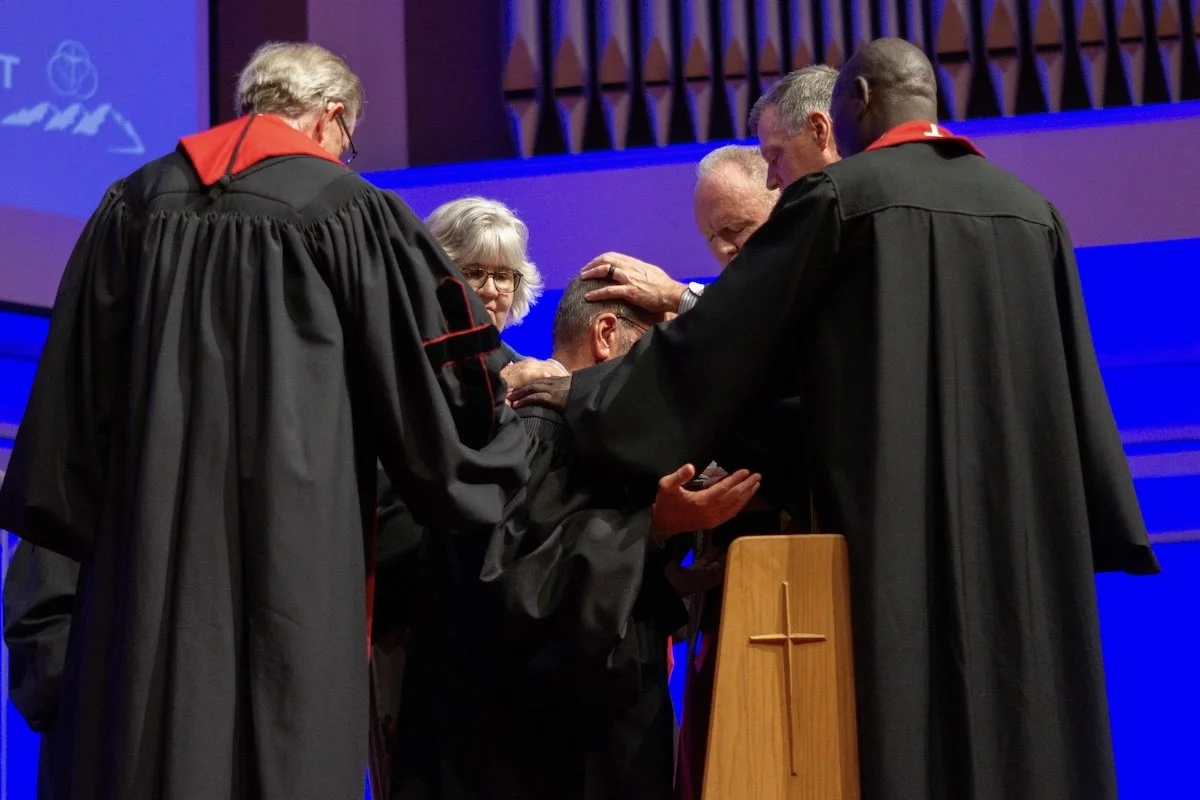
Photo from ordination service of the Allegheny West Annual Conference of the Global Methodist Church, 2024.
This is Part 3 of a three-part series. Click here to read Part 1 and Part 2.
The Three Orders of the Church: Laity, Deacon, Elder
In parts one and two of this series, I described three orders of ministry (laity, deacon, and elder). These three orders, I argued, are scriptural and Wesleyan. The first order has a mission to the world. The other two have missions to the Church.
The order of laity is called from the world as ecclesia. They minister “in the world” (Jn 17:11) but are “not of the world” (Jn 17:14).
The order of deacon is called from the laity and set apart within the laity as servants.
The order of elder is called from the deacons, and set apart within the diaconate and laity, to oversee the ministry of deacons and laity. They oversee Word, Sacrament, and Order in the Church, representing Christ’s offices of prophet, priest, and king to the Church.
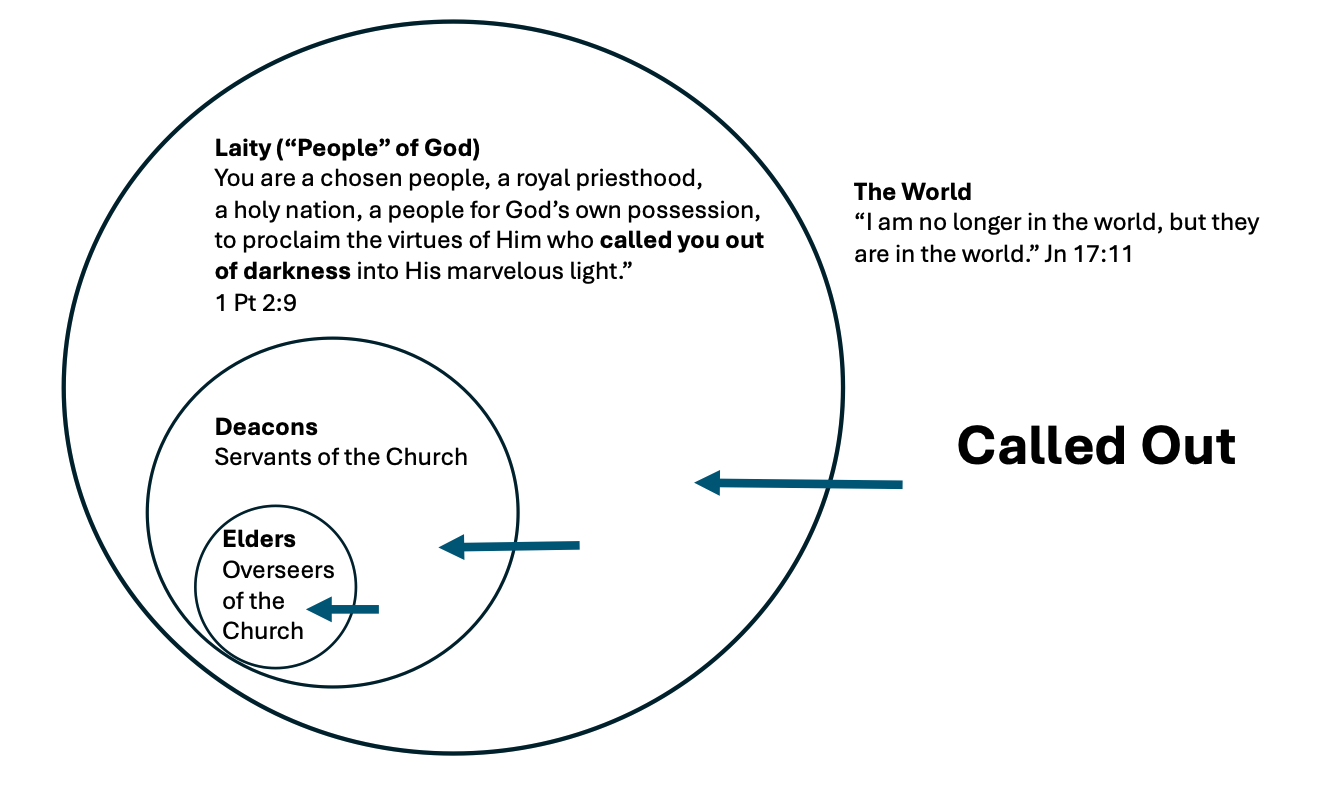
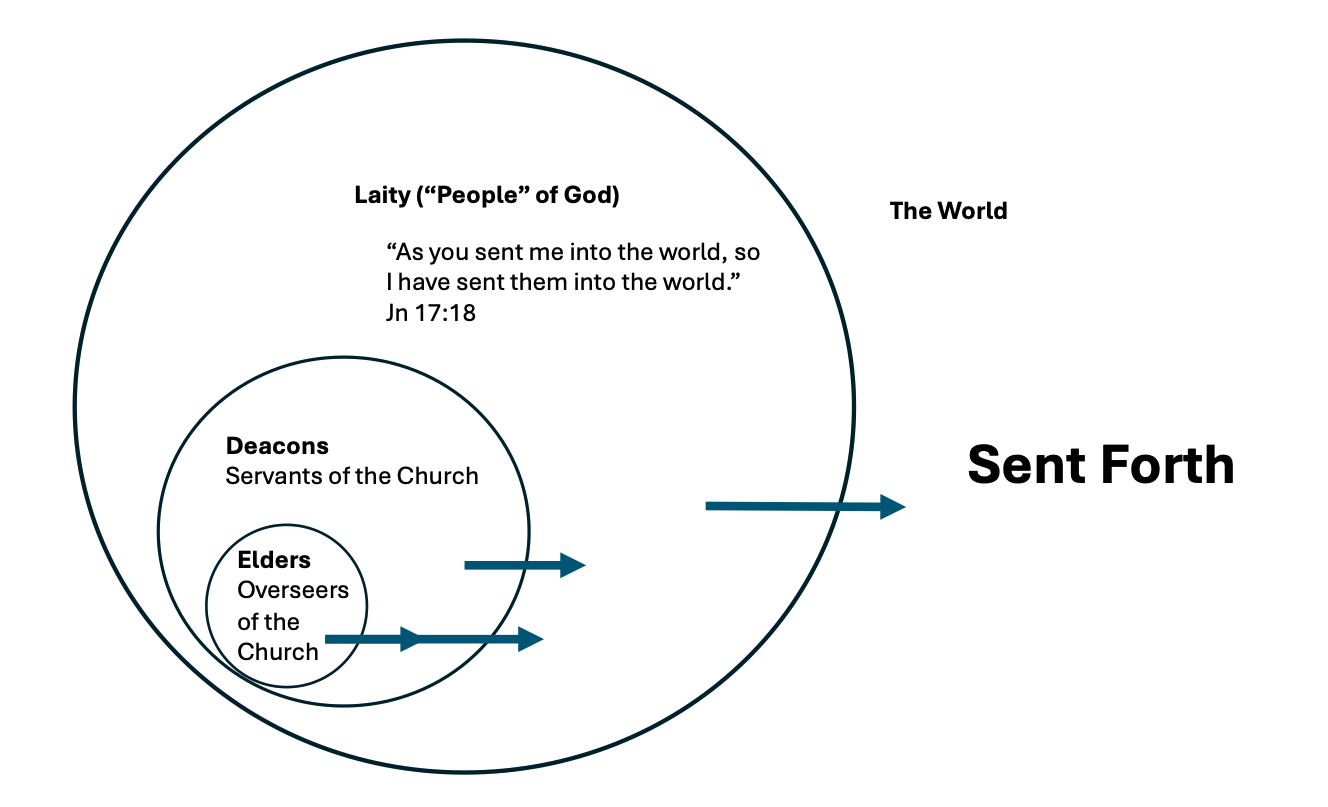
Deacons are laity. Elders are laity and deacons. The distinction of order comes from whom they are called and to whom and for what they are sent.
This article is not intended to be an historical exposition of John or Charles Wesley’s views on ordination, which differed from each other. Both died Anglicans. Were Charles to have had his way, there would never have been churches in the Wesleyan tradition to ponder a biblical Wesleyan ordering of our common life. Instead, this article attempts to propose and articulate an understanding of ordination that is biblically coherent and defensible, as well as thoroughly Wesleyan.
The Order of Elder: A Confusion of Terms (Elder, Overseer, Bishop, Superintendent)
“Elder” and “overseer” are, scripturally, the same order. Elders oversee. In Acts, Paul “sent to Ephesus for the elders of the church” (Acts 20:17 emphasis mine), and when those elders arrived, “he said to them, … ‘Keep watch over … the flock of which the Holy Spirit has made you overseers.’” (Acts 20:27-28 emphasis mine). In Paul’s first letter to Timothy, he does not mention “elders” at all but has instructions to “overseers” (3:1-7) and “deacons” (1 Tim 3:8-13). In his letter to Titus, whom he left in Crete to “put in order what was left unfinished and appoint elders in every town” (Titus 1:5 emphases mine), Paul insisted that these elders were to be blameless “since an overseer manages God’s household” (Titus 1:7 emphasis mine). Peter, an apostle who is considered the first “overseer” of Rome, identifies himself to elders “as [their] fellow elder” (1 Pt 5:1). John also introduces himself as “the elder” (2 Jn 1:1; 3 Jn 1:1). To New Testament writers “elder” and “overseer” are interchangeable terms.
This was also true in, at least part of, the primitive church. A twofold order within the church of deacons and elders (also referred to as overseers) is seen in the oldest known church discipline, likely written in the late first century. The Didache or The Lord’s Teachings through the Twelve Apostles to the Nations reads, “therefore, appoint for yourselves overseers and deacons worthy of the Lord, men meek, and not lovers of money, and truthful and proven; for they also render to you the service of prophets and teachers” (Didache, ch. 15)
The same twofold order is assumed in Clement’s first letter from the church in Rome to the church in Corinth in the late first century. Clement wrote:
The apostles received the gospel for us from the Lord Jesus Christ. … So preaching both in the country and in the towns, they appointed their first fruits, when they had tested them by the Spirit, to be overseers and deacons for the future believers. And this was no new thing they did, for indeed something had been written about overseers and deacons many years ago; for somewhere thus says the scripture: “I will appoint their overseers in righteousness and their deacons in faith.” (1 Clement 42:1-5)
Clement also used the term “elder” interchangeably with “overseer” in mediating the dispute over the deposition of elders and a schism in the Corinthian church:
For it will be no small sin for us if we depose from the overseer’s office those who have offered the gifts blamelessly and in holiness. Blessed are those elders who have gone on ahead, who took their departure at a mature and fruitful age, for they need no longer fear that someone may remove them from their established place. For we see that you have removed certain people, their good conduct notwithstanding, from the ministry that had been held in honor by them blamelessly. (1 Clement 44:4-6 emphasis mine)
The identification of “elder” with the ministry of oversight in the New Testament (as well as in the Didache, and I Clement) is why Methodism has no “order” of bishop. Indeed, the English word “bishop” is a degradation through usage of the Greek word for overseer (episkopos => piskop => bishop). The Greek literally combines two words epi (which means above or over) and scopos (which means to see) to form over-seer, the mandate of an elder. “Superintendent” is a synonymous term from the Latin roots. Francis Asbury identified the office of superintendent or “bishop” with the office of apostle. (Asbury, “Valedictory Address,” 1813). Thus a superintendent (the term for “bishop” in Methodism before the American church changed it, to Wesley’s dismay) is simply an elder rendering itinerant general oversight in an apostolic office. There is no distinction of order.
This is important because legitimacy and primitive apostolicity of Methodist ordination hinge on this identification of elder and overseer/bishop. John Wesley (who was not an Anglican bishop, but an elder in the Church of England) and Thomas Coke (another elder), together ordained Richard Whatcoat and Thomas Vasey, two lay preachers, as deacons and as elders for ministry to the church in America. Wesley also set apart Coke (already an elder) as a “superintendent.” Wesley wrote:
I have accordingly appointed Dr. Coke and Mr. Francis Asbury, to be joint superintendents over our brethren in North America: As also Richard Whatcoat and Thomas Vasey, to act as Elders among them, by baptizing and administering the Lord’s Supper” (Pastoral Letter to “Our Brethren in North America,” 1784).
Wesley, an elder with the mandate of oversight, along with another elder, ordained lay people as deacons and elders, and appointed an elder as superintendent, an office for an elder.
The same assumption of elders having the mandate of ecclesial oversight in the consecration of superintendents (later called “bishops”) is seen in early Methodism’s plan to address a crisis where there were no superintendents (or apostolic general overseers). The Minutes of the 1784 Baltimore Conference, which established Methodism as a church with separate oversight from the Church of England, read:
Q. 29. If by death, expulsion or otherwise there be no superintendents remaining in our Church, what shall we do?
A. The Conference shall elect a superintendent, and the elders or any three of them shall ordain him according to our liturgy. (“Minutes of Conference”, Baltimore, 1784)
Elders could consecrate “superintendents” (or apostolic general overseers, later “bishops”). That would be impossible if the authority to oversee the church were not within the order of elders.
The Mandate of an Elder
Elders, as laity, serve the Master who called them, and as deacons, are the church’s servants. But unlike laity and deacons, elders are charged with the responsibility of governing, of oversight. Elders are governesses to the bride of Christ. They differ from other lay servants of Christ and diaconal servants of the church in that they have greater responsibility within and for the church. Elders do not simply serve the church. They ensure that the church is well served. This ministry of oversight means elders or overseers have the mandate and authority to “direct the affairs of the church” (1 Tim 5:17). In this role of oversight, elders “keep watch over [them]selves and all the flock” (Acts 20:28).
An elder’s authority to govern does not belong to them. It is derived authority. Elders’ authority within the church comes from God, the Father, whose daughter the church is, having been chosen by His Son. That authority also derives from the Son, the bridegroom himself who chose her. Paul admonishes the Ephesian elders “to care for the Church of God which he obtained with the blood of his own Son” (Acts 20:28). This is why all ministry of oversight is in persona Christi, representative of Christ, the primary “Shepherd and Overseer of your souls” (1 Peter 1:25).
The ministry of elders must also be accepted by the laity, the people of God. Clement assumed that overseers who were “appointed by apostles or, later on, by other reputable men” also had “the consent of the whole church” (1 Clem 44:3). Without that consent, true oversight, watching over in love, becomes coercive, which is anathema to a Wesleyan understanding of God’s governance and the work of grace. As Jesus said to the twelve:
The rulers of the Gentiles domineer over them, and those in high position exercise authority over them. It is not this way among you, but whoever wants to become prominent among you shall be your servant, and whoever desires to be first among you shall be your slave; just as the Son of Man did not come to be served, but to serve, and to give His life as a ransom for many” (Mt 20:25-28).
As the church’s governesses, elders are responsible for making sure the church is prepared for her wedding, having proper education and training, appropriate spiritual food, and fit raiment in anticipation of “the wedding of the lamb” (Rev 19:7), when “‘the two will become one flesh.’ … a profound mystery… about Christ and the church (Eph 5:30, 32). To this end, her governesses oversee the Church’s education (the ministry of the word), her birth and nourishment (the ministry of sacrament), and her activities, “the righteous acts of the saints” (Rev. 19:8) (the ministry of order). In this sacred work, the elders also prepare the Church for her joint rule with her husband, to whom “all authority in heaven and on earth has been given” (Mt 28:18). For the church “if we endure, we will also reign with him” (2 Tim 2:12).
Elders alone bear this burden of church governance. Neither deacons nor laity are elected to the responsibility of oversight. This is why in the book of Acts it is the apostles and elders who discern the will of the Spirit for the Church at the Jerusalem council. “And after Paul and Barnabas had no small dissension and debate with them, Paul and Barnabas and some of the others were appointed to go up to Jerusalem to the apostles and the elders about this question” (Acts 15:2). In the earliest days of the church, the elders met in regional and general councils. Deacons were often present, and in some instances might be delegated to represent an elder who could not attend. Methodism, a conciliar church, also discerns what seems “good to the Holy Spirit and to us” (Acts 15:28) in council, or conference. Originally, those who had vote in Methodist annual and general conferences were elders.
Elders’ greater responsibility comes with greater scrutiny and greater judgement. The late nineteenth-century Methodist innovation of laity voting in conference could be considered a usurpation of legitimate authority, since laity bear no responsibility and are subject to no judgement for the church’s governance in this life or the next. The same holds true for ensuring apostolic teaching and preparing the sacrament. The duty to keep watch for the coming bridegroom, and make sure his bride is prepared, is perilous. “If the master comes” and an elder, the “wise servant, whom the master has put in charge of the servants” (Mt 24:45), is found to be unfaithful, “there will be weeping and gnashing of teeth” (Mt 24:51). But that duty is also honorable. “Elders who lead well are to be considered worthy of double honor, especially those who work hard at preaching and teaching” (1 Tim 5:17). And no elder should be removed without trial. One should “not accept an accusation against an elder except on the basis of two or three witnesses” (1 Tim 5:19).
But not all elders will prove faithful. Paul warned the Ephesian elders that “savage wolves will come in among you, not sparing the flock; and from among your own selves men will arise, speaking perverse things to draw away the disciples after them” (Acts 20:29-30). For this reason, elders can be “defrocked”, stripped of their right to represent Christ publicly and inhibited from exercising the authority for which they remain responsible. But even a defrocked elder is an elder. Clement assumed elder’s orders were for life. The apostles “appointed the overseers mentioned earlier, and afterwards … gave the offices a permanent character; that is, if they should die, other approved men should succeed to their ministry” (1 Clem 44:2). An elder’s responsibility, once assumed, cannot be relinquished. An elder is always an elder and will be judged as an elder, even if barred from exercising their responsibility. Therefore, the order of elder should not be entered into lightly, but soberly, counting the cost. This is also why the preparation and examination of deacons for the order of elder is so important.
The Preparation and Ordination of an Elder
Scripture indicates that elders ought to be trained. To govern well, elders must be skilled “in the word of righteousness” (Heb 5:13). Paul reminded the Ephesian elders of the training he did with them. He “did not shrink from declaring to [them] anything that was beneficial, and teaching [them] publicly and from house to house, solemnly testifying to both Jews and Greeks of repentance toward God and faith in our Lord Jesus Christ” (Acts 20:20-21). Paul as their professor had taught these elders “the whole purposes of God” (Acts 20:27). That training was not easy. It apparently went on “night and day for a period of three years,” during which Paul “did not cease to admonish each one with tears” (Acts 20:31). But the result of this training was that Paul felt confident to “entrust [these elders] to God and to the word of His grace, which is able to build up and to give the inheritance among all those who are sanctified” (Acts 20:32).
And the issue of sanctification is key. Paul’s training of the Ephesian elders was not only of their minds. The scriptural qualification for elders is not simply academic. While elders “encourage others by sound doctrine and refute those who oppose it” (Titus 1:9), most New Testament stipulations for the order concern character not intellect. Elders, as it says in Hebrews 5:14, are to be “mature” (τελείων, a very Wesleyan concept). They must be those “who by constant use have trained themselves to distinguish good from evil” (Heb 5:14). They “must be blameless—not overbearing, not quick-tempered, not given to drunkenness, not violent, not pursuing dishonest gain” (Titus 1:7). They are “to be above reproach, faithful to his wife, temperate, self-controlled, respectable, hospitable, able to teach, not given to drunkenness, not violent but gentle, not quarrelsome, not a lover of money” (1 Tim 3:1-3). These are not issues of orthodoxy, but of hearts made soft by holy love.
There is an argument to be made for an elder’s maturity being physical as well. While Paul instructed Timothy not to “let anyone look down on you because you are young” (1 Tim 4:12), Jesus did not begin his ministry as prophet, priest, and king until his baptism by John and anointing by the Holy Spirit at the age of 30. This corresponds to instructions in Numbers 4:3, which set a minimum age of 30 for those who serve as priests at the Tent of Meeting. There does seem to be an allowance for an internship for Levitical priests to begin either at 25 (Numbers 8:24) or 20 (1 Chronicles 23:24,27), but full priesthood seems to require the older age. While Elders in the New Testament are not Levitical priests (nor was Jesus), they do serve a priestly function in persona Christi and the wisdom of physical maturity cannot be denied, if only in imitation of Jesus’ wisdom in his own humanity.
Following a period of education, equipping, and formation, of examination and testing (what Methodists historically referred to as being “on trial”), elders are received into the order, having a call from their Master, the Lord Christ, the consent of the Church, and the recognition and approval of that call by other elders. The role of elders in approving and ordaining is central and scriptural. Paul and Barnabas, when they traveled through Derbe, Lystra, and Iconium, “appointed elders for them in each church and, with prayer and fasting, committed them to the Lord, in whom they had put their trust” (Acts 14:23). Elders confirm the call of elders, approve their fitness, and bless them as fellow overseers.
The sacramental blessing of ordination requires two things scripturally: An elder, and the laying on of hands. Paul cited the presence of several elders in Timothy’s ordination when he encouraged him not to “neglect your gift, which was given you through prophecy when the body of elders laid their hands on you” (1 Tim 4:14). And though in Methodist practice, as well as early church’s, ordination generally involves multiple elders, Paul left Titus “in Crete that [he] might put in order what was left unfinished and appoint elders in every town, as [Paul] directed [him]” (Titus 1:5). Titus, as an elder, seems to have had the ability to ordain other elders on his own, though under Paul’s direction.
Conclusion
Elders are governesses to the bride of Christ: teaching, feeding, and directing her. In this, elders prepare the church for her union with the bridegroom, and to this end, elders oversee the church’s word, sacrament, and order. They must be trained and tested, demonstrating both the skills and character requisite to represent Christ in and to his church in his offices of prophet, priest, and king. Oversight of Word means elders ensure that the Scriptures are rightly interpreted and that apostolic teaching is upheld. Oversight of Sacrament means they can mediate the mystery of Christ’s incarnation, crucifixion, resurrection, ascension, and bodily return, making present the new creation for the healing and nourishment of the Bride. Oversight of Order means they guard, direct, and encourage the church in her ministry in the world, watching over her in love and speaking the truth in love.
In a scriptural and Wesleyan understanding of God’s ordering of the people of God, there is one order to which all “people” of God belong – the laity. Two orders are within the laity – deacons and elders. The mandate for deacons is to serve. The mandate for elders (who are deacons) is to oversee. Paul and Timothy address their letter “To all God’s holy people in Christ Jesus at Philippi, together with the overseers and deacons” (Phil 1:1), a threefold structure of laity (“all God’s holy people), deacons, and elders (in this case “overseers”). These three orders in scripture reflect a primitive and apostolic polity – a holy order.
Scott T. Kisker is the Associate Provost at Asbury Theological Seminary and is an ordained elder in the Global Methodist Church. He serves on the Firebrand Editorial Board.