
The Proposed Global Methodist Articles of Faith: Addressing a Legacy of Unfinished Business
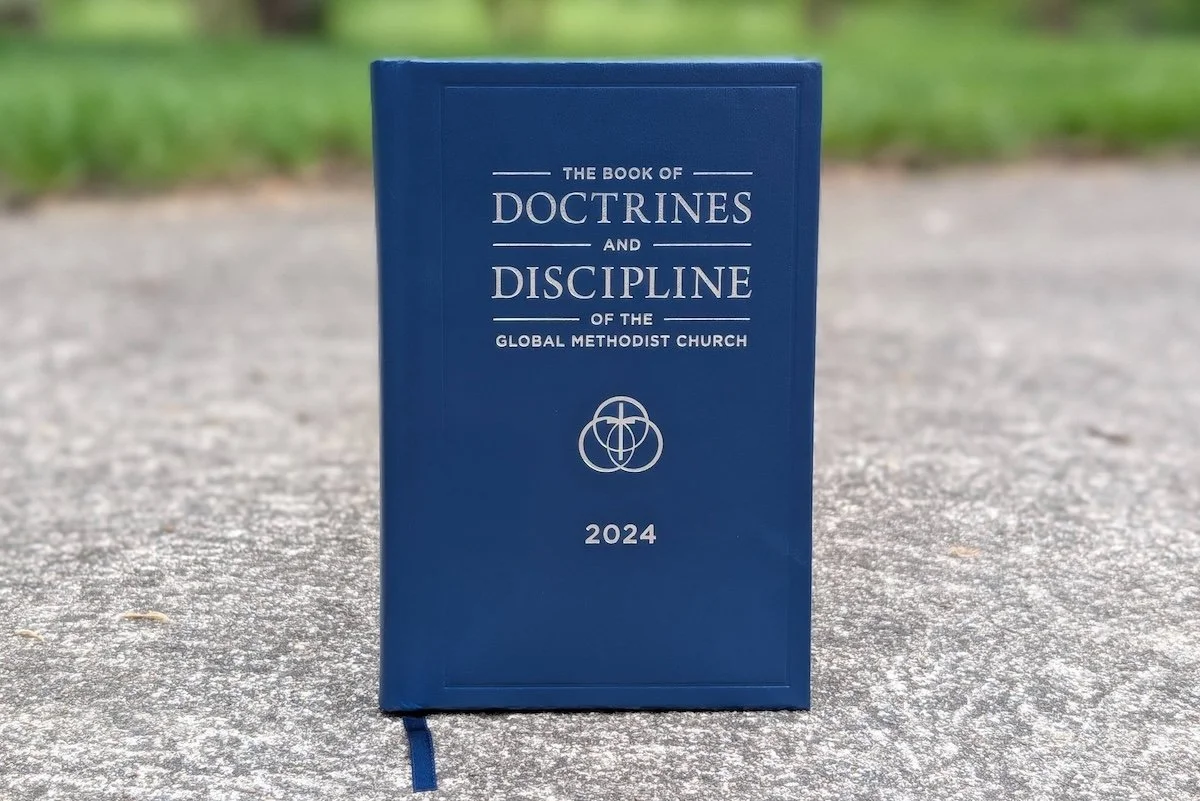
Photo by Matt Reynolds
The publication of the proposed Articles of Faith of the Global Methodist Church has engendered lively conversation. The decision of the 2024 General Conference of the GMC to call for the development of a new doctrinal standard replacing the Articles of Religion and Confession of Faith was no lark, but the continuation of long-unfinished business. As we consider the possibilities before us, some historical background may be helpful.
The Methodist Articles of Religion were John Wesley’s creation. On his own authority he abridged the Anglican Thirty-nine Articles, which had been developed over decades of debate and controversy, approved by the Convocation of 1563 under the direction of the Archbishop of Canterbury, finalized in 1571, and incorporated into the Book of Common Prayer. Wesley offered only twenty-four articles, a plucky move since he remained an elder of the Church of England for his entire life. His collection has been modified twice, once by the addition of Article XXIII (“Of the Rulers of the United States of America”), and once by the omission of the phrase “begotten from everlasting of the Father.” (See Jason Vickers’ article on the two documents here and his piece on the omitted phrase here.) If our overriding concern is originalism, it makes sense to consider a return to the Thirty-nine Articles.
The Evangelical United Brethren’s Confession of Faith was adopted in 1962. It was the core doctrinal statement of a denomination that resulted from a merger of two German pietistic denominations. Neither denomination was explicitly Wesleyan, but both were Wesleyan-compatible. While the EUB tradition was not altogether doctrinally robust, its Confession elaborates and clarifies some doctrines more thoroughly than the twenty-five Methodist articles.
When the United Methodist Church was formed in 1968, it was faced with a problem: each of its two parent denominations (the EUB and the Methodist Church) had its own statement of doctrine. Which statement should the UMC adopt? The Methodists were much larger than the EUBs. They could simply have voted through the Articles and discarded the Confession, but such was not in the spirit of the ecumenical fervor that characterized the era. They thus decided to form a new doctrinal statement. Albert Outler chaired the commission charged with the production of this new standard. For those interested in this history, I strongly recommend Ted Campbell’s article on the subject.
Outler’s commission did not fulfill its assignment. The reasons are not entirely clear. My unscientific hypothesis is that the leading lights of the UMC at this time were, by and large, mid-twentieth-century theological liberals. The reaffirmation and preservation of historic doctrines held no interest for them. In fact, I suspect many would have regarded such a project as retrograde among their mainline Protestant peers. Rather than carrying through with their mandate, then, they brought back a proposal based on Outler’s work, what we have come to call the “Wesleyan Quadrilateral." We use the term “quadrilateral” for this approach because it identifies four resources for theological reflection: Scripture, tradition, reason, and experience.
Their proposal, however, did much more than describe a process by which United Methodists were to utilize these four resources. It was a bold statement of theological pluralism. Thus we read in the 1972 Book of Discipline,
Since “our present existing and established standards of doctrine” cited in the first two Restrictive Rules of the Constitution of The United Methodist Church are not to be construed literally and juridically, then by what methods can our doctrinal reflection and construction be most fruitful and fulfilling? The answer comes in terms of our free inquiry within the boundaries defined by four main sources and guidelines for Christian theology: Scripture, tradition, experience, reason. These four are interdependent; none can be defined unambiguously. They allow for, indeed they positively encourage, variety in United Methodist theologizing. Jointly, they have provided a broad and stable context for reflection and formulation. Interpreted with appropriate flexibility and self-discipline, they may instruct us as we carry forward our never-ending tasks of theologizing in The United Methodist Church (¶ 70, p. 75, emphasis mine).
I’ve written a critique of this statement, which I won’t fully duplicate in this article. The key point is that, rather than facilitating the doctrinal specificity that would help to establish the identity of a new denomination, Outler’s commission and the 1972 UMC General Conference adopted an ethos of doctrinal ambiguity. Put more simply, they were supposed to produce a new doctrinal statement, but instead they created an escape hatch from any real doctrinal commitments. Some key phrases highlighted in bold above are telling:
The standards of doctrine “are not to be construed literally and juridically.”
Free inquiry has taken the place of literal or juridical affirmation of the standards.
None of the four resources can be defined clearly.
They encourage variety in United Methodist “theologizing.”
They could not discard the Articles and Confession because of the First Restrictive Rule, but they did find an ingenious way to make them irrelevant. The Articles and Confession were to be construed neither literally nor juridically. In other words, no one was required to believe them and no one would be held accountable to them. Therefore they could have had two, four, fourteen, or forty doctrinal standards. It didn’t matter. The standards had no force.
The Global Methodist Church was born as the unwanted and rebellious child of the UMC. Those of us who left the UMC were unwilling to participate in the inexorable march of progressivism. Yet from the outset, we have carried a family resemblance to our parent denomination. We still do so in ways we do not always see. The retention of both the Articles and Confession is one example. When the 2024 General Conference instructed the Commission on Discipleship, Doctrine, and Just Ministry to create a new doctrinal standard based on the Articles and Confession, the impulse to do so came from a desire to form a more theologically precise, concise, and coherent statement of Wesleyan belief than our predecessor denomination had produced. We were asked to do what Outler and his Theological Study Commission were unwilling or unable to do.
Our Commission has now fulfilled its mandate. We did so through a process inviting feedback from both a fifty-person review team and the GMC at large. We have taken this feedback seriously and made revisions where appropriate and necessary. (Because of these revisions, the publicly released draft of the Articles will be different in some ways from the draft that the Commission will submit as legislation.) The goal was to produce a consensus document. We made every effort to avoid idiosyncratic interpretations. We were guided by the Articles and Confession, and where we needed additional help, we generally turned to the Apostles’ Creed, the Nicene Creed, and the Definition of Chalcedon. I can, with good conscience, say we wrote every line with the people of our denomination in mind. Whether or not the General Conference accepts what we have written, we have done what we were asked to do, and we carried out our work with seriousness and in good faith.
The GMC inherited two doctrinal standards because the 1970 Theological Study Commission of the UMC could not fulfill its mandate. It created an alternative proposal, which the denomination adopted in 1972, and that decision has borne the bitter fruit of doctrinal indifference across five decades. I am grateful that we have not adopted in our Book of Doctrines and Disciplines the so-called Wesleyan Quadrilateral. The question before us now is whether we will take the additional step of affirming a single statement of Wesleyan, orthodox faith.
Having completed my work as co-chair of the writing team (along with Jason Vickers), my prayer is simply that God will guide us into all truth. Like so many others, I want God’s will to prevail at our General Conference. I believe it would be to our benefit to adopt this standard, but if God wills otherwise, then may his will be done. There is only one agenda that matters, and that’s God’s agenda. May we discern it well.
David F. Watson is President of Asbury Theological Seminary and a member of the Editorial Board Lead Team for Firebrand.