
Take Up the Towel: Leadership Formed by the Cross, Not Spectacle
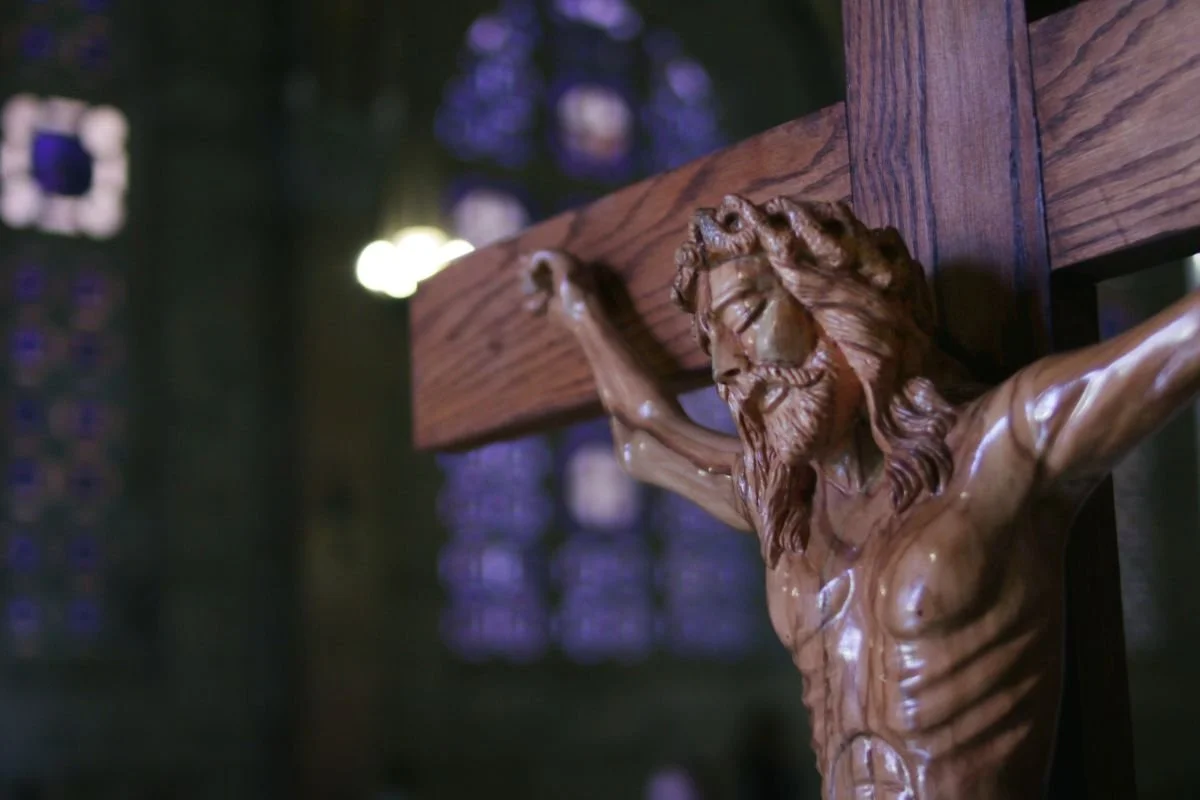
Photo by Michael M.
"And I, brethren, when I came to you, came not with excellency of speech or of wisdom, declaring unto you the testimony of God. For I determined not to know anything among you, save Jesus Christ, and him crucified. And I was with you in weakness, and in fear, and in much trembling. And my speech and my preaching was not with enticing words of man's wisdom, but in demonstration of the Spirit and of power: That your faith should not stand in the wisdom of men, but in the power of God." (1 Corinthians 2:1-5)
We have badly misread Paul. When he speaks of "demonstration of the Spirit and of power," we instinctively imagine spectacle: the dramatic, the impressive, the crowd-gathering display that validates ministry through visible results. But Paul has just told us the content of his demonstration: "Jesus Christ, and him crucified." The power Paul embodies is not the power of performance but the power of the cross. The demonstration is cruciformity, not spectacle.
This distinction matters enormously for how we understand Christian leadership. In a consumer Christian culture that measures success by attendance, influence, and platform, we have largely abandoned the pattern of leadership that Jesus himself embodied and that Paul made central to his apostolic identity. We have exchanged the servant's towel for the executive's chair, and in doing so, we have lost something essential to the Gospel itself.
The Cruciform Shape of Power
Paul's language in 1 Corinthians 2 is deliberately paradoxical. He came in "weakness, and in fear, and in much trembling," yet he also came in "demonstration of the Spirit and of power." These are not contradictions but clarifications. The power of the Spirit is revealed precisely through weakness, not despite it. Michael Gorman, in his important work on Pauline theology, has argued that Paul's entire apostolic existence was shaped by what he calls "cruciformity," the pattern of Christ's self-giving love enacted in daily life and ministry (Cruciformity: Paul's Narrative Spirituality of the Cross, 4-5, 75-94). For Paul, the cross is not merely an event in the past but a pattern for existence in the present.
This pattern finds its theological grounding in the great christological hymn of Philippians 2:5-8: "Let this mind be in you, which was also in Christ Jesus: Who, being in the form of God, thought it not robbery to be equal with God: But made himself of no reputation, and took upon him the form of a servant, and was made in the likeness of men: And being found in fashion as a man, he humbled himself, and became obedient unto death, even the death of the cross." The Greek verb translated "made himself of no reputation" is ekenōsen (ἐκένωσεν), from which we derive the theological term kenosis: self-emptying.
Kenosis Rightly Understood
The history of interpreting kenosis is marked by serious missteps. Some nineteenth-century theologians understood kenosis as a literal divestiture of divine attributes, as though the Son temporarily ceased to be fully God in order to become human. But this fundamentally misreads the text and creates more problems than it solves. Richard Bauckham has argued persuasively that the Philippians hymn does not describe a subtraction from divinity but a revelation of what divinity truly is. He argues that Christ's self-humiliation reveals rather than contradicts divine identity (God Crucified: Monotheism and Christology in the New Testament, 45-79). The self-emptying is not the abandonment of divine nature but its fullest expression. God is most God in the act of self-giving love.
Robert W. Jenson presses this insight further, arguing that the identity of the Triune God is constituted by precisely this pattern of self-giving. The Father gives all to the Son; the Son returns all to the Father in the Spirit. The economic mission of the incarnate Son reveals the eternal character of the Godhead (Systematic Theology, vol. 1, The Triune God, 63-65, 138-141). Kenosis is not a temporary departure from divine life but its very shape. As Jenson puts it, God's being is in becoming, and that becoming is always toward the other in love.
Maximus the Confessor, the seventh-century Byzantine theologian, offers perhaps the most profound reading of kenosis in the patristic tradition. For Maximus, the incarnation is not a problem to be explained but a mystery to be inhabited. The Word becomes flesh not by ceasing to be the Word but by extending the divine life into the very depths of created existence. The kenosis is thus an act of expansion, not contraction: God makes room within the divine life for all that is human, including suffering and death (Ambiguum 7, in On Difficulties in the Church Fathers: The Ambigua, ed. and trans. Nicholas Constas, 2 vols., 1:74-143). The humility of God is not weakness but the supreme expression of omnipotent love.
Michael Gorman synthesizes these insights under the rubric of "kenotic theosis": the self-emptying of God enables the filling of humanity with divine life (Inhabiting the Cruciform God: Kenosis, Justification, and Theosis in Paul's Narrative Soteriology, 9-39). The downward movement of the Son creates the possibility of the upward movement of redeemed humanity. Kenosis and glorification are not opposites but two moments of a single divine action. The cross is not a detour on the way to glory but the very form that glory takes in a world marked by sin.
The Servant's Towel
All of this finds concrete expression in John 13, where Jesus performs the act that interprets his entire ministry. Before the Passover feast, knowing that his hour had come to depart out of this world, "Jesus knowing that the Father had handed all things over to him, and that he had come forth from God, and was going back to God; got up from supper, and laid his outer garments aside; and he took a towel, and tied it around himself" (John 13:3-4). The sequence is theologically precise. Jesus acts from a place of complete security in his identity and destiny. He knows where he came from. He knows where he is going. He knows that all things have been given into his hands. And knowing all this, he takes up the servant's towel.
The removal of the outer garment and the donning of the towel is a prophetic enactment of the Philippians hymn. He who was in the form of God took the form of a servant. The seamless robe, which the soldiers will later refuse to divide, gives way to the linen cloth of the slave. And in this posture, Jesus washes the feet of all twelve disciples, including Judas, who will betray him before the night is over. The kenotic love of God excludes no one, not even the traitor.
In certain iconographic traditions, the cross itself is depicted with a servant's towel draped over its arms. This image captures something essential: the crucifixion is the foot-washing extended to its ultimate conclusion. The towel and the cross belong together. Both reveal a God who stoops, who serves, who refuses the postures of domination that the world calls power. "You call Me ‘Teacher’ and ‘Lord’; and you are correct, for so I am. So, if I, the Lord and the Teacher, washed your feet, you also ought to wash one another’s feet. (John 13:13-14).
Identity, Destiny, and Humility
Here is the heart of kenotic leadership: Jesus was able to stoop because he knew who he was. His security did not rest in the recognition of others, in the size of his following, or in the impressiveness of his platform. He came from God and was going to God. This identity, rooted in the eternal love of the Father, freed him to take the lowest place without any loss of dignity. Indeed, the lowest place became the revelation of the highest reality. God is the most humble person in the universe.
This reframes everything we think we know about greatness. Because Jesus knows who he is, nothing is beneath him in terms of task. The washing of feet, the touching of lepers, the eating with sinners: none of these diminish his glory. On the contrary, every task he takes on is elevated to that which is most holy and sacred. The servant's work becomes the work of God. The menial becomes the sacramental. The last place becomes the first.
Christian leadership today desperately needs to recover this pattern. We have built a culture of celebrity pastors, entrepreneurial church planters, and ministry moguls whose success is measured by metrics borrowed from the marketplace. We have created systems that reward self-promotion and penalize hiddenness. We have confused platform with calling, influence with faithfulness, and numerical growth with spiritual fruitfulness. In short, we have chosen spectacle over cruciformity.
The recovery of kenotic leadership will require more than a change in strategy. It will require a conversion of imagination, a willingness to see power differently, to measure success differently, to define greatness by the standard of the towel rather than the throne. It will require leaders who know where they come from and where they are going, whose identity is so secured in the Father's love that they have nothing to prove, nothing to protect, and nothing to lose. Only such leaders are free to serve.
The demonstration of the Spirit and power that Paul embodied was not a display designed to impress but a life poured out in self-giving love. The power was real, but it was the power of the cross: the power to forgive enemies, to bless persecutors, to serve the ungrateful, to love without return. This is the power that changes the world, not because it dominates but because it draws all things to itself through the irresistible magnetism of cruciform love.
Let this mind be in you, which was also in Christ Jesus. Take up the towel. Wash feet. And discover that in losing your life, you find it; in emptying yourself, you are filled; in descending to the lowest place, you participate in the very life of God.
Mark Chironna is the Presiding Bishop of Engage, a network of bishops and pastors, and the founding pastor and Overseer of Church On The Living Edge in Longwood, Florida. He serves on the editorial board for Firebrand.