
The Character Test of a New Denomination: Pursuing Holiness at the 2026 Global Methodist General Conference
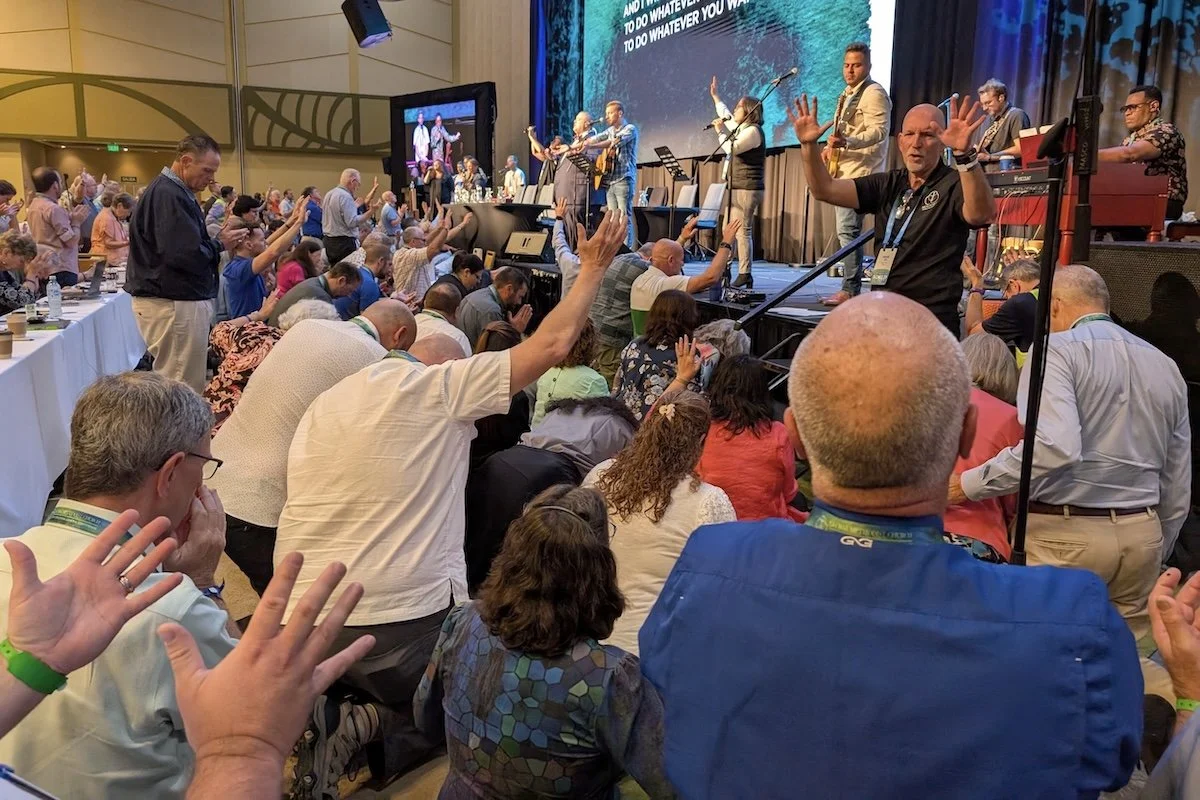
A time of prayer at the Global Methodist Convening General Conference in Costa Rica, 2024. Photo by Matt Reynolds.
Methodists talk a lot about holiness (or at least we should). Holiness is central to our calling and how we understand the very reason for our existence. As we talk about holiness, though, we must remember that it’s not purely conceptual. Holiness doesn’t happen in a vacuum. For human beings, holiness is forged through trial and temptation because it reveals the character of God in the midst of a sin-torn world.
Lately, I have been praying for the coming general conference of the Global Methodist church in Johannesburg, South Africa, and I cannot shake this conviction: The great test for a denomination that names scriptural holiness as its mission is whether or not it will embody that which it’s attempting to share with the world. You can't give what you don't have yourself.
Attending the convening general conference in Costa Rica was a powerful experience. I have heard countless friends and colleagues recount their sense of the Spirit’s presence during that gathering. God seemed near. It was a tangible answer to many prayers. Leading up to that historic meeting I wrote in Firebrand of my sense that the start of this denomination had to begin with consecration. And indeed, Costa Rica felt like an extended consecration service more than a business meeting. I attended to help lead evangelism training and outreach for the GMC. (And I still praise God for a denomination that wants to do evangelism at a legislative gathering!) On the days I was not leading prayer teams on the streets, I attended and worshiped alongside the delegates and observers. There was a palpable sense of God setting us apart for this new season of ministry.
One of the most consequential moments of the conference came near the end of our business when a proposal was made to change our mission statement. In a miraculous moment of unity, the Spirit brought conviction that we were to become a church that “exists to make disciples of Jesus Christ and spread scriptural holiness across the globe.” Reclaiming the historic Wesleyan language of scriptural holiness felt like a watershed moment. It was as if the Spirit confirmed in an instant that this is who he has called us to be.
Now the GMC finds itself a couple of years removed from that inaugural gathering and only a couple of weeks away from our second general conference. As I prepare to leave for Johannesburg, my sense is that the denominational questions and concerns at the center of this conference are different. This time around we meet in the process of ongoing theological debate around how we articulate our core convictions as stated in the Articles of Faith. We will be sorting through hundreds of pieces of submitted legislation that are aimed at various new policies or fixing things that have arisen in these early formational years. We are no longer electing transitional bishops to help get us started, but rather employing a brand new (and complicated) process to elect bishops who will serve a minimum of six years, and will be central custodians in shaping the DNA of this denomination for years to come. Costa Rica felt a bit like a launch party and a revival. South Africa feels a little more like work. We are getting down to the nitty-gritty of forming a connection that has more than 7,000 churches spanning most of the globe.
While I still have great confidence that much of our gathering will contain Spirit-filled worship, passionate prayer, and the ethos of an old-fashioned Methodist (indoor) camp meeting, the fact is that we have much work to do. The other delegates I talk with understand the gravity of the structural, doctrinal, and episcopal decisions that will be made. The looming question, however, is not just about how these decisions will turn out. Just as important will be the way we go about this work. This general conference is an opportunity for us to learn in greater measure how to be holy as a gathered people.
Those of us who have institutional memories from our previous Methodist connection may be experiencing familiar feelings of anxiety around how we will respond when sensitive issues come up for discussion. I am sure that I am not the only Global Methodist who has underlying concerns about the possibility of politicking and posturing around episcopal elections. Those who are following conversations related to our doctrinal statements have witnessed some spirited debates, some right here in Firebrand. While we may wishfully dream of a time to come together, sing Kum-ba-yah, and leave without any contested votes, the reality is that many smart, passionate people, from different cultures, will all be in one room holding many different opinions on what is best for our fledgling denomination.
That’s ok. It’s normal for the church to have conflict as it sorts through complex issues. We don’t have to go many chapters into the book of Acts to see that even the early church had to navigate difficult and contested decisions. Ultimately, we must remember that the church belongs to God, so there is no need for anxiety! The church of Jesus Christ will be just fine regardless of any particular vote at the GMC General Conference. If God wasn’t upholding and preserving the church universal by his hand, we certainly wouldn’t have made it out of the first century!
So, I am not concerned about any one particular vote or issue. My primary conviction, in the midst of this time when hard decisions will inevitably be made, is that if we will let him, this is precisely the time and situation God is going to use to shape us in holiness. It’s in the hard moments and the difficult decisions where we are formed more into the likeness of Jesus. It’s also in those moments when we are most tempted by our sinful and selfish proclivities. Johannesburg is an opportunity to decide, not just how our church will be structured, but what kind of character will define us as we make hard decisions. The more I’ve reflected on our convening conference and where we now arrive, it strikes me that it should come as no surprise that our next general conference will test our culture. Those who officially acknowledge that spreading holiness is central to their mission will certainly wrestle with allowing that aim to form their own gatherings and structures.
In a setting like a general conference there will always be a temptation to default to our cultural formation. We often underestimate how much the world has shaped us. The truth is that we live in a world whose primary lens is political. Politics is the religion of our age. Our temptation will always be to respond to church situations with political strategy and scheming. For many of us it is simply how we have been formed both outside and, unfortunately, inside the church.
The church is not called to operate in the same ways as worldly politics. We don’t make decisions based on what we can control but rather, what we must surrender. We don’t posture for the sake of self-interest. Cross-shaped living is about self-sacrifice. And this is our ultimate calling because holiness and love are the very character of God. God is both radically self-sacrificing in his love and utterly separate from the power-seeking strategies of the world. We must remember that holiness is not focused on pragmatic concerns. In fact, most of the time, holiness is the least efficient path to our goals. It’s as if Jesus doesn’t think efficiency is a fruit of the Spirit.
This truth is evidenced most profoundly in the cross. Think, for example, of Matthew 16. Peter has just declared Jesus as Messiah, the Son of the Living God. And yet when confronted with Jesus’ prediction of his coming death, Peter instantly protests.
“Never, Lord!” he said. “This shall never happen to you!” Jesus turned and said to Peter, “Get behind me, Satan! You are a stumbling block to me; you do not have in mind the concerns of God, but merely human concerns.” (Matthew 16:22-23, NIV)
The disciples wanted a political solution and a conquering king. They had no time for a suffering and crucified savior. That was not efficient. That did not seem to be an immediate solution to their problems. Jesus identified their concerns as merely human, not the mind of God.
How often do we do something similar, prioritizing human concerns over those of God’s? How often do we long for quick fixes from God or answers that make us immediately more comfortable? When we do this we bypass our primary call to holiness.
Our political programming most often operates with a win-at-all-cost mentality and almost always views the ends as justifying any means. If we can rationalize a particular end goal, then why not employ any means necessary to get there? But Christians can never be an ends-justify-the-means type of people. Paul says, “So whether you eat or drink or whatever you do, do it all for the glory of God.” Every single thought and action of a Christian is an opportunity for worship.
If whole-life worship is the primary goal, we must remember that it is entirely possible to end up with the shape and structure of the church we personally hoped for and, in the process, forfeit becoming the church God has called us to be. We will not be a denomination that “spreads scriptural holiness across the globe” until we have learned to walk in holiness in our shared life together. Holiness was not an abstract, disembodied concept transported to the world. Jesus’ message of holiness had power because the messenger and message were perfectly in sync. The same must be true for us as well.
At the denominational level, the question is not simply, “What is best for me, my church, and my annual conference?” The question is, “What is best for the kingdom? What is best for my brothers and sisters around the globe? And is this what a holy church looks like?” As we make decisions and vote on legislation, we must aim at being faithful, not politically expedient.
How is holiness revealed in our conferencing? Holiness is not revealed by the perfection of our decisions. Our decisions and legislation will never be perfect. Our holiness is revealed in the decision-making process and how we love one another along the way. How we make decisions is an even greater test than the final result. How we treat one another, debate, engage in prayer, operate with integrity, and speak honestly even when it’s hard—all of our actions are sanctifying opportunities to embody holy love.
As we prepare to descend on South Africa, we must remember that with God, crossing over into new territory is never the end. God’s people are always called and then sanctified. We see this play out on basically every page of the Bible. On the other side of the Red Sea is a barren land of formation and trial. On the other side of the Jordan are temptations and battles. On the other side of Jesus’ baptism, which confirmed his identity and calling, came the intense wilderness struggle with Satanic temptation. When it comes to the call of God, a new step of faithfulness is never the end, but only the beginning.
I am praying that we embrace this general conference as a chance to be who God has called us to be in every conversation, speech, and vote. I’m praying that we would reject every temptation to default into political creatures who manipulate or scheme. In it all, may we die to ourselves and let holiness take root. Certainly, the specific outcomes of this general conference will have significant consequences, but even more this gathering will reveal the character of our young denomination. I, for one, am longing to be a part of a church that has a culture and character that matches its mission. May God examine our hearts and truly make us holy.
Matt Reynolds is the founder and president of Spirit & Truth, a church-equipping, resourcing, and missions ministry based out of Dayton, Ohio. Firebrand is a ministry of Spirit & Truth.