
The Five Prayers of the Asbury Outpouring
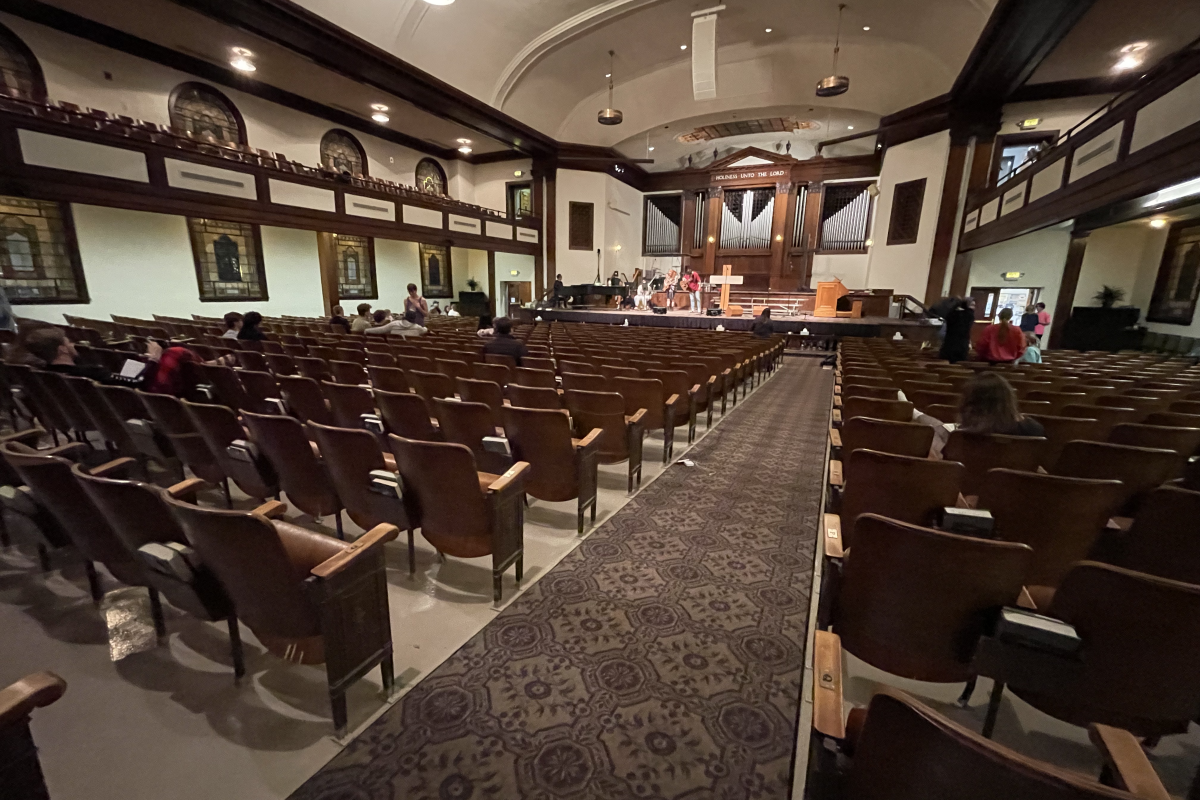
Hughes Auditorium, Wilmore, KY. (Source: WikiCommons)
It was 5:30 in the evening and the last light of day hung low in the western sky. I stood on the seminary side of the road and looked across toward Hughes Auditorium. I had arrived at the seminary to work on my dissertation but early some friends sent me text messages that the Lord was moving and the Asbury University chapel had continued since it started at 10am that morning. I saw lights on at the auditorium and watched as a few people ran up the stairs and into the building. I thought to myself, I'm going to go see what's going on in Hughes.
I walked across the green of the university and entered the large building. It was hushed, dimly lit, and filled with a sense of God’s presence. When I looked around the auditorium, about 75 people were present. There were groups worshiping near the stage, praying at the altar, and sharing testimonies of how God moved in their lives. I found my way to a seat near the front, soaking in the nearness of the Spirit and attentive to the activity in Hughes Auditorium.
Earlier that evening, I had dropped my daughter off to study at Kinlaw Library, located next door to the auditorium. Soon after arriving inside, I texted her, with a brief explanation: I'm sitting here in Hughes. Do you want to join me? She responded immediately: I'll be right over, Dad, and before I knew it, she was seated next to me.
We sat side by side, joining the worship and listening to testimonies, sensing the palpable presence of the Holy Spirit. After a short time, my daughter gently laid her head on my shoulder. A few minutes later, she lifted it up, looked at me, and said, "Dad, I could feel waves of the Holy Spirit coming into the library where I was seated." That was the beginning of 16 days that marked my life and the lives of many others.
Prayer helped to prompt and sustain what happened at Asbury and I want to share my perspective on how I saw God move during those days. My perspective is informed by dozens of interviews that I have conducted since that event and my role training nearly 1000 people for altar ministry during the Outpouring.
We will look at five ways that prayer took place in connection to the Outpouring: preceding prayer (prayer that led up to and happened before the Outpouring); intercession (a response in prayer to anything that required attention); altar ministry (prayer for those who came forward); the consecration room (prayer for the worship team that ministered on stage); and congregational prayer (prayer led or directed from the stage).
Preceding Prayer
Many people that I interviewed shared the insight that prayer led up to and prepared the way for the Asbury Outpouring. Students, alumni, faculty, staff, and townspeople all participated in preceding prayer. Some of the prayers were organized and consistent, while others were occasional and intermittent, but all asked God for something similar. In 2020, people commemorated the 50-year anniversary of the Asbury revival that occurred in 1970. These people who prayed had heard of that Revival and asked God to visit the campus again. Some people had been praying for years, even decades, for the Spirit to be poured out on Asbury in the same way as the 1970 Revival.
There was expectancy in those prayers. People knew of God’s move, believed that He could move again in a similar way, and their prayers reflected a belief that God would appear at Asbury again. This type of preceding prayer echoes the testimony of Scripture: Anna living in the temple praying for the salvation of Israel; Jesus teaching the disciples to pray steadfastly with the story of the persistent widow; the people of Israel crying out for deliverance from Egypt. Preceding prayer reminds God of His promises and persists in asking Him to do in our day what he has promised and done in other times. God hears and honors that type of prayer and this is one way the Lord used prayer to prepare hearts for the Asbury Outpouring.
Intercession
The second type of prayer was intercession. Almost immediately the university formed an intercession team that included alumni, supporters, friends of the university, and others connected to the university. This group began to intercede, joining via Zoom or in person in a room located underneath Hughes Auditorium. They prayed for God's protection and lifted up every situation that appeared. Many different needs arose during the Outpouring and these requests were shared in a group text, communicated to the intercession group, and lifted up in prayer.
This intercession took on a depth that went beyond formulated prayers and structured requests. The intercessors understood their spiritual responsibility, that the spirit realm is more real than the physical realm. What had begun on February 8th during chapel was ultimately a spiritual activity and even though it spread by word of mouth and social media, it would be sustained through prayer. The intercessory prayer team asked the Lord to birth something new, and to continue pouring out His Spirit.
Teams of people prayed during the entirety of the outpouring. They interceded without ceasing. Their prayers encompassed all spiritual, emotional, physical, or relational needs that arose. Four predominant themes emerged that required persistent intercession: anxiety, depression, suicidal ideation, and addiction. The intercessors lifted these burdens to God, asking for His favor on the students and all who attended as well as God's protection over each and every person. They understood that God’s presence among the students could not be manufactured. By grace, the intercessory team sought to support God’s movement through humble prayer.
The intercessory team sensed that what was happening at Asbury belonged to the broader church. People arrived from many locations, feeling they were coming to receive answers to prayers. The intercessors embraced this, with the understanding that what was happening in Wilmore was to be shared everywhere. Consistent intercession played a key role from the first to the last hours of the outpouring, providing a spiritual foundation upon which God moved in power.
Altar Ministry
As soon as the outpouring began, altar ministry started concurrently. In the first few days prayer at the altar was spontaneous and organic. Those in attendance with experience in pastoral or prayer ministry served at the altar, ministering in prayer to all who came forward. As attendance at the outpouring began to swell, leadership sensed a need for organization in the approach to altar ministry in order to reflect and honor what God had started. It was important for the altar ministry to align with how God was at work in Hughes Auditorium.
As the crowds increased, I was soon asked to train and oversee those who would provide prayer ministry at the altar. I taught a class twice a day that summarized parts of my teaching into fifty minutes. People were equipped for the specific need of the hour. Eventually, nearly 1000 people received training.
The altar ministry communicated the gentleness, kindness, and compassion of Christ while embracing the power of the Holy Spirit. Equipped altar ministers expanded the territory of prayer to include people outside of Hughes, as well as those waiting in line. They ministered healing to thousands of people in their bodies, minds, emotions, relationships, and spirits. Personal friends who experienced revivals from Toronto to Brownsville, as well as other environments pregnant with the presence of the Holy Spirit, later told me it was the healthiest prayer ministry environment they had ever experienced.
Salvation, deliverance, and healing took place during the outpouring. The Spirit’s power was never treated as an end unto itself. People were guided towards a discipleship journey to help them grow in the fruit of the Spirit. The gentle, reverent, and worshipful atmosphere that characterized the outpouring at Asbury University may seem different than what the church may expect when we think of the power of the Holy Spirit. Another way to think about it is that His power was not tempered by gentleness and kindness, rather His power was amplified in ways that were meaningful to this generation.
The Consecration Room
A fourth way prayer occurred was through the consecration room. Students on the worship team, and those ministering with them, birthed this aspect of prayer ministry. University leadership prioritized students throughout the duration of the outpouring. As the outpouring continued, there were moments of divine appointment when God seemed to indicate people who should help lead worship. There was also a genuine and practical need for a continual flow of people to help with the worship. On the fourth day of continuous prayer and worship someone offered to help lead telling those responsible for worship that they led worship in their local church. However, once on the platform, it became clear that this person was not in alignment with how the Spirit seemed to be moving in that moment. The question became: How can we steward what God is doing and ensure that the people on the stage are discerning the spiritual environment with humility and care?
One student proposed the idea of a consecration room as a place to receive prayer before leading worship or speaking from the platform. It served as a way for worship leaders to receive prayer, listen to the Lord, embrace humility, and receive as much as they gave. It was also a space for personal confession and healing prayer. The consecration room allowed people space to examine personal motives before leading. This served as a refining moment to purify hearts and keep those who led worship attuned with the Spirit’s work.
Collective Prayer
There was also collective prayer directed from the stage. Other times leaders gave prompts for people to break into small groups and pray for each other. These times of prayer were often directed toward confession, sharing of burdens, and asking God to pour out more of His Spirit. Those in attendance participated by praying corporately in unison, and other times everyone prayed individual prayers out loud at the same time. The desire was to encourage and provide space for every person to participate. Prayer invitations also included times of crying out to God for personal issues, for families, communities, and churches, as well as for the unsaved. The united voice of God’s people invited more of the Spirit and created space allowing for His continued manifest presence. There were also many opportunities to corporately pray for issues that Gen-Z seems to be facing, such as depression, anxiety, self-harm, loneliness, and addictions. People were encouraged to cry out for freedom and healing from whatever issue troubled them.
One friend shared a testimony of reconciliation that happened during a moment of corporate prayer. The prompt from the platform was to pray for "whatever concern the Lord put on your heart." My friend felt led to pray for reconciliation with one of his adult children. They rarely spoke because of a strained relationship. Seated in the upper reaches of the balcony my friend began to pray when he felt someone put a hand on his shoulder. When he turned around he saw his child for whom he had been praying at that exact moment. They embraced and began a heartfelt conversation that the Lord used to begin healing in their relationship. This is only one story among hundreds of how God worked through prayer.
Summary
The witness of preceding prayer, intercession, altar ministry, consecration, and collective prayers all played a role in feeding the fires of the Outpouring during those days. The intensity of God’s presence did not diminish; if anything, it seemed to increase and was evident to almost everyone who came to Hughes Auditorium during those 16 days.
It is always good and right to seek God with our whole hearts and on this third anniversary of the Asbury Outpouring, my prayer is that we are encouraged to pursue God more deeply. The Spirit was invited and expected during the outpouring through each type of prayer. I echo a prayer from a friend: Lord, do a new thing in our midst, revive us by Your love.
Bud Simon is an author, speaker, and educator. He mentors doctoral students at Global Awakening Theological Seminary.