
A Tradition That Thrives: The Enduring Importance of Holiness Camp Meetings
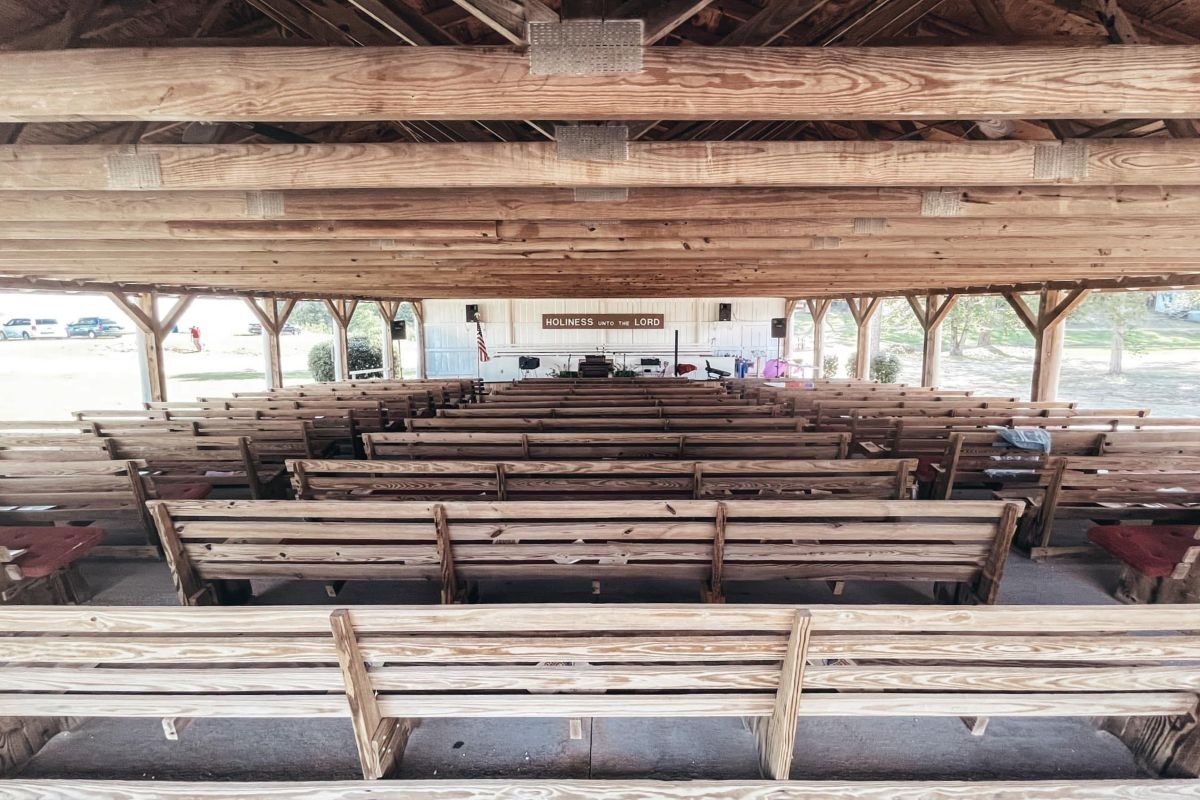
Photo from Beulah Camp Meeting in Excel, AL (provided by article author, Anna Adams).
The United States of America turns 250 this year. In the centuries since its founding, many movements and traditions have come and gone. Yet one enduring practice within American Christianity continues to shape the life of the church: the camp meeting. The lasting presence of these gatherings testifies to their significance and their ongoing role in the spiritual life of the Wesleyan movement.
Camp meetings trace their roots to the early Methodist practice of preaching in open fields, often because buildings could not accommodate the crowds who came to hear the gospel. This willingness to step outside traditional spaces allowed the message of salvation and holiness to reach ordinary people who might otherwise never enter a church.
John Wesley himself wrestled with this approach before eventually embracing it. In March of 1739, he recorded in his journal his hesitation about preaching outside a church building and the moment he realized the necessity of doing so.
“I could scarce reconcile myself at first to this strange way of preaching in the fields… having been all my life (till very lately) so tenacious of every point relating to decency and order that I should have thought the saving of souls almost a sin if it had not been done in a church” (John Wesley, Journal, March 31, 1739).
That moment marked an important shift in the Methodist movement. By stepping beyond the walls of the church, Wesley and the early Methodists demonstrated a willingness to meet people where they were. The practice of preaching in open spaces eventually helped give rise to the camp meeting tradition that would spread across America in the generations that followed.
It can be difficult to imagine in today’s world taking eight to ten days off work, packing up your household, and traveling as a family to what often feels like the middle of nowhere. In a culture shaped by constant digital connection and relentless pace, the very idea seems almost foreign. Yet as summer approaches, this is exactly what will begin happening across the United States.
For those who have had the privilege of growing up attending camp meetings, there is a shared testimony: something about these gatherings feels different. Many describe it as if the veil between earth and heaven becomes thinner on these small plots of holy ground. With little or no cell service, no televisions, and limited connection to the outside world, the distractions of everyday life fade into the background. In their place comes something increasingly rare in modern life: space to encounter God.
Time slows. Worship lingers. Testimonies stretch long into the evening. And again and again, people testify that God meets them there in ways they had not experienced before.
One thing I have often found difficult to explain to people is what a camp meeting truly is. To those unfamiliar with the concept, it can sound almost silly when I say my family is going to camp. They immediately imagine rappelling, cabins, and perhaps a scene out of The Parent Trap. In reality, a camp meeting is something quite different.
Camp meeting truly feels like a cross between a revival and a gathering of generations. Throughout the day, services take place in an open-air tabernacle, a simple structure that functions much like a church sanctuary. The congregation sings hymns, listens to sermons, and gathers at the altar in prayer. People stand and testify to what God has done in their lives. Moments of repentance, restoration, and renewal unfold in ways that many churches rarely experience today. Fellowship spills onto cabin porches, gathers around home-cooked meals, and stretches late into the night as the world grows quiet. Somewhere in the middle of it all, a camp meeting begins to feel like a family reunion as generations return year after year around a shared pursuit of holiness.
Throughout Scripture, God’s people regularly set aside sacred times and places to gather before Him. In the Old Testament, Israel observed appointed feasts and assemblies where the community came together for worship, repentance, and renewal. These gatherings often took place around the tabernacle, the central place of worship for the people of God. It is perhaps no coincidence that many holiness camp meetings still worship in structures called tabernacles. Above the platform of many of these open-air sanctuaries hangs a simple phrase drawn from Scripture: “Holiness Unto the Lord.” The words serve as both a declaration and a reminder. Camp meeting has never merely been about religious tradition or nostalgia. At its heart lies a deeper pursuit: the call to live lives wholly devoted to God.
Today, camp meetings still serve as places where the message of scriptural holiness and entire sanctification is preached with clarity and conviction. For many people, especially teenagers, these gatherings may be the first or only place where they hear this language. In a world where young people and adults alike face a constant flood of information but often lack a clear sense of truth, the steady witness of camp meeting preaching offers something remarkably grounding.
Camp meetings have also long served as places where young men and women sense God’s call on their lives. For many, these gatherings become the setting where the Lord quietly stirs their hearts toward missions, pastoral ministry, or a lifetime of faithful service in the church. Away from the noise and distractions of everyday life, young people often find space to listen more closely for God’s voice. Time and again, individuals trace their calling back to a moment of prayer at an altar, a sermon preached in a tabernacle, or a conversation late in the evening with a mentor or friend.
For many people, the impact of camp meetings is not merely theoretical but deeply personal. I experienced this firsthand growing up attending Beulah Camp Meeting in Alabama and spending weekends each summer at Indian Springs Holiness Camp Meeting in Georgia. These gatherings shaped my understanding of faith long before I could fully articulate it. Sitting in an open-air tabernacle, singing hymns alongside generations of believers, and hearing sermons that called people to lives of holiness formed my spiritual imagination in ways that continue to influence my faith today. Experiences like these remind us that camp meetings do more than preserve tradition. They help form believers who carry the message of holiness into the next generation.
As the United States marks 250 years of history, the quiet endurance of holiness camp meetings offers a remarkable reminder that some traditions continue to shape the spiritual life of the nation in profound ways. Long before modern conferences, podcasts, and digital platforms, believers gathered in simple tabernacles to seek the Lord together. They came to hear preaching that called them not only to salvation but to lives wholly devoted to Christ.
That same message still rings out each summer in camp meetings across the country. The call to scriptural holiness continues to challenge believers to deeper obedience, reminding the church that the gospel transforms not only what we believe but how we live. In these gatherings, young people still kneel at altars, families still worship together, and men and women still sense the quiet stirring of God’s call toward ministry, missions, and faithful service.
At a time when many churches wrestle with questions about identity and direction, the enduring witness of camp meetings points to something both ancient and necessary. The Wesleyan movement has always been marked by a deep commitment to holiness of heart and life, and camp meetings remain one of the places where that vision continues to take root in new generations.
In recent years, many have begun to speak of a renewed interest in Wesleyan theology and the call to holiness.
For those who have never experienced one, the invitation remains open. Step into an open-air tabernacle. Join in the singing of hymns that have carried the faith for generations. Listen as the message of holiness is preached with clarity and conviction. You may find that these gatherings, which began centuries ago, still offer exactly what the church needs today: space to seek God, to renew faith, and to prepare the next generation to carry the message of holiness forward.
Anna Adams is an Alabama native and ordained minister in the Association of Independent Methodists. She writes and speaks on discipleship, holiness, and the Wesleyan tradition and has spent much of her life participating in holiness camp meetings across the Southeast.