
The Questions of Easter that Prepare Us for Pentecost
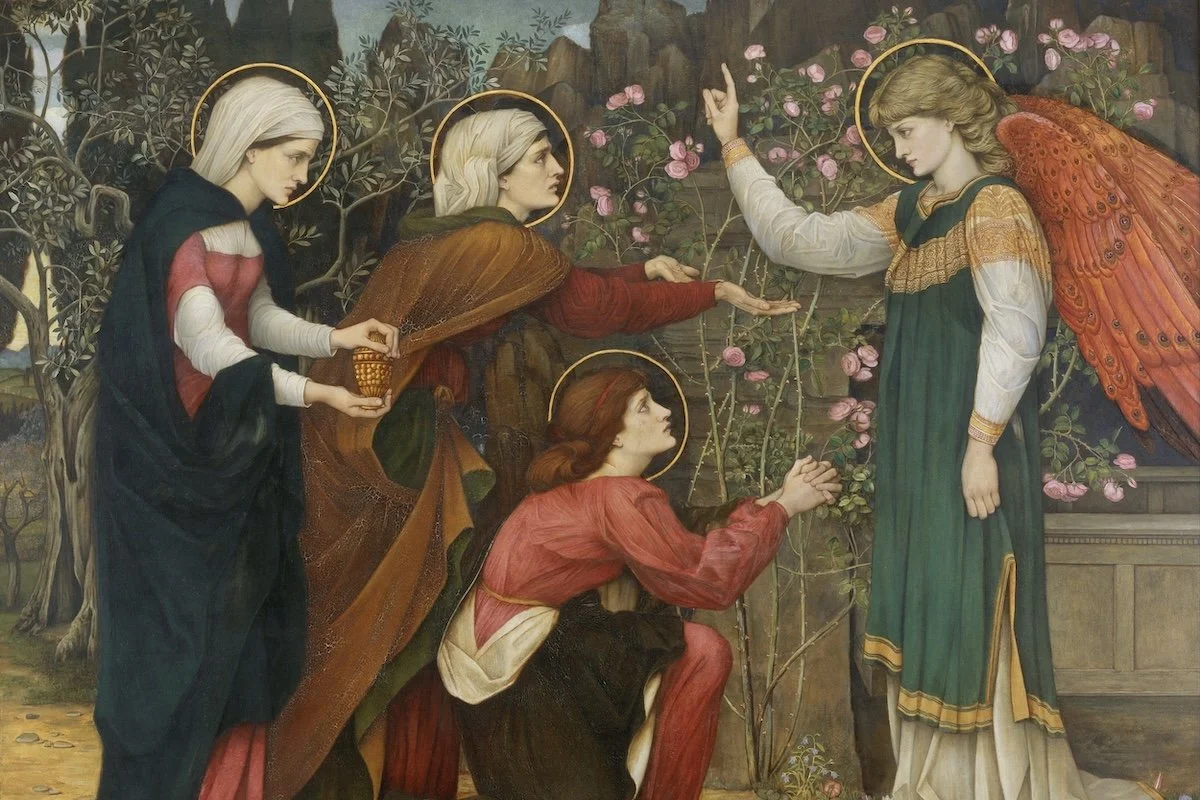
“Why seek ye the living among the dead?” by John Stanhope, circa 1870. (Source: WikiCommons)
The week after Easter Sunday, I was in a board meeting for the Biblical Seminary of Colombia, and the rector’s devotional on the “Easter questions” in John 20:15 was powerful and timely. (You can read it here.) As I continued to reflect on his words, it struck me just how much of the resurrection (and ascension) narratives are shaped by key questions, particularly in Luke-Acts and the Gospel of John. Everyone in these stories is asking questions—the women of each other, the Emmaus road pair of Jesus and each other, angels of the women on Resurrection Day and of the whole company of disciples on Ascension Day, Jesus of individual disciples like Mary and Peter, as well as of gathered groups of his followers. As we continue to journey through the 50 days of Easter, these questions may be the very instrument the Holy Spirit uses in the life of the church to illuminate our challenges, call us to repentance, fill our hearts with hope, and prepare us for Pentecost.
The Easter questions begin in the pre-dawn darkness, as the faithful women creep toward the tomb. They ask each other: “Who will roll away the stone for us from the entrance to the tomb?” (Mark 16:3, NRSV). There are at least two elements underlying their interrogative, elements to which the church must continue to be attentive in its Easter reflections. First, their question is purely pragmatic—who is the key player or what is the mechanism that will give them access to the tomb? Solutions, fixes, expediency, efficiency—these are the concerns of pragmatism, with its focus on what “works.” Pragmatism has its place—but not as the go-to modus operandi for Easter people! What if the question for the church is not, “who will fix this for us” (whether “this” is declining membership or increasing cultural pressure), but rather, “What unexpected and breath-taking thing might God have for us to discover in this season?”
Woven into the women’s pragmatic approach is a second element: an understanding of reality that allows them only one interpretation of how things work. Jesus died, his body was placed in that tomb; therefore, his body must surely still be there. For God to act outside the box of their worldview and radically reshape possibility—this is not something that is on their radar as they make their way to the tomb, despite the many ways that Jesus had prepared them for this very thing (cf. Mark 8:31; 9:31; 10:33–34). And while we sympathize with the women, because they ask their question before they see any evidence to the contrary, the insidious pull of a contrary worldview can also be seen in post-resurrection encounters, most notably the conversation between Jesus and two disciples on the road to Emmaus (Luke 24:13–35). Even though Cleopas and his fellow traveler (probably his wife Mary, cf. John 19:25) also know Jesus’ words about his suffering, death, and resurrection, and even though they have received the witness of the Easter women (Luke 24:22–23), they have not allowed either word or witness to reshape their understanding of reality. They remain locked in grief and disappointment (v. 21). They continue to interrogate the past, rather than exclaiming over the divine disruption of the present. This presses us to ask, what if the appropriate punctuation for the church’s life in this season is not a question mark, but an exclamation mark? Asking who will move the stone sets the emphasis on the difficulty of the task, analyzing it from a purely human perspective and contemplating it through the lens of what “common sense” says is possible. Exclaiming that the stone has been moved, the tomb is empty, and Jesus lives and reigns—that embraces “impossibility” as the new normal and fixes our attention squarely on the One who makes all things new.
The twice-repeated question to Mary (by the angels, by Jesus) may be the Spirit’s unsettling challenge to the church in this Eastertide. “Why are you weeping?” (John 20:13, 15). Mary’s weeping is loss-focused—disappointment with the past coupled with a distorted understanding of the present and a lack of hope for the future. The Easter question redirects her (and us), shaking the paralyzing pragmatism and the inadequate worldview that hold so many of us in their grip. As he did for Mary, Jesus speaks our names (and speaks to his Beloved, the Church), calling us to redirect our gaze to himself, to contemplate the radical redefinition of reality and possibility that the resurrection has accomplished.
The Easter questions in the Gospels and Acts also push Jesus’ followers—then and now—to (re)define our focus and our loyalty. In Luke’s overlapping accounts of the resurrection (Luke 24, Acts 1), we hear angels addressing the disciples with two focus questions: “Why do you look for the living among the dead?” (Luke 24:5) and “Why do you stand looking up toward heaven?” (Acts 1:11). Both interrogatives seem to have deep urgency for the character and mission of the church in our day. The Spirit calls us, as he called the first disciples, to examine honestly where, why, and how we are seeking life among dead things, to identify—with repentance and confession—where we have placed our hope and confidence in sources that are incapable of producing life. Where have we, like the people in Jeremiah’s day, exchanged the fountain of Living Water for dry, cracked cisterns (Jer. 2:13)? The angels’ question on Ascension Day, “why do you stand looking up toward heaven,” highlights another aspect of their Resurrection Day question—when we seek life among dead things, there is also the tendency to relegate Jesus to an “up there” status and location. Heaven is something remote and future, we think (even if we don’t say it out loud), and Jesus is too far away to make much difference in our current situation. Pentecost gave a resounding divine correction to that mistaken posture and perspective! The risen, living, and reigning Jesus is ever-present with his church through the indwelling, abiding, empowering presence of the Holy Spirit. Church of Jesus, let us not look for life among dead things! Easter people who are also Pentecost people, may we look for—and respond to—the presence of Jesus right here and right now!
Perhaps the most pressing question of all is the matter of loyalty, embedded in Jesus’ triple interrogation of Peter: “Do you love me?” (John 21:15–17). This is the real question that confronts the church—do we love Jesus, with passionate, persevering, undivided loyalty? Is he the singular object of our worship, the exclusive focus of our hope, the only One to whom we render allegiance? Do we love him more (v. 15) than all other aspirants for our passion and loyalty?
May we submit ourselves—individually and collectively—to the interrogatives of Easter. As we do so, may we (re)discover, as the first disciples did, the explosion of joy, wonder, and hope that upended “business as usual” on Resurrection morning.
Rachel Coleman is affiliate professor of Biblical Studies at Asbury Theological Seminary, profesora adjunta de Nuevo Testamento for United Theological Seminary, and the regional theological education coordinator (Latin America) for One Mission Society. She serves on Firebrand’s Editorial Board.