
Our Word to the World: Revisiting the GMC Social Witness
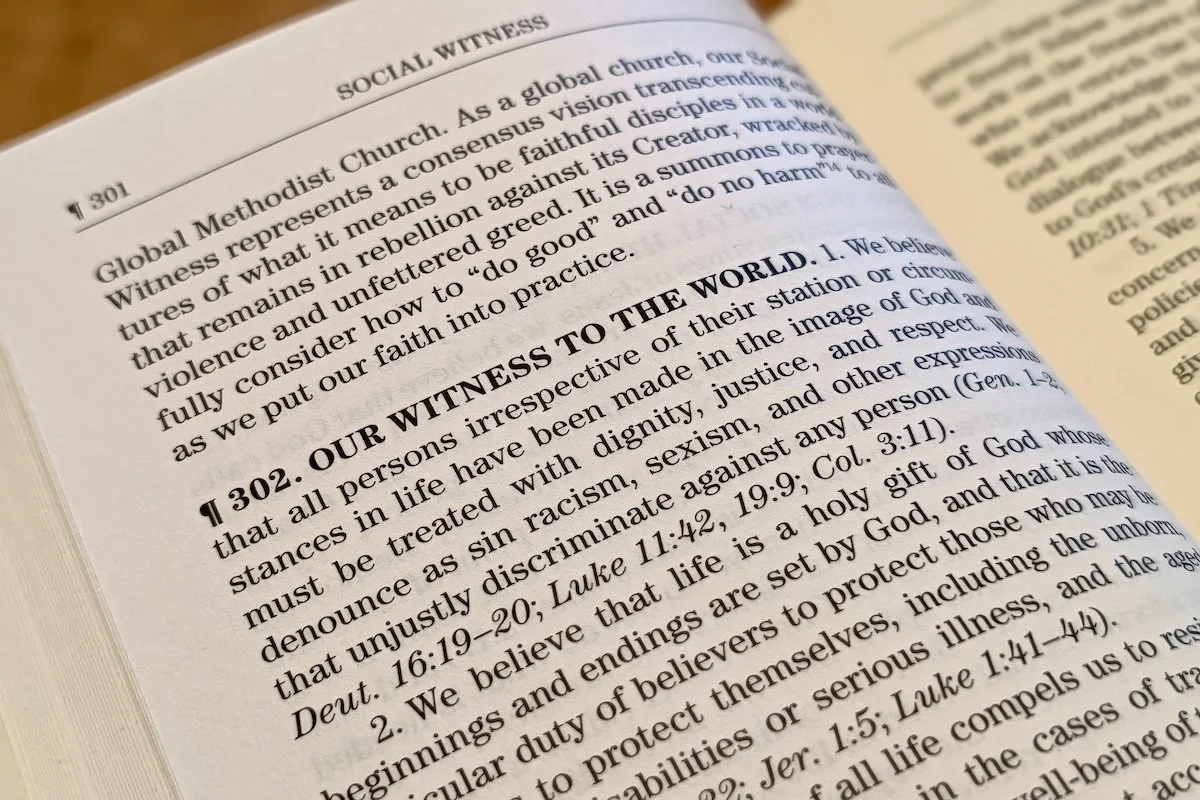
Photo by Matt Reynolds
In a previous iteration of Methodism, noting a revisitation of our social witness after coming out of the General Conference would have been a noteworthy headline indeed, if only because of the controversies that it might have engendered. But for Global Methodists gathered in South Africa, the attention rightly focused on our refashioned Articles of Faith, displaying a wonderful shift towards the importance of sound doctrine more than social debate. After more than half a century of being unable—or more accurately, unwilling—to state what we as Methodists take to be the tenets of our faith, that work was both completed and celebrated by the more than four hundred delegates who quite literally spanned the globe.
Along with that historic passage there was also a closer look at Part Three of the Book of Doctrines and Discipline of the Global Methodist Church containing our Social Witness. In just five short pages—a tenth the size of other Methodist pronouncements—“Our Witness to the World” is laid out in fourteen simple affirmations that embody the biblical admonition to “learn to do right, seek justice, defend the oppressed, take up the cause of the fatherless, and plead the case of the widow,” as Isaiah 1.17 expresses it.
In that respect, these affirmations are not put forth as “principles” or moral rules or laws which should control or explain how life should work, even in the church. They do not bind the behavior of Methodist clergy or laity in any legal way, nor are they considered to be part of the legislative or administrative framework of our common polity or organization. Rather, they are intended to simply witness to what we believe to be God’s intentional will for His children, reflecting His character and testifying to what He has done.
They are meant to be both simple and succinct, with the goal of inspiration, not regulation. A few scriptural passages accompany each affirmation, not to prooftext the statements but instead to hopefully connect our thoughts with those of the Author of Life. Similarly, the statements do not attempt to cover every aspect of life in the modern world, so much as they point us towards the kind of life God would have His children live.
Accordingly, they are by design broad enough to stand the test of time. In successive General Conferences, changing these fourteen statements will take not just a three-quarters’ vote of the delegates, but also a similar aggregate vote of all the annual conferences worldwide. This is an intentional high bar meant to discourage social trends of the day from wiggling their way into our foundational document.
The preamble in Paragraph 301 remains unchanged from that first stated in 2024:
As a global church, our Social Witness represents a consensus vision transcending cultures of what it means to be faithful disciples in a world that remains in rebellion against its Creator, wracked by violence and unfettered greed. It is a summons to prayerfully consider how to “do good” and “do no harm” to all as we put our faith into practice.
Four of the fourteen planks did see a revision, however, that was carefully considered by the legislative committee charged with this section before being affirmed by the whole of the General Conference. Our statement on the sanctity of life in 302.3 was strengthened to read as follows:
We believe that all human life, regardless of level or development or ability, is sacred. The sacredness of all life compels us to resist the practice of abortion. In the cases of tragic conflict of life against life when the mortality of the mother or the child is at stake, premature delivery may be necessary with the baby and the mother cared for as separate patients. We call upon all Christians, as disciples of the Lord of Life, to prayerfully support mothers and fathers facing unintended or unwanted pregnancies by prayerfully providing them with care, counsel, and resources.
New wording was also added to address the question of assisted suicide, namely,
“We oppose the euthanizing of any person. This is not a condemnation of the removal of life support from terminally ill patients with no medical expectation of recovery and facing near-term death, but a rejection of the practice of terminating life directly or through the facilitation of their suicides, rather than allowing their lives to end in natural death.”
Paragraph 302.4 saw a slight wording change to now read:
We believe that all should have the right to work in safe conditions with fair compensation and free of grinding toil or exploitation by others. We respect the right of workers to negotiate wages and benefits with their employers, individually or collectively. We pray that all should be allowed to freely follow their vocations, especially those who work on the frontiers of truth and knowledge and those who may enrich the lives of others with beauty and joy. We acknowledge that science and technology are gifts of God intended to improve human life and we encourage dialogue between faith and science as mutual witnesses to God’s creative power.
Paragraph 302.7 was reformulated to emphasize the biblical understanding of marriage by expressing it thus:
“We affirm that marriage is God’s holy gift instituted by God in creation, affirmed by our Lord Jesus Christ, and intended as a lifelong covenant of mutual love, fidelity, and support between one man and one woman. Sexual intimacy belongs only within the covenant of marriage between one man and one woman.”
Similarly, Paragraph 302.8 was expanded to clarify what we believe to be God’s desires regarding sexual conduct and questions of gender identity across the globe. It will now read as follows:
We recognize as sinful all expressions of sexual behavior that seek to exploit, abuse, objectify, or degrade others. Such behaviors include, but are not limited to adultery, pedophilia, pornography, polygamy, promiscuity, and sex slavery. These activities diminish both the abuser and the abused, in that God’s intentional design for persons is their fulfillment and flourishing as distinct human beings with meaningful identity as males and females. The proper expression of sexual behavior is the covenant of marriage between one man and one woman.
Necessarily, then, we affirm there are two sexes. We acknowledge the ambiguity caused by the rare exceptions of intersex people, but we do not understand their condition to undermine the normative categories of male and female. Such is a disordered condition—as is any illness or disabling condition—and in those cases the person is to be valued as imago Dei, not for the sake of the disordered state but beyond it.
We affirm the sacred worth of every child as created in the image of God and oppose practices, policies, or interventions that encourage or assist minors in seeking to alter their God-given sex through social, medical, or surgical transition. While affirming a scriptural view of sexuality and gender, we welcome all to experience the redemptive grace of Jesus. We are committed to being a safe place of refuge, hospitality, and healing for any who may have experienced brokenness in their sexual lives.
The remaining ten statements were unaddressed by petitions submitted from across the church and thus will remain as currently stated in the new 2026 Book of Doctrines and Discipline, which will hopefully find its way into the home of every Global Methodist member worldwide. And from there, it is the fervent prayer of our church that these proclamations, adopted overwhelmingly by the General Conference without rage or rancor, may indeed be a faithful witness to others. For “we believe in the final triumph of righteousness when the kingdoms of this world shall become the Kingdom of Christ, and we accept our calling to work toward that end as Christ’s light and the salt of the earth.”
C. Chappell Temple is an instructor and the manager of the Wesley House Pastoral Studies Program at Truett Seminary of Baylor University and served as the chair of the Social Witness Legislative Committee at the 2026 General Conference of the GMC.