
The Power and Peril of George Whitefield’s Ministry
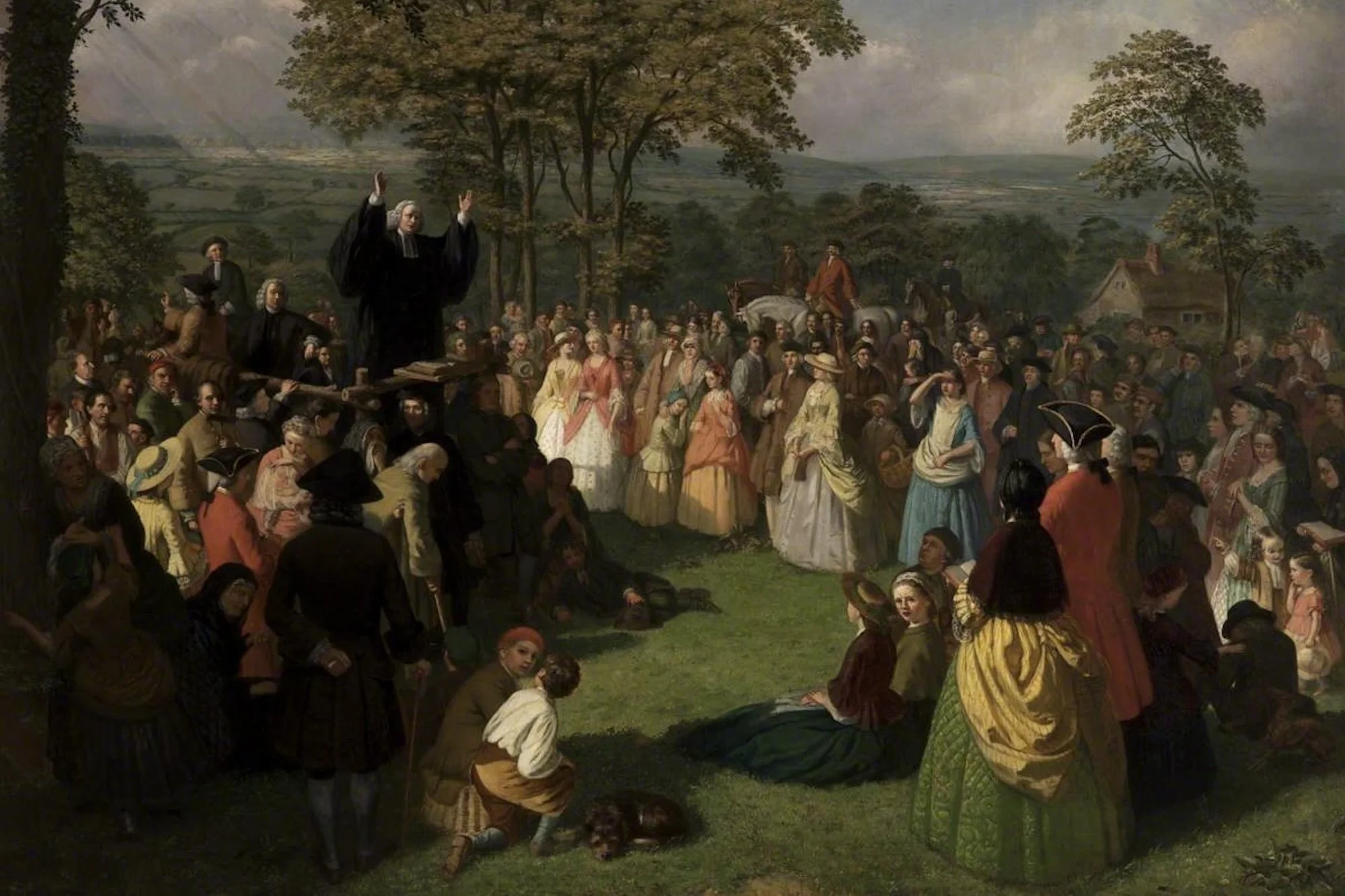
George Whitefield Preaching in Bolton, June 1750 by Thomas Walley (1817-1878). (Source: WikiCommons)
At the time of his death in 1770, George Whitefield was one of the most well-known people in the American colonies. Though virtually unknown outside of religious circles today, he has been regarded by many historians as perhaps the greatest religious figure of the 1700s. A central voice of the First Great Awakening, he preached more than 18,000 sermons to audiences totaling up to ten million listeners. Biographer Arnold Dallimore describes him as “the greatest evangelist since the apostle Paul.”
Whitefield regularly preached to thousands without amplification. Yet his legacy is about more than his audiences or voice. His ministry offers lessons about preparation, integrity, perseverance, relationships, and faithfulness to the gospel. It also contains a grievous contradiction that should cause us to examine our own cultural blind spots. What can we learn from his life and ministry?
The Most Remarkable Message Needs to Be Communicated in the Most Memorable Way
Prior to his call to preach, Whitefield spent much of his youth in the theater. With a strong voice and keen memory, he starred in performances at St. Mary de Crypt in Gloucester, England. After his conversion and call to preach, he used those skills in the pulpit, preaching extemporaneously and interacting with large audiences.
Benjamin Franklin said of him, “Every accent, every emphasis, every modulation of voice was so perfectly well turned and well placed, that, without being interested in the subject, one could not help being pleased with the discourse.” Historian Harry Stout records this observation in The Divine Dramatist: George Whitefield and the Rise of Modern Evangelicalism.
Whitefield’s theatrical style led many to criticize him as manipulative and undignified. He responded by telling of an archbishop who asked an actor why actors could move audiences while speaking of imaginary things, yet ministers often failed to move congregations while speaking of real things. The actor replied, “We actors on stage speak of things imaginary as if they were real, and you in the pulpit speak of things real as if they were imaginary.” Whitefield concluded, “I will not be a velvet-mouthed preacher” (Stout, The Divine Dramatist: George Whitefield and the Rise of Modern Evangelicalism).
The gospel does not derive its power from presentation, but neither should the world’s most remarkable message be communicated as though it were lifeless.
Effective Ministry in the Pulpit Is Built Upon a Faithful Lifestyle Outside of It
Whitefield’s effectiveness before crowds was grounded in his character and discipline in isolation. His extemporaneous style connected him with the people while reflecting a dependence upon the Holy Spirit. Yet extemporaneous did not mean unprepared. It was said that he would be studying at 5:00 every morning in his flat over Harris’s Bookstore. Reading his Bible, his Greek New Testament, and Matthew Henry’s commentary, he prayed over every line and word. Whitefield sometimes preached 40—and occasionally 80—hours a week. His early study gave him a foundation from which to draw throughout the busyness of ministry. Preparation today is a foundation for ministry tomorrow.
If passion and power described Whitefield’s public persona, grace and warmth described his personal interactions. John Willison, once critical of Whitefield’s ministry, wrote, “It is rare to see in a man such a flaming fire for God in the pulpit, and yet most easy and calm when conversing with men out of it; careful not to give offence to any of them, and yet never courting the favour of any” (The Christian History for 1743).
Integrity enables a minister to be completely oneself in the pulpit because one is completely oneself outside of it.
Faithful Preaching Will Win Both Friends and Opponents
When it seemed as if much of the pulpit preaching was apathetic and uninspiring, Whitefield took his message to coal miners and open fields despite ridicule and opposition from Anglican authorities. Whitefield also won the respect of some who did not believe his message. Though we see no record of Benjamin Franklin converting to Christianity, he deeply respected Whitefield, writing, “He is a good man, and I love him.” Whitefield also engaged gracefully with people with whom he had theological disagreements. John and Charles Wesley introduced him to the Holy Club at Oxford, while Whitefield later introduced John Wesley to field preaching.
Despite their deep friendship, the Wesleys broke fellowship with Whitefield over his embrace of a moderate form of Calvinism that taught election and rejected Wesley’s understanding of Christian perfection. These were meaningful differences, but Whitefield would not allow them to destroy either the friendship or their shared mission. When Wesley challenged Whitefield’s theology publicly, Whitefield responded, “Why dispute? I am willing to go with you to prison and to death, but I am not willing to oppose you”(The Works of the Reverend George Whitefield, M.A. Vol. 1). According to a well-known account, when asked, “Will we see John Wesley in heaven?” Whitefield said, “I fear not. He will be so near the throne, and we shall be at such a distance, that we shall hardly get a sight of him” (Sanders, Wesley on the Christian Life: The Heart of Methodism). At Whitefield’s request, Wesley preached his funeral sermon following Whitefield’s death.
Whitefield understood that conviction did not require contempt and disagreement did not require personal hostility.
Biblical Preaching Will Endure for Generations
Although no denomination bears Whitefield’s name, his legacy continued through countless individuals whom he inspired to proclaim the gospel. His central message was the necessity of the “new birth”—a genuine conversion brought about by the grace of God.
Whitefield’s sermons, and the preachers who followed him, were deeply committed to pillars of Christian faith: the authority of Scripture; the deity of Jesus Christ; the virgin birth, Christ’s atoning death and bodily resurrection; and the necessity of receiving the new birth by faith through grace rather than through works of the law.
Those influenced by him were committed to enthusiastic preaching, direct application of Scripture, and theological orthodoxy. This model impacted churches in America and Great Britain for more than 100 years.
Effectiveness in ministry is not ultimately found in being innovative, but in being faithful to the timeless message of the gospel.
Even the Best of People Are Capable of the Worst of Things
Whitefield, like all of us, was a complex and flawed person. He held beliefs that were incompatible with the gospel he preached.
In 1740, Whitefield established the Bethesda orphanage near Savannah, Georgia. Although well-intended, the orphanage left him in significant debt. Georgia initially prohibited slavery, but Whitefield eventually advocated for its legalization because he believed enslaved labor would sustain the orphanage. He later enslaved people at Bethesda and on property connected to it.
It is confounding that Whitefield could preach for the spiritual liberation of enslaved Africans while advocating for and benefiting from their physical enslavement. It cannot be overstated how reprehensible and theologically inconsistent with the mission of the gospel his endorsement of slavery was. But rather than dismissing him, we can do well by learning from his inconsistencies and becoming more aware of our own theological and ethical departures from Christianity.
What can we learn from Whitefield’s hypocritical endorsement of chattel slavery?
We are all far more influenced by the values of our era and culture than we objectively realize. Whitefield preached for the salvation of enslaved people, publicly rebuked those who mistreated them, and proclaimed that they had souls worth saving. Yet he could not—or would not—see how vile the institution of chattel slavery was itself.
Christians in every generation accept cultural patterns that are antithetical to the gospel, yet often cannot see them because we are formed by the environment of our time and culture. Other Christians outside our culture may be offended by practices and attitudes we cannot recognize. Similarly, our children and grandchildren may look back with shame and confusion upon things we currently consider normal.
We can allow secondary things to overtake primary things. Whitefield supported slavery because it benefited his orphanage. In ministry, we sometimes create programs with great intentions that impact people in meaningful ways. Yet the financial, time, and relational costs of sustaining them can begin to hijack the ministry or compromise the integrity of church leadership. It is the proverbial tail wagging the dog.
Our failures may not rise to this level of endorsing slavery, but all Christians and Christian leaders are capable of neglecting the primary things of God in favor of what we merely wish to rationalize as being of God.
God works through deeply flawed people. The only people God uses are flawed people. Moses was a murderer. Jacob was a liar. Abraham allowed his wife to be taken into Pharaoh’s household to protect his own life. Their failures reveal both our need for God and God’s mercy in using unworthy people. This truth neither excuses Whitefield’s sin nor minimizes its consequences. This reality should lead us to humility. Despite his grievous flaws, God still worked through Whitefield’s ministry, including through his proclamation of the gospel to enslaved people.
In a 1740 letter published by Benjamin Franklin, Whitefield rebuked colonists for their treatment of enslaved people: “God has a quarrel with you for your abuse of and cruelty to the poor Negroes.” Historian Harry Stout observes in The Divine Dramatist that the letter represented the first journalistic statement on slavery and established a precedent with implications Whitefield could not have imagined. Whitefield also proclaimed the gospel directly to enslaved people. In his sermon “The Lord Our Righteousness,” he said, “Jesus Christ has died for them, as well as for others.… Even you may be the children of God, if you believe in Jesus.”
These words affirmed a spiritual equality that Whitefield’s actions tragically failed to honor. That inconsistency should cause every generation of Christians to seek out the ways in which our own lives contradict the gospel we proclaim.
Faithful Ministry Is a Marathon, Not a Sprint
By 1770, Whitefield was suffering from asthmatic colds. Those close to him pressed him to slow his ministry pace. His standard response was, “I would rather wear out than rust out” (The Revived Puritan: Select Works of George Whitefield). On the day before his death, someone said, “Sir, you are more fit to go to bed than to preach.” Whitefield looked toward heaven and said, “Lord Jesus, I am weary in thy work, but not weary of it. If I have not yet finished my course, let me go and speak for thee once more in the fields, seal thy truth, and come home and die” (Gillies, Memoirs of the Life of the Reverend George Whitefield, M.A.).
After preaching, Whitefield went to the home of the Reverend Jonathan Parsons in Newburyport, Massachusetts. Later that evening, with a candle in hand, he continued speaking to those gathered to hear him until the candle was extinguished. It was said that the candle was a metaphor for Whitefield’s life: when it burned out, so did he. Whitefield died the next morning, September 30, 1770.
His ministry was not a momentary burst of enthusiasm, but a lifetime of proclaiming the gospel across oceans, in churches and fields. He was weary in the work, but not weary of it.
What Whitefield’s Life Leaves With Us
George Whitefield’s legacy cannot be reduced to the number of sermons he preached, the crowds he gathered, or the movement he helped awaken. His influence grew from his ability to communicate the gospel, a disciplined private life, courage in the face of opposition, graciousness amid disagreement, and commitment to the new birth.
His life also reminds us that extraordinary gifting and genuine spiritual fruit do not make a person immune to moral blindness. Remembering Whitefield honestly requires us to learn from both his faithfulness and his failures.
We may never preach to thousands or travel from continent to continent, but his life still asks something of us. Do we communicate the gospel as if it is real? Are our public lives supported by private faithfulness? Can we maintain conviction without surrendering charity? Are we willing to examine the assumptions our culture has taught us not to question? And will we remain faithful throughout the course God has given us?
Whitefield’s story is not an invitation to imitate a flawless man. It is an invitation to serve a gracious God with conviction, humility, and endurance—and to remain open to the ways that same grace still needs to transform us.
Jason Bunger is the Lead Pastor of Hope Church, a Global Methodist congregation in Dayton, Ohio.