
What John Wesley Can Still Teach the Church, If We Listen
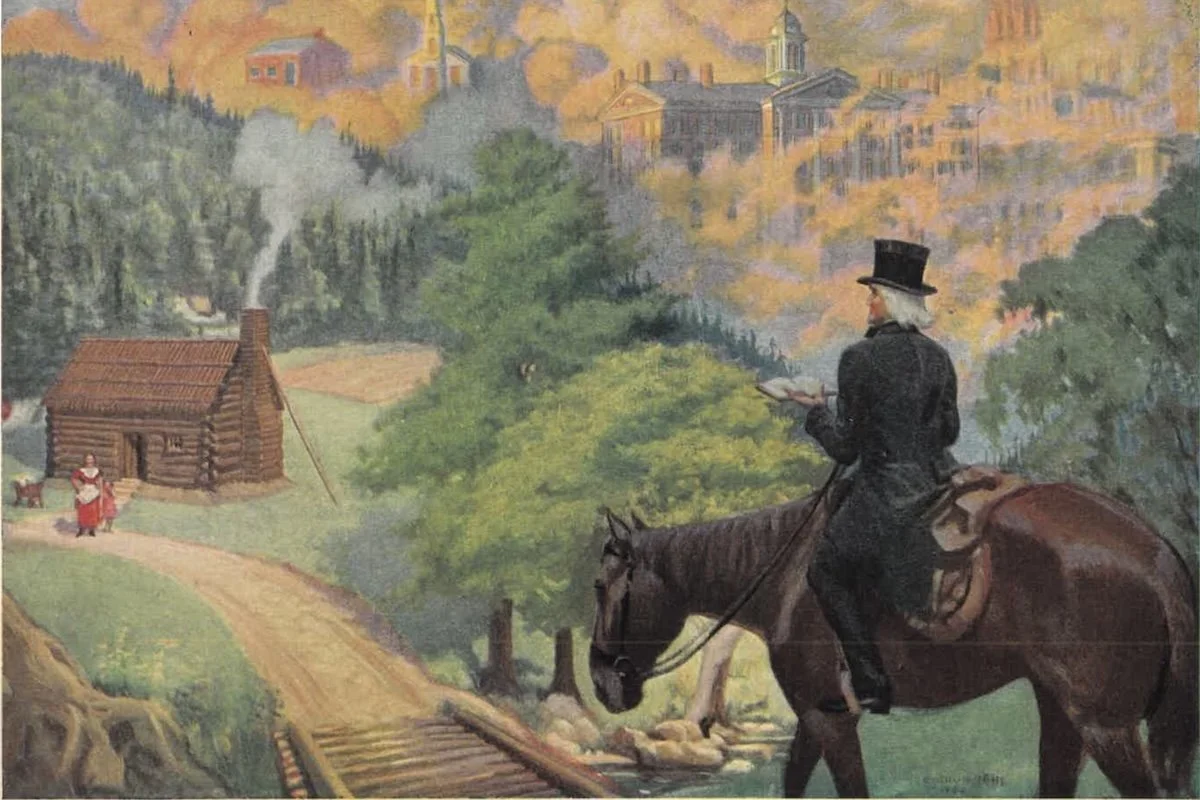
"The Vision of the Circuit Rider". Original Caption is "Painted expressly for The Pageant of America by Charles Lennox Wright." (Source: WikiCommons)
Origin stories have a profound impact on our identity and destiny. They explain who we are, where we come from, and sometimes what we need to claim or reclaim for ourselves and others.
Genesis begins with several origin stories that include the cosmos and the earth, humanity, the fall of humanity, and the promised redemption of humanity. The call of Abraham describes the origin story of God‘s covenant people. The origin story of Moses describes the liberation of God’s people from bondage to a place that he has promised. The book of Acts describes the origin story of a promise received at a prayer meeting that led to the ongoing expansion of the gospel to the ends of the Earth.
As humans, we see our origins in Eden. As Christians, we see it in the gospels. As the Church, we see it in Acts. And for those who call themselves Wesleyans, our origin story is not in a denominational schism, but in a reclamation of the transforming power of the gospel that was believed, applied, and proclaimed by John Wesley.
I am convinced the renewal of the Methodist movement must involve a holistic remembrance of our origin story in the ministry of John Wesley.
“Give me one hundred preachers who fear nothing but sin and desire nothing but God, and I care not whether they be clergymen or laymen; they alone will shake the gates of hell and set up the kingdom of heaven upon earth” (Tyerman, The Life and Times of the Rev. John Wesley)
John Wesley’s influence reaches far beyond the Wesleyan movement that bears his name. His preaching helped awaken faith across eighteenth-century England, but his legacy was shaped by more than the thousands of sermons he preached. Wesley’s ministry was marked by personal transformation, dependence on the Holy Spirit, disciplined study, perseverance through opposition, and an unwavering commitment to reach people with the gospel. His life was not without failure or conflict, but both his strengths and his shortcomings offer valuable lessons for the church today. The following observations invite us to consider not only how Wesley ministered, but what his example can teach us about faithfully participating in God’s work in our own time.
John Wesley (1703–1791), regarded as the founder of Methodism, became a significant voice in the Evangelical Revival. The son of an Anglican priest, Wesley was a member of the Holy Club at Oxford University along with his brother Charles and, later, George Whitefield. In 1735, he sailed to the American colony of Georgia as a missionary. During the voyage, a violent storm—and the striking peace displayed by a group of Moravian Christians aboard the ship—caused Wesley to question the depth of his own faith.
His mission in Georgia ended painfully, and Wesley returned to England deeply discouraged. Then, on May 24, 1738, he had the life-changing experience he described in his journal:
In the evening I went very unwillingly to a society in Aldersgate Street, where one was reading Luther’s Preface to the Epistle to the Romans. About a quarter before nine, while he was describing the change which God works in the heart through faith in Christ, I felt my heart strangely warmed. I felt I did trust in Christ, Christ alone, for salvation; and an assurance was given me that he had taken away my sins, even mine, and saved me from the law of sin and death.
In the years following Aldersgate, Wesley became an impassioned itinerant preacher. He preached at factories as laborers were going to work and drew enormous outdoor crowds through his field preaching. It is estimated that he preached more than 40,000 sermons and traveled approximately 250,000 miles, much of it on horseback, spreading the gospel and establishing ministries devoted to scriptural holiness.
Wesley was born and died a member of the Church of England. He never belonged to a separate Methodist denomination, although the structure and legal constitution he developed for the Methodist societies helped prepare the way for their separation from the Church of England after his death. His influence also extended beyond the movements that bear his name. Wesley was an outspoken abolitionist, and his final known letter encouraged William Wilberforce to persevere in the struggle against slavery.
The preaching legacy of John Wesley is enormous. The principles that shaped it, however, were relatively simple. What distinguished Wesley was the depth of his commitment to them.
Wesley showed the impact of the Holy Spirit upon a person’s life and preaching ministry.
Wesley’s missionary work in Georgia ended in failure by his own admission. After returning to England, he wrote in his journal, “I went to America to convert the Indians; but oh! who shall convert me?” (Wesley, Journals) The man who had crossed an ocean to proclaim faith to others was forced to confront the uncertainty within his own soul.
At Aldersgate, Wesley received a new assurance that he trusted in Christ alone for salvation. His life and ministry were changed. Less than one month later, he preached the sermon now known as “Salvation by Faith,” in which he described salvation as:
A deliverance from guilt and punishment, by the atonement of Christ actually applied to the soul of the sinner now believing on Him, and a deliverance from the power of sin, through Christ formed in his heart. So that he who is thus justified, or saved by faith, is indeed born again. He is born again of the Spirit unto a new life.
Wesley’s experience reminds us that ministry is not sustained by education, position, or effort alone. The gospel must first take root in the life of the person who proclaims it. What we offer to others must flow from the continuing work of God’s Spirit within us.
Wesley recognized that he was part of something far greater than himself.
The awakening in England did not begin with Wesley. George Whitefield had already begun preaching to large crowds before Wesley’s Aldersgate experience, and others were also participating in the work. Wesley joined an outpouring of God that he did not create and could not control.
Years later, Wesley reflected that we do not fully understand “the times and seasons God has reserved in his own power” (Acts 1:7). God has wise reasons for pouring out his Spirit at one time rather than another, Wesley wrote, but those reasons are too deep for human understanding to fathom.
Neither Wesley nor Whitefield manufactured the Evangelical Revival. By God’s grace, they were invited to participate in it. The same is true for us. We are not responsible for producing the work of God, but we are responsible for recognizing where God is at work and faithfully joining him there.
Wesley did not allow discouragement or opposition to deter him from preaching.
As Wesley and Whitefield became known for enthusiastic preaching, many Church of England pulpits were closed to them. Wesley responded by taking the message beyond church walls. In 1742, when he was denied permission to preach inside the parish church at Epworth, he stood on his father’s tomb and preached to the people gathered outside. He later wrote, “I am well assured that I did far more good to my Lincolnshire parishioners by preaching three days on my father’s tomb than I did by preaching three years in his pulpit” (Wesley, Journals)
Wesley took his message to mines and fields. He endured threats and mob violence. At times, he preached amid wind, sleet, and snow until he was reportedly encased in ice. Wesley did not confuse opposition with a closed door from God. When traditional avenues were no longer available, he found new places and new ways to proclaim the gospel. His perseverance challenges the church to ask whether an obstacle is truly the end of the work or an invitation to carry the message somewhere new.
Wesley demonstrated the value of disciplined study.
Wesley famously described himself with the Latin phrase homo unius libri, meaning “a man of one book” (Wesley Sermons on Several Occasions). He did not mean that he refused to read other books. Wesley was a prolific reader with wide-ranging intellectual interests. He meant that Scripture held ultimate authority and that he sought to pattern his entire life after its teaching.
Wesley insisted that preachers should be not only prayerful but also committed to serious study. He urged preachers to study the Greek and Hebrew Bible, and pursue experience and understanding of the love of Christ. In another letter, he instructed his preachers to spend regular time reading useful books. When one protested, saying he had no taste for reading, Wesley’s response was direct: “Contract a taste for it by use, or return to trade” (Luke Tyerman, The Life and Times of John Wesley)
For Wesley, the call to preach was also a call to study. Dependence upon the Holy Spirit was never an excuse for intellectual laziness. Prayer, Scripture, and disciplined learning belonged together in the formation of those entrusted to teach God’s people.
Wesley preached that we are justified only through the work of Christ, not through our own merit.
Wesley knew that it is God alone who saves. We bring nothing to our salvation except the sin that makes it necessary. Through the work of Christ on the cross, we can be made right with God. Christ lived the life we should have lived and died the death we deserved to die so that we might be justified. His death and resurrection give us victory over both the consequences and the power of sin.
Wesley also refused to separate justification from sanctification. In “On Working Out Our Own Salvation,” he wrote, “By justification we are saved from the guilt of sin, and restored to the favor of God; by sanctification we are saved from the power and root of sin, and restored to the image of God.” Elsewhere, he declared, “None can trust in the merits of Christ, till he has utterly renounced his own.”
The grace that forgives us is also the grace that transforms us. For Wesley, salvation was not merely a change in our standing before God. It was the beginning of a life in which the Holy Spirit continually shapes us into the likeness of Christ.
Wesley was far more concerned about reaching the lost than appeasing the status quo.
Any Christian organization—a church, denomination, or nonprofit—begins to die when it becomes more concerned with preserving the institution than proclaiming the gospel. Wesley understood this danger. He wrote:
I am not afraid that the people called Methodists should ever cease to exist either in Europe or America. But I am afraid lest they should only exist as a dead sect, having the form of religion without the power. And this undoubtedly will be the case unless they hold fast both the doctrine, spirit and discipline with which they first set out.
Wesley was not interested in preserving Methodism merely for Methodism’s sake. The movement mattered only as long as it remained faithful to the mission that gave it life. His warning remains timely for every church: survival is not the same as faithfulness, and maintaining an institution is not the same as participating in the kingdom of God.
Wesley was at his best when he remained clear about the gospel—and at his worst when he was drawn into secondary arguments.
Wesley believed that proclaiming and applying the gospel to all of life was not merely the main thing, but the defining work of ministry. He told his preachers, “You have nothing to do but to save souls. Therefore spend and be spent in this work” (“John Wesley’s 12 Rules for Preachers”)
Methodism was centered on a serious commitment to both doctrine and discipline—to Christian belief and to the way of life that flows from it. In his 1746 essay “The Principles of a Methodist Farther Explained,” Wesley wrote, “Our main doctrines, which include all the rest, are three: that of repentance, of faith and of holiness. The first of these we account, as it were, the porch of religion; the next, the door; the third, religion itself.”
Wesley warned his followers about controversies rooted in speculation beyond what Scripture clearly reveals. Writing to one of his assistants, he counseled, “Abstain from all controversy in public” (Outler, John Wesley) and urged him instead to remain focused on repentance toward God, faith in Christ, and holiness of heart and life.
Wesley did not always follow his own advice. His handling of interpersonal and theological disagreements—particularly those involving Sophia Hopkey, George Whitefield and the Moravians—reveals one of the more painful limitations of his ministry. At times, he allowed relationships that had significantly shaped his life and faith to become public divisions. His failures remind us that even gifted and faithful leaders can lose focus, and that being correct in our convictions does not excuse us from practicing humility, wisdom, and love.
Finally, Wesley believed that preaching alone was not sufficient for the ongoing maturity of God’s people.
One of my preaching mentors likes to say, “Preaching is not everything, but preaching is not nothing.” Preaching is vital to the life of the church, but it is not the only thing we need in order to mature. We often grow most in close, accountable relationships with people who love us enough to encourage us, challenge us, and refuse to let us quietly surrender to patterns that are harming our lives and faith.
This is why Wesley insisted upon class meetings and band meetings. These smaller communities created space for confession, encouragement, accountability, and growth. When Wesley wrote that Christianity knows “no holiness but social holiness” (Wesley, Hymns and Sacred Poems), he was rejecting the idea of a private faith isolated from other people. We grow in the likeness of Christ in community, and that growth bears fruit in active love toward our neighbors.
John Wesley’s legacy cannot be reduced to the number of sermons he preached, the miles he traveled, or the movement he helped begin. His lasting influence came from a life transformed by the grace of God and then given fully to God’s work. He depended upon the Holy Spirit, devoted himself to study, persevered through opposition, kept the gospel at the center, and created communities where people could grow together in holiness.
Wesley was not without faults, and his failures remind us that gifted leaders still need humility, wisdom, and accountability. Yet his life also shows what God can do through people who are willing to be shaped by grace and faithful to their calling. We may never preach to thousands or travel hundreds of thousands of miles, but we are each invited to participate in something larger than ourselves. The question Wesley’s life leaves with us is not simply whether we admire his ministry, but whether we are willing to pursue Christ with the same conviction and join God in bringing the hope of the gospel to the people around us.
Jason Bunger is the Lead Pastor of Hope Church, a Global Methodist congregation in Dayton, Ohio.