
An Alternative to Orthodoxy: or How Pietism Saved the Protestant Experiment
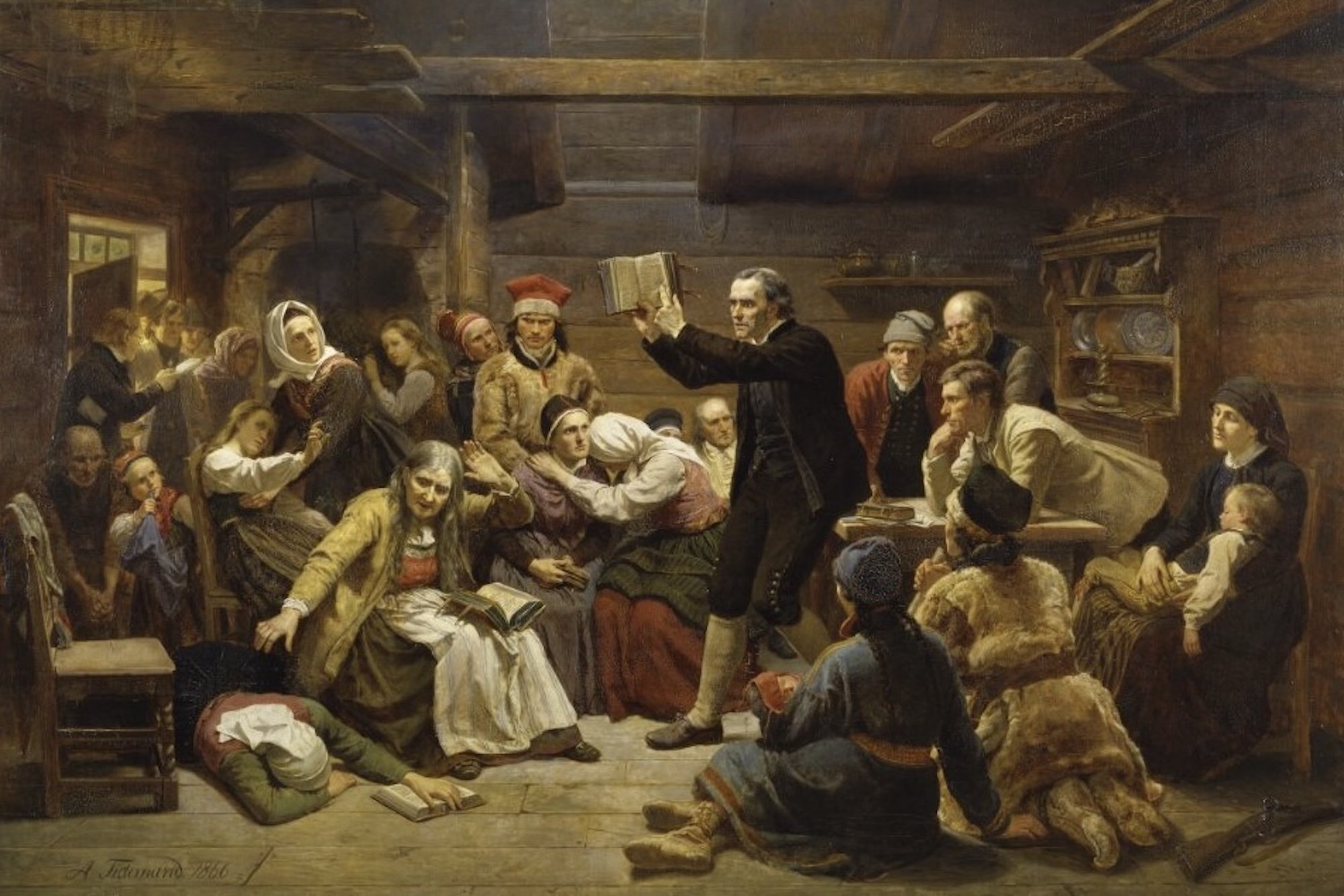
“The Fanatics” by Adolph Tidemand, 1866. (Source: WikiCommons)
Philip Jacob Spener died in 1705. He was perhaps the most important figure in German Lutheranism in his day. In 1666, as lead pastor in Frankfurt, he began meetings with lay people to discuss the previous sermon. In 1675, he published a book Pia desideria or Earnest Desires for a Reform of the True Evangelical Church, which produced a movement called “Pietism”, where Lutheran pastors and laity gathered in small groups called collegia pietatis (colleges of piety) to pursue the riches of life in Christ. He helped reform theological education and even helped start a new seminary. Those he influenced began the Protestant overseas missions and ignited renewal and revival movements throughout the Protestant world.
But the man and the movement had detractors. Spener taught that sanctification was an essential part of Christian experience. This potentially violated the tenets of Lutheran orthodoxy as defined in the Formula of Concord. He also did not mince words in denouncing the moral laxity of the ruling classes, the clergy, and the laity. In 1695 the faculty of Wittenberg formally charged him with 264 theological errors. Only his death released him from the conflict.
He was not the first to run afoul of self-designated preservers of "orthodox Protestantism" (an oxymoron, of course, to Catholic Christians). When Luther died in 1546, his designated successor, Philipp Melanchthon (1497-1560), found himself in the crosshairs of the guardians of "genuine" Lutheranism. As head of the University of Wittenberg, Melanchthon, seeing how justification by faith alone could lead to lawlessness, asserted "new obedience, the new life" as "necessary to salvation." This assumption (natural to future Pietists) got him labeled "Catholic".
Another “synergistic” controversy erupted when he argued for spontaneous cooperation of human and divine power released by grace (what we Methodists would call preventing grace), again a lapse into Catholicism. Then, in 1552, when Calvinism was still illegal in the empire, Melanchthon was accused of crypto-Calvinism regarding Christ’s presence in the Eucharist. The year before he died, “genuine Lutherans” at Wittemburg denounced Melanchthon with Servetus (anti-Trinitarians), Antinomians (anti-law Anabaptists), and Zwingli (anti-sacramentalists).
Attempts at Doctrinal Purity and The Near Demise of the Protestant Experiment
The culmination of "Lutheran" orthodoxy was in 1577. The Lutheran Formula of Concord defined Lutheran orthodox teaching with the same precise and emphatic language used by the Catholic Council of Trent (which had concluded in 1563). Positions held by Melanchthon's followers were excluded, along with Roman and Calvinist positions. Like Trent, the Formula was one of several attempts in the breakup of the western church to define a Christian not by faith as an experience but as a set of theological positions precisely worded. Among the Calvinists, the Reformed Synod of Dort finished its work in 1618 and condemned the followers of Arminius for asserting, among other things, that Christ died for the sins of the whole world.
The Synod of Dort ended the year of the Bohemian revolt, which ignited The Thirty Years War (1618-1648), a civil war within the German Holy Roman Empire. Contributing factors to that War included: 1) the hardening of orthodoxies to define doctrines previously considered debatable (adiaphora) and 2) the alignment of orthodoxies with civil governments, which meant theological factions had armies. While it began as an imperial civil war, both the Lutheran Swedes and the Catholic French joined the fight for their own interests, the French ironically on the side of Protestants. Catholics killed Lutherans and Calvinists. Catholics killed Catholics. Lutherans killed Catholics and Calvinists. Calvinists killed Catholics and Lutherans. And everyone killed Anabaptists, since they don't fight back. Between famine, disease, and violence, roughly a third of Germany's population was wiped out. The Peace of Westphalia (1648) solved no disputes over orthodoxy. It simply told the various combatants to go to their respective theological corners.
The English Civil War broke out in 1642, along doctrinal divisions between Reformed Puritans of various stripes in parliament and high church Arminian Episcopalians loyal to the crown. Parliamentary forces were led by Oliver Cromwell (d.1658), whose “new model army” was organized into independent gathered churches. Fearful of these dissenters from an orthodox polity, Presbyterian Puritans signed The Solemn League of Covenant with the Scots. Scottish Presbyterian troops fought for England, paid by Parliament in exchange for church reform, defined in 1643, by the Westminster Assembly dominated by Presbyterians. With Parliament’s victory in the war in 1645, Presbyterianism was established in the Church of England in 1646. King Charles I was captured and executed by Parliament in 1649. The new Protector, Cromwell, however, let official polity go unenforced. Plurality proliferated.
The end of these wars left religion in the West in a very precarious state, indeed. And through the second half of the 1600s things got worse for Protestants. In the empire, Catholic forces made inroads into former Protestant strongholds. Bohemia, Moravia, the Palatinate, and Silesia all reverted to Catholicism after conquest by the forces of the Catholic League. In France, the Edict of Nantes (signed in 1598), which guaranteed religious rights to Huguenots, was gradually eroded until finally repealed in 1685, leading to widespread persecution. In England, the Protestant Protectorate proved unable to govern and the biological heir to the throne was invited by Parliament to return from France. King Charles II was married to a Roman Catholic, rumored to be the illegitimate daughter of the pope himself. The King's brother and only heir, who ascended the throne the same year as the revocation of the Edict of Nantes, was Roman Catholic.
Anyone looking at the Christian landscape in the late 1600s could be excused from thinking that Protestantism, this experiment in religious individual conscience that had brought forth a flurry of theological activity and a limitless array of theological positions, had played itself out in about a hundred years. All that codifying of orthodox "Protestant" theological positions seemed to be coming to a tragic (or not so tragic, if you came from a Catholic perspective) end. The long tradition of Catholic orthodoxy, now clarified by the Council of Trent, was ascendant. The nailing down of theological orthodoxies with states protecting them with arms was not succeeding in preserving Protestant reform. Protestantism, it seemed, would vanish in time, going the way of Novatianism and Donatism.
The Renewal of Protestantism through the Pietist Experiment
But here we are in 2026. Protestantism did not vanish. The old state churches of Europe are indeed shadows of their former selves, theologically anemic at best, architectural preservation societies at worst. But Protestantism ended up flourishing without state sanctions and without an orthodoxy upheld through coercion. So how did Protestantism become the second largest group of Christians on the planet? One clue is found in an early Pietist movement among the Dutch Reformed. Known as the Further Reform (Nadere Reformatie) movement, its goal was reform not of Doctrine but of the hearts of the Dutch people through small groups.
In the 1600s, beleaguered Protestants of all confessions, whose consciences were “captive to the word of God,” as Luther said at the Diet of Worms, now followed their consciences to join with other like-conscienced Christians in prayer, mutual edification through small groups, and cooperation in mission. These Protestants in Reformed, Lutheran, Anglican, and Anabaptist communities began to define “the faith” not by intellectual assent to a set of particular articulations of systematic theology, but as a heart encounter with the Living Christ through the power of the Holy Spirit. This was not an enlightenment of the mind, but rather the “eyes of the heart” being enlightened, as St. Paul terms it. This understanding of Protestantism, of Christianity, was conversionist, expectant, hopeful, missionally driven.
Persecuted Protestant children in Silesia gathered for prayer, protected by their persecuted elders, and sent emissaries around the Empire to give witness to the work of God among these least. Persecuted Moravian and Bohemian refugees gathered into band meetings on the estate of a German noble to seek the Lord and, after a dramatic experience of the Holy Spirit, sent lay people as missionaries (a first). These sought out pockets of renewal among all confessions to spread the good news of this cross-confessional move of the Spirit and band meetings. Disaffected youth in decadent Restoration England, who were convicted by the preaching of a German immigrant turned Anglican priest, gathered in societies the purpose of which was "holiness of heart and life." These then began other societies to spread the Gospel through education and mission throughout the expanding British Empire and throughout the world.
In Germany, Spener's successor in the movement, August Hermann Francke, began a school for poor children that became an orphanage, boarding school, publishing house, and mission sending agency all supported through voluntary charitable giving. Francke became the First Corresponding Member of the English Pietist Society for the Promotion of Christian Knowledge. In his letter to the society, he wrote: "I look upon these things as comfortable signs that the Spirit of God is now about a great work to put a new face on the whole Christian Church."
In the 18th century, this way of defining Christianity in Reformed and Wesleyan versions swept across England and Wales. In the 19th century an Awakening transformed the character of a new nation with no established church, no official creed on the American continent. In the early 20th century, it swept through Korea, and East and West Africa, turning cultures with small minorities of Christians into major missionary sending areas of the world, within a generation. In the late 20th century, this way of being Christian moved through Central and South America, turning a part of the world that had been nearly 100% Roman Catholic into a place that is nearly 50/50 Protestant/Catholic. Non-Pietistic Protestantism, of whatever confessional tradition, is almost absent from contemporary global Protestantism, outside the West. All of this occurred through revolutions, global depressions, and two world wars. Empires rose and empires fell, but the kingdom of God as understood by Pietism continued to spread.
Conclusion
It is no exaggeration to say that the continuation of Protestantism is historically remarkable, given its worldly obstacles in the late 17th century. Now, of course, theological statements of what we believe are important. They state, at a point in time in particular language, our commitment to the apostolic witness to the event of the creation, incarnation, resurrection, and new creation. However, the state church's compulsion to define what it means to be a true Christian based on particular orthodox formulations of doctrine did not preserve Protestantism. State churches' spread of these confessions through imperial expansion did not save Protestantism. The flesh could not achieve what the Spirit accomplished.
While the confessional way of determining who is "in" and "out" based on agreement with a doctrinal statement is far easier than determining the state of a person's heart toward God and neighbor, it was the latter that preserved Protestantism. No Protestant consensus has ever been achieved on the doctrine of election, the presence of Christ in the sacraments or ordinances, or the possibility of entire sanctification in this life. These opinions identify us with a particular Protestant "church," but they do not define Protestantism. Rather, Protestantism generally is an understanding of what it means to be a Christian based on individual conscience, an individual encounter with Christ through the Holy Spirit, voluntary missional cooperation for the sake of the Kingdom, and the expectation of growth in holiness in the individual and community is the de facto consensus for what defines Protestantism globally. That is Pietism, and it has de facto defined Protestantism and preserved Protestantism for the world.
Melanchthon, Spener, Franke, Horneck, Zinzendorf, Whitefield, Wesley, Boehm, Otterbein, Albright, who could not agree on a single confessional statement, and millions of other unnamed individual men and women whose encounter with the Living and Loving God and voluntary cooperation for the sake of a living and loving witness to the gospel in the world. Today Protestantism and its spread is not the mission of one creed, one nation, one denomination. It is from all to all. This movement of pietistic Protestantism is not dependent on any one community, state, denomination, or confession. It is thus nearly impossible to stamp out by any principality or power of this world.
Scott Kisker is the Director of Church Leadership Formation & Scholar-in-Residence at Spirit & Truth. He is a member of the Firebrand editorial board.