
The Antiochian Church as a Model of Redemptive Ethnic Relations (Acts 13:1-4)
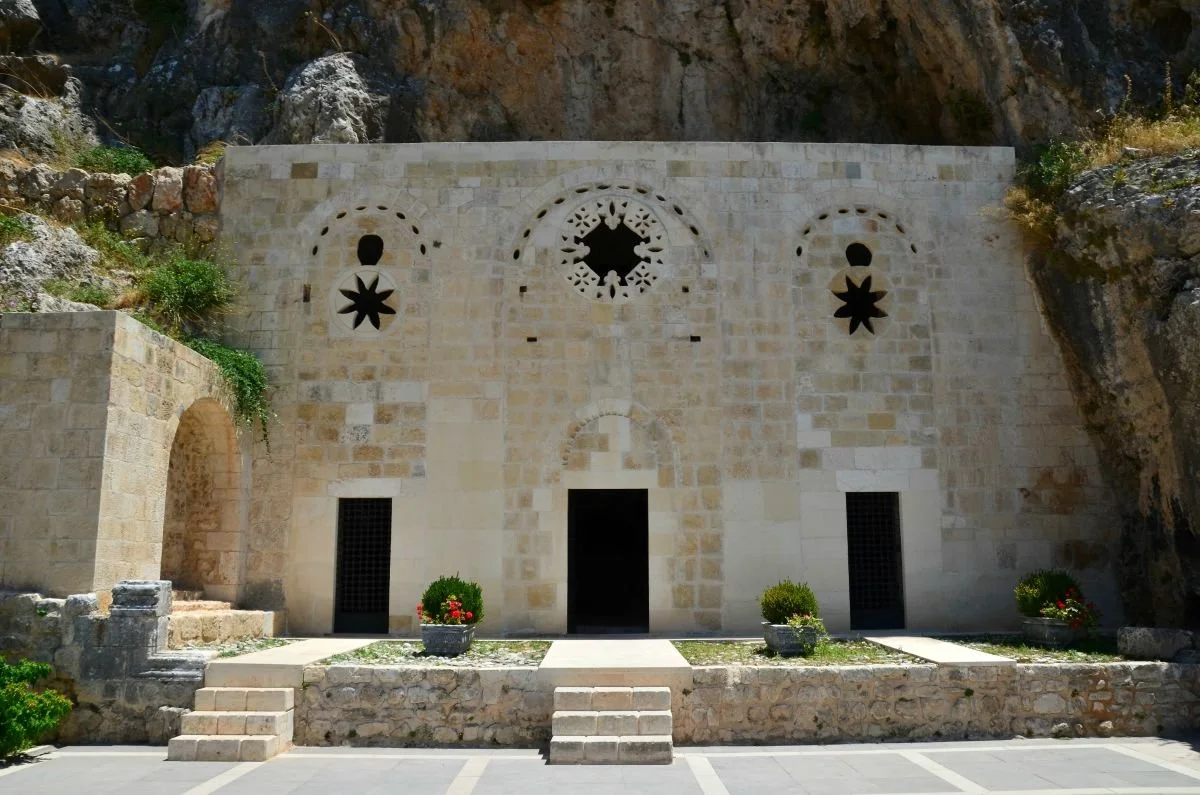
The Church of Saint Peter, a cave carved into the mountainside just outside of Antioch, is believed to have been used by the very first Christians making it one of Christianity's oldest churches. (Source: WikiCommons)
This past month we celebrated Black History Month, which highlights the often-overlooked achievements of Black men and women. My journey in various Christian spaces over time led me to understand that some Christians think highlighting ethnic-specific events is tantamount to distracting from or left-sizing the Gospel. The following exploration can encourage believers not only to engage those special occasions redemptively but also to go beyond them and make it a habit of the church to take notice of and engage ethnically different others. We begin with Luke’s description of the multiethnic church in Antioch:
Now in the church at Antioch there were prophets and teachers: Barnabas, Simeon called Niger, Lucius of Cyrene, Manaen (who had been brought up with Herod the tetrarch) and Saul. While they were worshiping the Lord and fasting, the Holy Spirit said, “Set apart for me Barnabas and Saul for the work to which I have called them.” So after they had fasted and prayed, they placed their hands on them and sent them off. The two of them, sent on their way by the Holy Spirit, went down to Seleucia and sailed from there to Cyprus. (Acts 13:1-4)
The city of Antioch belonged to the province of Syria under the Roman Empire as a vibrant cosmopolitan and multicultural city, and corresponds to the present-day city of Antakya in southern Turkey. The dominant ethnic configuration of Antioch would have been Hellenistic. Hellenes or Hellenic was used for indigenous Greeks, while non-Greek people who were significantly shaped by the Hellenes culture became Hellenistic, a mixing of Greek and Roman imperial cultures. Many Jewish and non-Jewish people were Hellenistic, having embraced the dominant culture of the day. They upheld ethnic-specific features such as language, so sharply distinct to be noticeable in intergroup interactions within the church (Acts 6:1). In the city of Antioch, as in the larger Roman Empire, the socio-cultural response to difficult intergroup interactions was a retreat into homogenous units, in which each ethnocultural grouping focuses on its own circle.
In such a context, Luke zooms in on Simon called Niger, Lucius of Cyrene, and Manaen (brought up with Herod the Tetrarch) as significant ethno-geographic and status markers for readers then and now. Niger, Latin for “dark” or “black,” refers to Simeon’s phenotype as a black African, and Cyrene refers to North Africa (Ben Witherington III, The Acts of the Apostles: A Socio-rhetorical Commentary, 1998, p. 392), the present-day Cyrenaica of Libya. Emphasizing these distinctives in the leadership of the Church of Antioch seems to follow the Lukan narrative according to which the inbreaking of God’s Spirit on earth displays God’s wonders (Acts 2:11), which consists in gathering people of various ethnic and geographical backgrounds, including those from the black lands of Libya and Cyrene (Acts 2:8-11). With consideration of Manaen in the team, regardless of whether he was brought up in the Herodian court from a lowly servant background or enjoyed the Herodian palace as a friend or as a free person in the court (Witherington, 392-393), he is a representative of high-ranking Hellenic or Hellenistic elites by the time he assumed ecclesial leadership. Overall, therefore, the scene suggests an initial intercultural and inter-regional leadership team in cosmopolitan Antioch. Then a prophetic pronouncement resulted in the sending away of Paul and Barnabas from said leadership to serve on a different missionary team in Cyprus and south Galatia. The remaining band is made up of the three whom Luke takes great care of describing ethnically, geographically, and socially.
Within that framework, against interpretive lenses that tend to downplay the African presence in Acts 13:1, it is plausible to see that “two men from Africa, Simeon and Lucius, also had a positive influence on the life of the greatest Christian movement of the New Testament” (Tim Welch, Africans and Africa in the Bible: An Ethnic and Geographic Approach, 2019, p. 59). This is significant because, while Hellenistic elites knew of black-skinned Africans in the region, their natural mythological gaze on the world projected a hierarchy of human beings in which the Hellenes were at the top of the ladder, non-Greeks were considered lower, and black-skinned Africans held the lowest status. Isaac Benjamin (The Invention of Race in Classical Antiquity, 2006) and Michael Bakaoukas helpfully engaged in this controversial classical literature to conclude that such ancient Hellenistic superiority served as a precursor to contemporary European superiority with its cultural prejudice and racial superiority toward those considered inferior beings by nature or design. This Hellenistic culture is the great-grandparent of Italian, German, French, Anglo-Saxon, and Anglo-American cultures, all of which morphed into the larger Euro-American culture with its socio-political, economic, and racial claims to superiority or exceptionalism in the world (Helena Rosenblatt, The Lost History of Liberalism: from Ancient Rome to the Twenty-First Century, 2018). Therefore, then and now, the Lukan specification of the ecclesial African leaders is a shocking surprise of joyful or sad news, depending on who is receiving it. The Church in Antioch was co-led by people from such diverse backgrounds that might have been offensive to the Hellenistic culture. The wonder from heaven gathers socio-ethnically incompatible human beings from antagonistic horizons to heal and restore them for missional living on earth.
That Luke stresses their human particulars suggests that the Gospel is doing what Paul called New Creation. Today’s readers can embrace this naming of the humanity of others in that perspective, finding no problem with ethnic, geographical, and social status varieties as a Gospel normality. Contemporary experiences during Black History Month and other ethnic-focused events suggest that the concretizing of this Lukan storytelling can invite controversies with the risk of losing members. Playing safe would consist of living into the narrative of cultural or ethnic neutrality or into a cultural melting pot. But in an Antioch dominated by Hellenism, the Scriptural narrative emphasizes ethno-geographical specificities as a soteriological matter because those living under the reign of God’s Kingdom may not ignore such obvious distinctions among human beings. Yet they do not use ethnic particulars as barrier-making tools. They account for God’s healing work among human beings.
The dominant narrative in the present world explains how difficult it is for black Africans to fully integrate into cosmopolitan communities and leadership structures. Such difficulties are numerous and include outright refusal, tokenism, legal yielding, and superficial openness to embracing different ethnicities. What is evident from this Lukan narrative is that the new world inaugurated by the Gospel preached by lay people who departed from Jerusalem (Acts 8: 1-4, Acts 11:20-21) can heal such a world. The healing exemplified here suggests that the presence of Africans in the ecclesial disciple-making team is a genuine embrace, which continues after Paul and Barnabas left.
Considering the importance of education for the rise to leadership, Wesley’s approach in the 18th century is congruent because he not only promoted the advancement through education of enslaved Black Africans who previously had been denied the opportunity, but he also educated the public out of the logic of enslaving others (Irv A. Brendlinger, Social Justice through the Eyes of Wesley: John Wesley’s Theological Challenge to Slavery, pp. 67, 156-157, 196). He published in his Arminian Magazine a poem by Phillys Wheatley, a formerly enslaved black woman, while he did not feel the need to explain why he later rejected Richard Williams’ poem on the topic of slavery. Considering Williams was a white man, Wesley’s action can easily be understood as an early step toward discerning, recognizing, and promoting African public thought-leadership in a Eurocentric culture. Wesley’s heirs can build on this heritage, considering realities in the public and in the church. Some newer scholarship has rehashed old myths of European superiority, now couched in supposedly scientific arguments. They posit, among other things, that exceptional biological traits convey exclusive capacities such as leadership to people of European heritage (Vladimir Avdeyev, Raciology: The Science of the Hereditary Traits of Peoples, 2nd ed., 2007, pp. 238-240). Likewise, many churches have difficulties embracing the scriptural world represented in the Lukan narrative. As a result, a body of evangelical theological rereading of Scripture includes racial-ethnic realities as integral to understanding and living in God’s kingdom (Jarvis J. Williams, Redemptive Kingdom Diversity: A Biblical Theology of the People of God, 2021). The intercultural and interethnic quality of the Antiochian church leadership contrasts with many contemporary churches and bids us to convert to this dimension of the Gospel.
The narrative of the old world and its hierarchy within humanity can be exposed and critiqued during unique events such as Black History Month through learning, unlearning, and reorienting our new creatureliness in Christ. The cultural memory and identity approach advanced by Jan Assmann suggests the importance of engaging values, artifacts, and practices for the present and the future (“Collective Memory and Cultural Identity,” in Cultural History/Cultural Studies, 1995, pp. 125-133). Ethnic-focused occasions can lead those involved into what he calls “concretion of identity.” Through this, the church can seek clarity on its identity through its positive identity (“we are this”) and negative identity (“that’s our opposite”). This identity work leads to “reconstruction,” which connects an understood identity to a real, presently ongoing situation that begs for actualizing the said identity in public. Reconstruction calls for “formative activities” that settle identity concretion into those in whom it crystallizes. Those desiring such formative experiences engage in “cultivation of values,” which bring upon them the sense of obligation, thus differentiating them from others who hold onto a different identity. Overall, the practice of cultural memory lends itself to the kinds of theological posturing that enjoins us to display God’s kingdom on earth and to engage in practices of “reflexivity,” that is, examining ourselves to see if we are in the faith as required by Kingdom diversity.
Engaged from this perspective, Black History Month and other events are not a ‘Black people thing’ only, but an occasion to revisit a commonly shared faith from the standpoint of a shared story of pain that still lingers. Special activities, colloquia, movies, field trips, Sunday school topics, and special seminars can enlighten and correct falsehoods about each other’s peoplehood. My own journey reading Deby Irving’s Waking Up White and Finding Myself in the Story of Race (2014) in an intercultural evangelical neighborhood group showed that people can be liberated from untruths communicated through mass media, social sciences, and history and thus shred inherited myths of inferiority and superiority, not merely on theological grounds but even with nuanced socio-historical information. The readings of biblical narratives and church history that focus on ethnic and geographical backgrounds could help in the task of debunking the belief of divine agency behind the cultural myths of a hierarchical world. In so doing, Black Africans can recover their “sense of somebodiness” in God’s redemptive engagement with the world, while others may embrace their modest place without a sense of guilt, shame, or humiliation.
Sègbégnon M. Gnonhossou is an ordained Free Methodist Elder and member of the Firebrand editorial board, and serves as a coordinator of a Wesleyan renewal movement in Benin, West Africa.