
Backing Into The Future
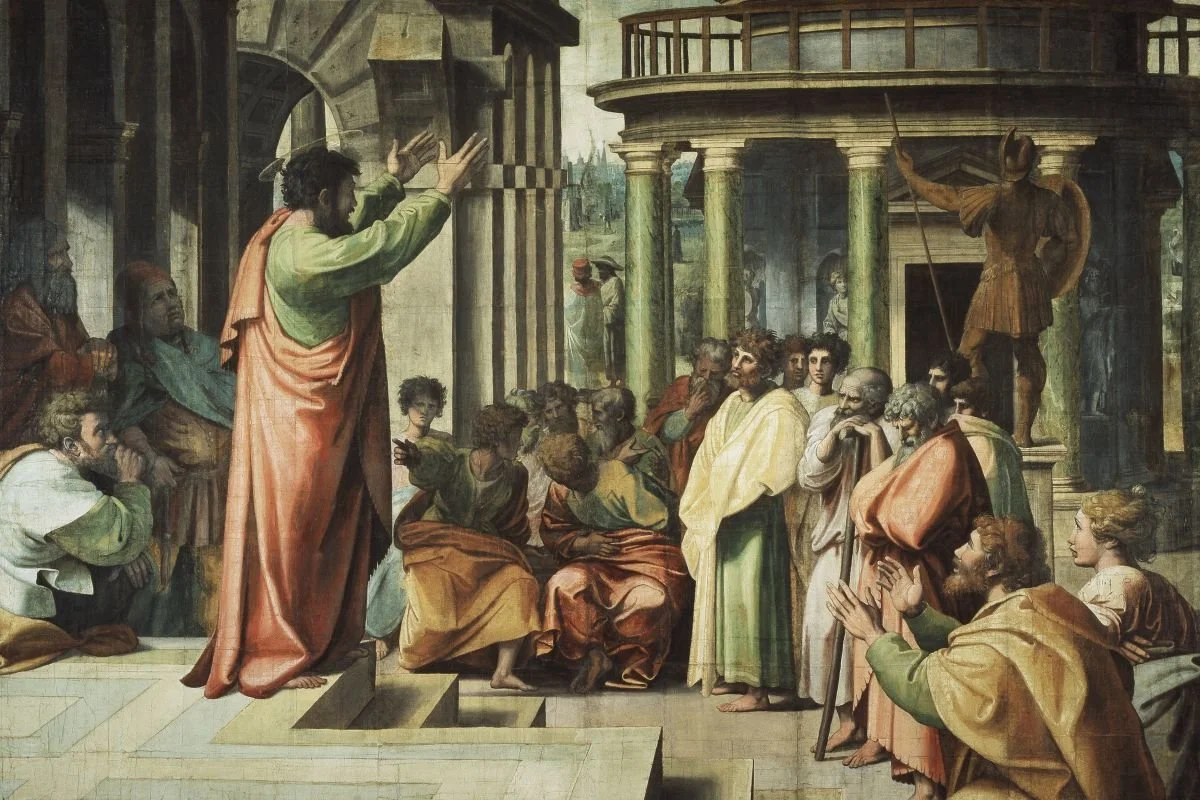
St Paul Preaching in Athens by Raphael, 1515. (Source: WikiCommons)
This is the sixth in a series of articles expounding on the need for re-formation in the church.
Links to other articles in this series: Thesis 1, Thesis 2, Thesis 3, Thesis 4, Thesis 5.
[See the original overview article here: 9.5 Theses: The Needed Re-Formation of the Church.]
Thesis 6. The Early Church Needs to Be Rediscovered so It Can Serve as a Model for Christians in the 21st Century
Years ago, when I (Hubert) was pastoring in Indiana, I attended a denominational meeting of our conference in central Ohio. I decided to make the trip in a single day, even though this meant I would get home well after midnight. When the meeting ended, I got in my car and, in the darkness, headed home. In those days we had no GPS, but that was no problem because I knew the route. Tired, but determined, I drove hard for two hours, pleased with myself for making such good time. Late that night, however, I came to an unfamiliar bridge and read a big sign that said, “Welcome to West Virginia.” I had been traveling east rather than west! I quickly made a U-turn and wearily made my way home. That night, I learned an important life lesson: it is possible to be on the right road but to be headed in the wrong direction!
This story helps us to understand one of the major problems in the church today. Many are on the right road. However, because of the truncated Gospel message in many evangelical churches, Christians seek personal happiness rather than holiness, self-esteem rather than self-denial, and Jesus as Savior rather than Jesus as Lord, and life after death in another world rather than life right now in this one. Unknowingly, they are moving in the wrong direction. When someone explains the truth to them, some just deny it. “I’m on the right road. That’s all that matters,” they insist. Others decide to redefine the goal. “I wanted to go to West Virginia anyway,” they mumble. The wise thing to do, of course, is to be humble enough to admit the truth, turn the car around, and start traveling in the right direction. The biblical term that describes such behavior is repentance.
We wrote the 9.5 Theses because we believe that, although the church is often on the right road, we fear she is headed in the wrong direction. One of the best ways we know to encourage modern Christians to make a U-turn is to introduce them to the early church. Yes, we can move forward by looking back. This is what the sixth thesis is all about.
New Wine Needs New Wineskins
Jesus knew that the explosive power of the gospel would need to be mediated through a special kind of community if it was to have its intended revolutionary impact on the world. Religious institutionalism was incompatible with the transformational reality of the inbreaking kingdom he had come to announce. The medium must match the message! He explained it this way: “No one puts new wine into old wineskins. If he does, the wine will burst the skins – and the wine is destroyed, and so are the skins. But new wine is for fresh wineskins.” (Mk. 2:22).
During the first three centuries, before the church was defined by buildings, budgets, flow-charts, and denominations, the body of Christ exhibited qualities that were beautifully in sync with the revolutionary power of the Jesus-is-Lord gospel she proclaimed. Yes, the wineskins actually enhanced the taste of the wine! Is it any wonder that the church grew in both depth and breadth?
The early Christians did not rely on human ingenuity, strategic plans, or political muscle to advance their cause, nor were they anxious or in a hurry. They were patient in their work because they knew God’s kingdom was unstoppable. Alan Kreider explains the impact of the early church in terms of fermentation. The process is gradual. Most people are not even aware that something is happening until late in its operation. “And yet [fermentation] has a cumulative power that creates and transforms…. So it was with early Christianity.” (The Patient Ferment of the Early Church, Baker, 2016, p. 73).
The early church made its impact on the world not primarily through organizational power or persuasive apologetics but rather through the manifest presence of King Jesus as he was embodied in the lives of his disciples, both individually and corporately. The reality of his kingdom was experienced in and through the church. Those first believers took seriously the words of Scripture that said, “whoever says he abides in [Jesus], ought to walk in the same way in which he walked” (1 Jn. 2:6).
The seriousness with which the church in the second and third centuries took this call of Jesus is seen in their catechetical process of new members, which was structured to combat moral decadence and apostasy in the midst of multiple persecutions. In contrast to minimum standards of contemporary church membership, often lacking in moral and theological accountability, the requirements of the early church as described by Justin Martyr, Hippolytus, and Origen required commitment to an often-lengthy process that focused on doctrine and practice. The goal was simple: full and total conversion of life to the Lordship of Jesus Christ. Any demonic presence, stronghold of sin, pagan practice, and trade or profession deemed unworthy of a Christian, was renounced and given up. Then, and only then, were people brought into the full fellowship of the church through baptism.
The Example of Paul and the Ante-Nicene Church (Before the Council of Nicaea in 325)
At his conversion on the Damascus Road, Paul made a U-turn. From this point forward he preached that the crucified Jesus was Lord over all creation. The gospel of the kingdom had created a revolution not only in his heart but also in his mind. He began to think with “the mind of Christ” (see Phil. 2:5). Repentance had caused Paul to be transformed by the renewing of his mind (see Rom. 12:2). He turned from racist attitudes of Jewish supremacy and turned to welcoming Gentiles as full members of the family of God. He turned from a religion based in good works and turned to an understanding of salvation that comes by grace, through faith alone. He turned from operating in the power of the flesh and turned to living and serving in the power of the Spirit. He turned from demanding his rights and turned to giving them up. He turned from the love of power and turned to the power of love.
Paul preached and modeled a lifestyle that the world considered to be upside down (see Ac. 17:6). He had learned from the Lord Jesus that the way to be great in the kingdom of God is to become a servant (see Mk. 10:42-45; Phil. 2:5-11). Taking their cue from both Jesus and Paul, the first believers began to model a way of life the world had never seen before:
The way up is down.
The way to be rich is to give everything away.
The way to be strong is to become weak.
The way to be wise is to become a fool.
The way to find yourself is to lose yourself.
The way to joy is through mourning.
The way to live is to die.
Now we can understand why Paul urged believers to be “imitators of me, as I am of Christ” (1 Cor. 11:1). He wanted them to model their lives after those who modeled their lives after Jesus. This produced an army of believers whose lives were characterized by status-renouncing, self-giving, other-oriented love. For the early Christians, being “the body of Christ” was more than a pious metaphor. It defined how they understood their identity. They saw themselves as the embodied presence of Jesus in the midst of the Roman Empire. They had been sent into the world so that they could lay down their lives for others, even as Christ had laid down his life for them.
Many leaders in the Ante-Nicene period of the church testified to this very character in Christians. The author of The Epistle to Diognetus described Christians as “aliens” within the Roman empire, living lives defined by the example of Christ. Tertullian asserted that absolute dedication to Christ in inward and outward conduct defined the character of Christians. Clement of Alexandria said Christians were known for their love of enemies and selfless benevolence toward others. Athanasius also contended that the transformed lives of Christians was one of the greatest witnesses to the truth of Christ. He encouraged critics of Christianity to examine how Christ took the worst of sinners and remade them into lives of virtue. This was a uniform theme throughout the early centuries of the church: the very lives of Christians embody the Gospel they proclaimed.
Called to be Martyrs
Through his life and ministry, Jesus boldly proclaimed that the kingdom of God was at hand (see Mk. 1:14-15). But when the fullness of this kingdom was still not evident even after Jesus rose from the dead, his disciples were eager to know just when this kingdom would come (see Ac. 1:6). Jesus’ answer gave the church her marching orders.
It is not for you to know times or seasons that the Father has fixed by his own authority. But you will receive power when the Holy Spirit has come upon you, and you will be my witnesses in Jerusalem and in all Judea and Samaria, and to the end of the earth. (Ac. 1:7-8).
In no uncertain terms, Jesus tells his disciples that knowing the dates of future events is none of their business! Their business is to bear witness to the reality of the Lordship of Jesus and the kingdom he has come to bring. Their assignment is not so much to “do witnessing.” Rather, they are sent into the world to “be witnesses.” Yes, in the mission of God who we are is so much more important than what we do.
The word “witness” (Greek, martur) is the root of our English word martyr. In the early church, to be a witness and to be a martyr were two ways of saying the same thing (see Ac. 22:20; Rev. 2:13; 17:6). Not everyone will be called upon to literally be killed for their faith, of course. But every disciple is invited to live a life of status-renouncing, self-giving, other-oriented love. They are called to deny self and take up their cross and practice the imitation of Christ (see Lk. 9:23). Yes, the normal Christian life is understood in terms of sharing in the fellowship of Christ’s sufferings and thus helping to complete what is lacking in his afflictions (see Phil. 3:10; Col. 1:24). To enable his disciples to accomplish this sacred task, Jesus promised them the empowering presence of his sanctifying Spirit. This is how God’s mission is carried forward in the world.
Looking Back to Move Forward
Christians today can benefit greatly from rediscovering the pre-Constantine era of the church. Although there are many lessons to be learned from that amazing period of gospel expansion, we close this article by highlighting just three. We mention these, not because we think they are the most important, but rather because we see the evidence of the negative impact that comes when the church today is not vigilant “to guard the good deposit” with which she has been entrusted (see 2 Tim. 1:14).
Redefine how power is understood. During the first three centuries of the church, Christians existed as a minority within the Roman Empire. According to the early third-century apologist, Tertullian, Christians sought to honor those in authority, despised the use of violence, and lived lives of such virtue that even the larger culture had to show them respect. They posed no physical threat to the society around them, and preferred death rather than deny Christ or bring harm to others. The early church sought to exert persuasive power through rational argument and the beauty of Christian life, not through the use of coercion. They understood the cross of Christ and the cruciform life of believers as the power of God, not political, military, or economic might.
Flee selfish ambition. The early Christians understood that Jesus came not to affirm the self, esteem the self, or express the self. He came, rather, to help us deny the self, indeed, to crucify it! Dying to self is part of the job description of every Christian. As the second-century theologian, Tatian, exhorted, “Die to the world, repudiating the madness that is in it. Live to God, and by apprehending Him lay aside your old nature” (Address to the Greeks 11).
Fight against escapist mentalities. Although the early Christians, like Irenaeus of Lyon, faced persecutions and tribulations, they did not develop an escapist mentality, forming ghettos where Christians could live isolated from the evil world, longing for the day when they would be snatched away to a heavenly paradise. Rather, they loved their pagan neighbors and prayed for the well-being of the cities where they lived. It was precisely because they were heavenly-minded that they accomplished so much earthly good.
Chris Bounds is Professor of Theology at Asbury Theological Seminary.
Hubert Harriman is Former President of World Gospel Mission (WGM).
Stan Key is Former President of the Francis Asbury Society.
Dave Smith is Professor Emeritus of New Testament at Indiana Wesleyan University.