
The Christ Of The Camp Meeting
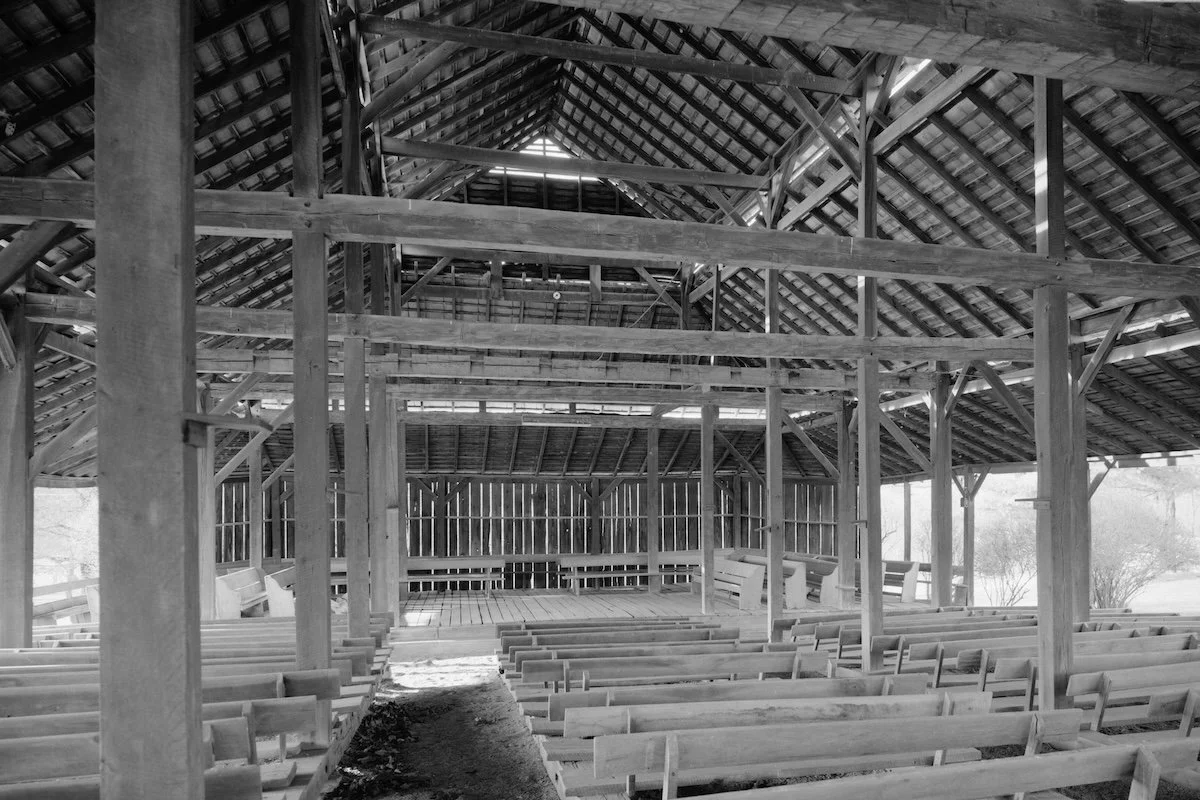
Meeting house from Sulphur Springs Methodist Campground in Sulphur Springs, TN. (Source: WikiCommons)
For generations of Methodists, summertime has meant camp meeting time. Anna Adams’ article “A Tradition That Thrives” helpfully (re)introduces readers to the camp meeting tradition with an accent on the American Southeast. Below I build on her foundation by looking at how camp meetings collaborate with Christ himself in his ongoing work. I’ll focus on the camp meetings I know best, located not only in the Southeast but also in the Midwest and Pacific Northwest.
The late Methodist church historian Russell Richey wrote an intriguing book, Methodism in the American Forest, on Methodists’ historically varied experience of the woodlands:
As nature’s “cathedral,” where preachers could address large crowds outdoors;
As a “confessional” where those troubled in soul could pray and surrender to God’s will just as Jesus did in the Garden of Gethsemane;
As the “challenge” of a dangerous frontier wilderness requiring domestication.
These three experiences combined in the institution of camp meetings, where preaching produced confessing and promoted the taming of both the wilderness without and the wild passions within. What Richey never mentions, though, is that his trifold portrait of the camp meeting corresponds beautifully with the Wesley brothers’ emphasis on Christ’s triple office (munus triplex) as Prophet, Priest, and King.
Christ as Prophet to the Camp
Charles Wesley’s “Hymn to Christ the Prophet” spells out how Jesus fulfills this role:
Publish the joyful year
Of God’s acceptance near,
Preach glad tidings to the meek,
Liberty to spirits bound,
General, free redemption speak,
Spread through earth the gospel-sound.
Central to the camp meeting are the morning and evening messages by the camp evangelist(s), supplemented by daily lessons from a Bible teacher and musical proclamation of the “glad tidings” under the direction of a song evangelist. Often the camp schedule includes time for visiting missionaries to raise awareness and support to “[s]pread through earth the gospel-sound.” By all these means, camp meetings echo Christ’s own prophetic ministry of preaching and teaching.
Those echoes travel farther than ever before in the foothills and hollows of Appalachia. Eastern Kentucky’s camp meeting at Mount Carmel takes place on a hilltop amid the countryside of Breathitt County, whose social and economic woes gained unsought-for exposure in Vice President J. D. Vance’s memoir Hillbilly Elegy. To reach those who can’t or won’t attend, the camp broadcasts its services over its Mountain Gospel radio network and streams them online. It’s the logical extension of John Wesley’s decision to start field preaching and Francis Asbury’s embrace of the American invention of camp meetings.
Christ as Priest for the Camp
In his “Hymn to the Son,” Charles Wesley rejoices in Jesus’ priesthood:
On Thee my Priest I call,
Thy blood atoned for all,
Still the Lamb as slain appears,
Still Thou stand’st before the throne,
Ever off’ring up my pray’rs,
These presenting as Thy own.
Note the two tenses of Christ’s priestly activity: in the past, on Calvary, he made atonement by offering up himself as the final sacrifice for sin; in the present, in heaven, he makes intercession by offering up his prayers and ours on the strength of his once-for-all sacrifice. Both tenses are vital to a camp meeting’s effectiveness.
The camp meeting agenda typically includes three sessions of intercession per day. The first falls soon after dawn as devout camp goers gather for prayer meeting. The second and third sustained prayer times come in conjunction with the “altar call” at the conclusion of the morning and evening sermons. The evangelist calls listeners to come forward to the kneeling rail (the “altar”) to confess their needs and seek forgiveness of sins or entire sanctification on the basis of Christ’s shed blood. While these seekers pray at the altar, the evangelist and other camp leaders pray with them as the congregation prays for them. All this occurs in the “tabernacle,” the central building of the camp where the services take place. The language of altar and tabernacle signals the spiritual continuity between the camp meeting and Israel’s sanctuary in the wilderness. As foreshadowed by the Old Testament, now the perfect High Priest and Lamb of God presides to cleanse his people from all the guilt and infection of sin.
Since 1885, Eaton Rapids Camp Meeting on the banks of Michigan’s Grand River has summoned its attendees to conversion, to holiness of heart and life, and to intercession for others to experience these same benefits of Christ’s atonement. Recent years have witnessed the addition of a service devoted to another benefit of Calvary: a healing service, in which individuals with physical complaints receive anointing with oil and prayer for recovery. Finally, in 2025, for the first time the camp celebrated the Lord’s Supper. This event reconnected participants with the eucharistic practice of the earliest American camp meetings and the historic church. In the consecrated bread and cup, Christ uniquely makes manifest his priestly self-offering.
Christ as King over the Camp
Returning once more to Charles Wesley, we find him lauding Christ’s royalty in a familiar Christmas hymn:
Born thy people to deliver,
born a child and yet a King,
born to reign in us forever,
now thy gracious kingdom bring.
By thine own eternal spirit
rule in all our hearts alone;
by thine all sufficient merit,
raise us to thy glorious throne.
These lyrics identify the primary realm of Christ’s reign as within the subjectivity of the human heart. Yet Charles wrote as a founding Methodist and a loyal Anglican churchman. As such, he believed that Christ’s rule in hearts also had objective dimensions in the shape of Methodist discipline, church order, and even church-state relations. So too, camp meetings have nurtured intensely personal spiritual and emotional experiences within a support system of bylaws and camp rules, scheduling and fundraising, business meetings, and food services. The rule of Christ that starts in the heart holds sway over the whole of one’s life in community.
Early Methodists viewed their camp meetings as outposts of godly civilization amid a sometimes-threatening wilderness. Today the situation has reversed for Multnomah Holiness Camp. Across the century since the camp’s establishment, the rowdy, relatively unchurched metropolis of Portland, Oregon has expanded and surrounded it. The campground shaded by mature evergreen trees exists as an outpost of godly wilderness amid a sometimes-threatening civilization. To support camp security, the MHC has converted one of its cabins into a breakroom for local police. It also has made its facilities available to an immigrant congregation and a rehabilitation ministry. Christ continues to exert his rule through prevenient, justifying, and sanctifying grace in the hearts of those who come in contact with this colony of the kingdom of heaven in the Pacific Northwest.
A Threefold Calling
Let me conclude with a triple encouragement to attend a camp meeting this summer. First, you will claim your inheritance of past Methodists’ threefold experience of nature. Secondly and more importantly, you will encounter “Christ in all his offices” (as John Wesley put it) in the living present. Lastly and just as crucially, you will help to sustain into the future a tradition of holiness advocacy, fervent intercession, and disciplined pursuit of God’s will—a tradition sadly missing in many a church today but still alive in the camp meeting.
Jerome Van Kuiken teaches at Oklahoma Wesleyan University, sits on Firebrand’s Editorial Board, and has authored The Judas We Never Knew: A Study on the Life and Letter of Jude (Seedbed, 2023) and The Creed We Need: Nicene Faith for Wesleyan Witness (Aldersgate, 2025).